
Biotech patents can feel like a different planet when you are at seed stage. You are building science, hiring your first real team, trying to get clean data, and still figuring out what your product will be. Then someone says, “We need patents worldwide,” and it sounds expensive, slow, and full of legal traps.
Here is the good news. You do not need to “patent the whole world” on day one. You need a smart filing path that protects what matters, fits your budget, and keeps your future options open. If you get the basics right early, you can avoid the most common mistakes that sink good biotech companies before they even get traction.
At Tran.vc, we help technical founders do this the right way from the start, by investing up to $50,000 in in-kind IP and patent services so your science becomes a real asset investors can trust. If you want help shaping your first global biotech patent plan, you can apply here anytime: https://www.tran.vc/apply-now-form/
Now let’s get into the seed-stage basics—worldwide, but in a way that is practical.
Biotech patents worldwide starts with one simple idea: dates matter more than geography
Most founders think the hard part is picking countries. In early biotech, the real game is time. If you miss the right timing, the “best country list” does not save you.
There are three time rules you should remember.
First, file before you publish. In biotech, publication can happen in many ways. A paper, a poster, a thesis, a preprint, a public talk, a press release, even a slide deck shown at a demo day. Any of these can count as public. Once it is public, you may have lost rights in many places.
Second, treat your first filing as the start gun. Your first patent filing sets your priority date. That date becomes the anchor for later filings in other places. Investors often ask, “What is your earliest priority date?” because that tells them how long you have had protection and whether you moved early or late.
Third, seed stage is about buying time wisely. You usually want a filing path that gives you room to learn. Your science will change. Your product may pivot. Your first customers might need a different form factor. You want your patent path to keep your options open while you learn.
This is why most seed-stage biotech teams begin with a single “base” filing that locks the date, then expand later when they have stronger data and clearer plans.
What you can patent in biotech, in plain words
A biotech patent is not one thing. It can cover many kinds of inventions, and each kind has its own risks.
You can often patent a new composition, like a molecule, a peptide, a vector, a strain, a cell line, a lipid mix, or a special blend. This is usually the strongest kind of protection, because it is about “what it is,” not just “what it does.”
You can also patent a method, like a way to treat a disease, a way to dose, a way to edit a gene, a way to deliver a payload, a way to culture cells, a way to detect a marker, or a way to make a product at scale. Method claims can be powerful, but you must write them carefully because methods can be easier to work around.
You can patent a device too, like a microfluidic system, a lab tool, a sensor, a cartridge, or a robotics system used in biotech. If you are building at the edge of biology and machines, this matters a lot. Many biotech startups quietly have very patentable “engineering inventions” that are easier to defend than the biology itself.
You can patent a diagnostic approach, like a new panel, a new way to process signals, or a new model that turns raw data into a clear call. Diagnostics can be tricky in some places, so strategy matters.
You can sometimes patent a manufacturing process that makes your product possible. In biotech, this is not boring. It is often the moat. If your therapy works but cannot be made cheaply, your company struggles. If you find the way to make it stable, pure, and scalable, that can be the real IP.
Seed stage is not about trying to patent everything. It is about picking the “core” inventions that will still matter in two years.
The biggest seed-stage mistake: filing too narrow because you only describe what you did this week
This happens all the time. A founder runs one set of experiments, gets results, and files a patent that reads like a lab notebook entry. It is detailed, but it is narrow. It protects one exact example, not the bigger concept.
The better approach is to file with enough detail to support the invention, but broad enough to cover reasonable variants. In biotech, variants are not “maybe.” They are certain. Competitors will try a different promoter, a different linker, a different dose, a different delivery route, a different target. Your first filing should anticipate that.
This is where strong patent drafting matters. The words you choose shape the fence around your invention. A good fence is not just tall. It is wide, and it has fewer holes.
If you want Tran.vc to help you draft a base filing that protects the real concept, not just a single example, apply here: https://www.tran.vc/apply-now-form/
Worldwide strategy starts with understanding the major patent “zones”
Think of the world like a few big zones where biotech patents are most often filed. Seed-stage teams do not usually file everywhere. They choose zones based on market, manufacturing, and where competitors may appear.
The United States is often the first target because it is a huge market, has a strong biotech funding ecosystem, and is a key place investors care about.
Europe is not one country in patents. It is a regional system where you can file through the European Patent Office and later “validate” in chosen countries. Europe matters because it is a large health market and many acquirers pay attention to European coverage.
China matters in many biotech areas because of manufacturing, scale, and a large market. Even if you think you will not sell there at first, competitors might emerge there. Some founders avoid it because of cost, but for the right company it is worth serious thought.
Japan and Korea can matter depending on your field, especially in diagnostics, devices, and some therapeutics areas.
Then there are other places like Canada, Australia, Israel, India, and others that can make sense depending on where you plan to sell, run trials, or manufacture.
At seed stage, you do not need to decide the full list today. You need a path that lets you decide later without losing rights.
The seed-stage filing paths that keep options open
There are a few common paths seed-stage biotech teams use. You do not need to memorize names. You need to understand what each path buys you.
One path is to file a first patent application in one place, often the US, to lock the date. Then, within a year, you file again claiming that earlier date, and you expand to other regions.
Another path is to file your base application, then file an international application that acts like a placeholder for many countries for a period of time. This helps you delay the big cost while keeping the door open.
The point is not the paperwork. The point is timing and flexibility. You want to protect your earliest date, then buy time to gather data, refine the claims, and choose where to spend money.
A good seed-stage plan often feels like this: lock date now, learn fast, then choose targets with confidence.
What “worldwide” really means at seed stage
When a founder says “worldwide,” they usually mean one of three things, even if they do not say it clearly.
Sometimes they mean, “I want investors to feel safe that we can protect this.” In that case, a strong early filing plus a credible global expansion plan is often enough.
Sometimes they mean, “I do not know where we will sell yet, so I do not want to shut doors.” That points to a path that preserves options.
Sometimes they mean, “I am afraid a big company will copy us.” That points to writing broad claims and protecting the parts that are hardest to work around, not just picking a long list of countries.
Worldwide is a strategy, not a shopping list.
How to decide where to file, without making it complicated
Here is a simple way to think.
Ask where the money will be made. If your buyers will be in the US and Europe, those zones matter.
Ask where the product will be made. If manufacturing is likely to be in certain regions, protection there can help.
Ask where your competitors will be. If you are in a fast-moving field where China-based competitors appear quickly, ignoring China may be risky.
Ask what an acquirer will expect. Many biotech acquirers and later-stage investors care most about US and Europe, and then add others based on the deal.
Notice what is not on this list: ego. You do not file broadly just to say “we filed broadly.” You file where it changes outcomes.
The early documents you must control before you file
Your patent strategy can be perfect, and you can still lose rights if your team handles information loosely.
At seed stage, you need a habit: treat anything that explains how your invention works as confidential until you file.
That means your deck, your demo scripts, your public website text, your grant submissions, your incubator updates, your hiring posts, and your partner calls. If you tell the world how it works before filing, you may have made your own invention unpatentable in many places.
You also want clean invention records internally. Who invented what? When? What data supports it? What variants did you consider? You do not need a heavy process. You need a simple, repeatable one.
This is also why NDAs are not the main tool. NDAs help, but they are not a magic shield. Filing is the real shield.
If you want Tran.vc’s team to help you set up simple, founder-friendly IP hygiene so you do not lose rights by accident, apply here: https://www.tran.vc/apply-now-form/
Provisional vs non-provisional: what seed-stage founders should actually care about
People get stuck on labels. The real question is: what did you file, and does it support the claims you will want later?
A “provisional” filing in the US is often used as a lower-cost way to lock a date. But a weak provisional can hurt you because later you might find it did not support your broad claims. Then your priority date is not what you thought.
A “non-provisional” is a formal application that starts examination later. It costs more, but it can be more robust.
Seed-stage founders should care about two things: does the filing describe the invention broadly enough, and does it include enough examples and detail to support future claims?
If the answer is no, the label does not save you.
In biotech, the quality of the first filing is often worth more than the number of filings.
What examiners look for in biotech, and how that affects your first draft
Biotech patents are examined closely. You need to assume that an examiner will challenge you on a few standard points.
They will ask if your invention is new. That means you need a careful search and careful writing so you do not claim what is already known.
They will ask if it is not obvious. In biotech, “obvious” can be argued using combinations of papers and known tools. Your application should explain why your approach is not just a routine tweak.
They will ask if you enabled the invention. This is huge. You cannot just say “we discovered a new class of molecules that treats cancer” and leave it at that. You need to teach how to make and use it, at least in a meaningful way.
They will ask if your claims match what you described. If you want broad claims later, your first filing must support them.
This is why seed-stage biotech patents are not a place to cut corners. Investors can often tell when a company filed something thin.
A tactical way to think about claim scope at seed stage
Instead of trying to guess perfect claims now, think in layers.
You want a core claim that maps to your main value. If your main value is a new composition, protect that. If it is a new delivery system, protect that. If it is a process that makes the product viable, protect that.
Then you want backup positions. If the broad claim gets narrowed later, you want narrower claims that still cover your product.
This is not about making the patent “long.” It is about making it resilient.
If you are working on AI-enabled biotech, do not forget to patent what is truly inventive
Many biotech teams use machine learning to find targets, design molecules, or predict outcomes. But a lot of those “AI parts” are not patentable if they are described like generic software.
The patentable part is often the special data pipeline, the novel way you label or clean data, the specific model structure tied to a biological insight, the way you validate, the way you reduce wet lab cycles, or the way the system controls real-world lab actions.
In other words, do not just say “we use AI.” That is not an invention. The invention is the new technical method you built.
If you are combining robotics, lab automation, and biology, there may be many inventions hiding in plain sight. Those can become strong patents because they are concrete and easier to prove.
Tran.vc works a lot with deep tech founders who have exactly this kind of hidden IP. If that sounds like you, apply here: https://www.tran.vc/apply-now-form/
How to talk about patents with investors without sounding vague
Seed-stage investors do not want legal lectures. They want to know if you can build a moat.
A strong way to talk about it is to be clear on three points.
One, what is the core invention you filed on?
Two, what future filings will expand protection as data grows?
Three, how does the patent map to your product and market?
If you can answer those in simple words, you sound prepared. If you cannot, investors worry you may be easy to copy.
A short introduction is done, and we’ve covered the first set of seed-stage worldwide basics in a practical way.
Global filing routes that work for seed-stage biotech
The “one strong first filing” route
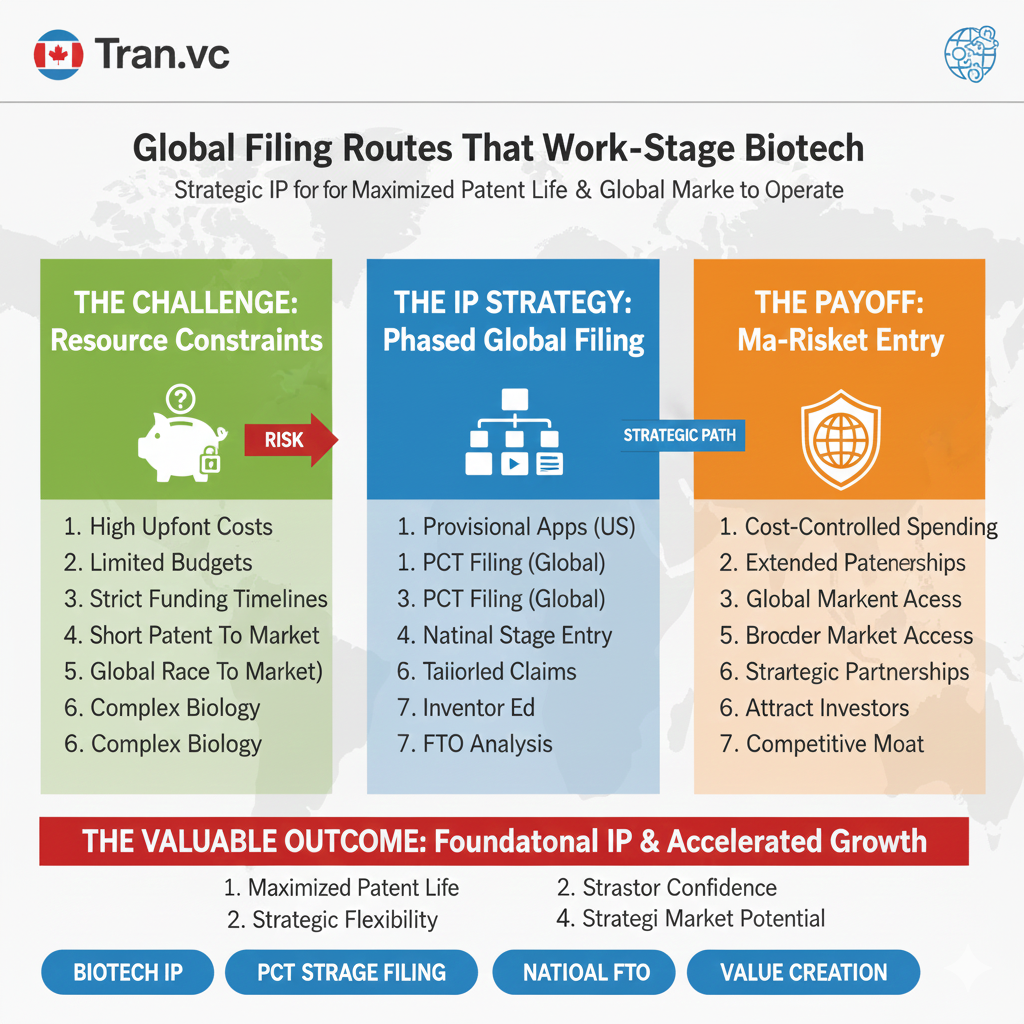
Seed-stage biotech teams often win by doing one high-quality first filing that truly explains the invention, instead of doing many weak filings. This first filing becomes your anchor. It sets the date that matters, and it sets the technical story that later filings can build on.
This route works best when your invention is still forming and you want to avoid spending big money too early. You lock the earliest date, then you use the next months to collect stronger data and decide where to expand. You are not trying to impress anyone with volume. You are trying to protect the core idea in a way that holds up under pressure.
If you want Tran.vc to help you draft a first filing that is broad, clear, and investor-ready, you can apply here anytime: https://www.tran.vc/apply-now-form/
The “file now, expand in 12 months” route
A common worldwide strategy is to file once, then use the next twelve months to decide which countries actually matter. That year is not meant to be idle. It is meant for fast learning. You run experiments, improve performance, confirm safety signals, and narrow down the exact product you will build.
The key is to treat that twelve-month window like a business deadline. Many teams file, then forget. Then they hit month eleven and panic. By then, they may not have the data they need to justify strong claims in later filings. A calm plan beats a rushed decision every time.
The “international placeholder” route
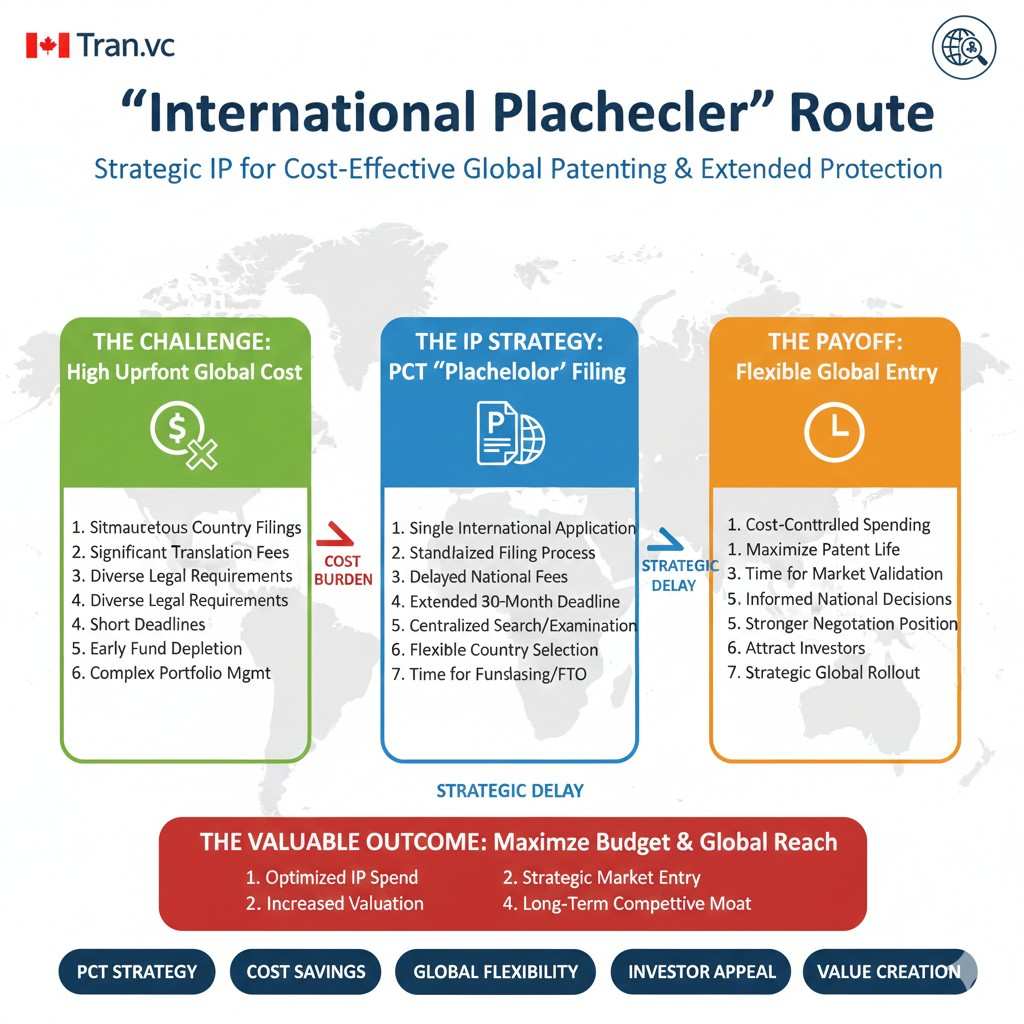
Some founders want to keep many countries open without committing to them right away. An international filing route can help with that, because it gives you a structured way to delay the most expensive steps while keeping options alive.
This is not a shortcut. It is a timing tool. You still need a well-written base application. If your base is thin, you are only delaying a problem. But with a strong base, you buy time to raise money, validate the market, and choose the few regions that will drive value.
The “two-track” route for biotech plus hardware or robotics
Biotech companies that also build devices, robotics systems, cartridges, or lab automation tools often benefit from a two-track strategy. One track protects the biological invention. The other track protects the machine or system that makes the biology repeatable and scalable.
This matters because biology can be hard to defend if competitors can “design around” small changes. But a well-claimed system can be harder to avoid, especially if it becomes part of the workflow customers adopt. When your platform has both biology and engineering, you should treat both as first-class inventions.
Planning the first 12 to 30 months of global patent work
Months 0 to 2: lock your date before your story leaks
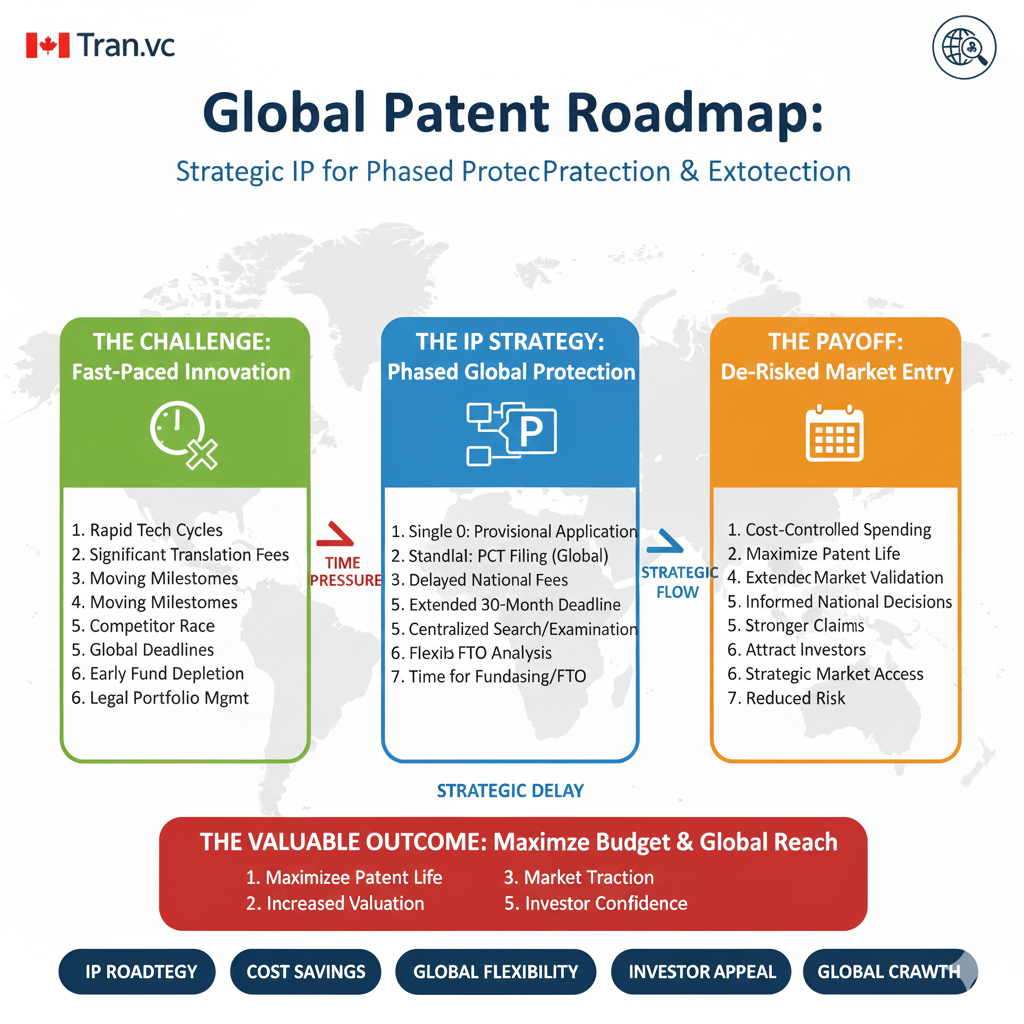
Most biotech startups leak their invention story without meaning to. A slide in a pitch deck, a conference abstract, a partner call that gets shared, or a hiring post that reveals too much can ruin rights in many countries. In seed stage, you need a simple habit: share outcomes, not enabling details, until you file.
In these first weeks, your main job is to capture the invention clearly. What is new, what problem it solves, and what makes it work. You also want to gather supporting information like protocols, figures, early results, and realistic variants so your first filing is not trapped inside one narrow example.
Months 2 to 6: build data that makes your claims believable
A patent is not just a legal form. It is a technical argument. In biotech, the strength of that argument often rises with data. You do not need perfection, but you do need credible proof that the invention works as described.
This period is a great time to run experiments that support broad coverage. That might mean showing that a method works across more than one cell type, more than one target, more than one formulation, or more than one delivery route. You are not doing this only for science. You are doing it to support stronger, more durable claims later.
Tran.vc often helps founders choose experiments that pull double duty: they make the product better and they make the IP stronger. If you want that kind of support, apply here: https://www.tran.vc/apply-now-form/
Months 6 to 12: decide where “worldwide” really pays off
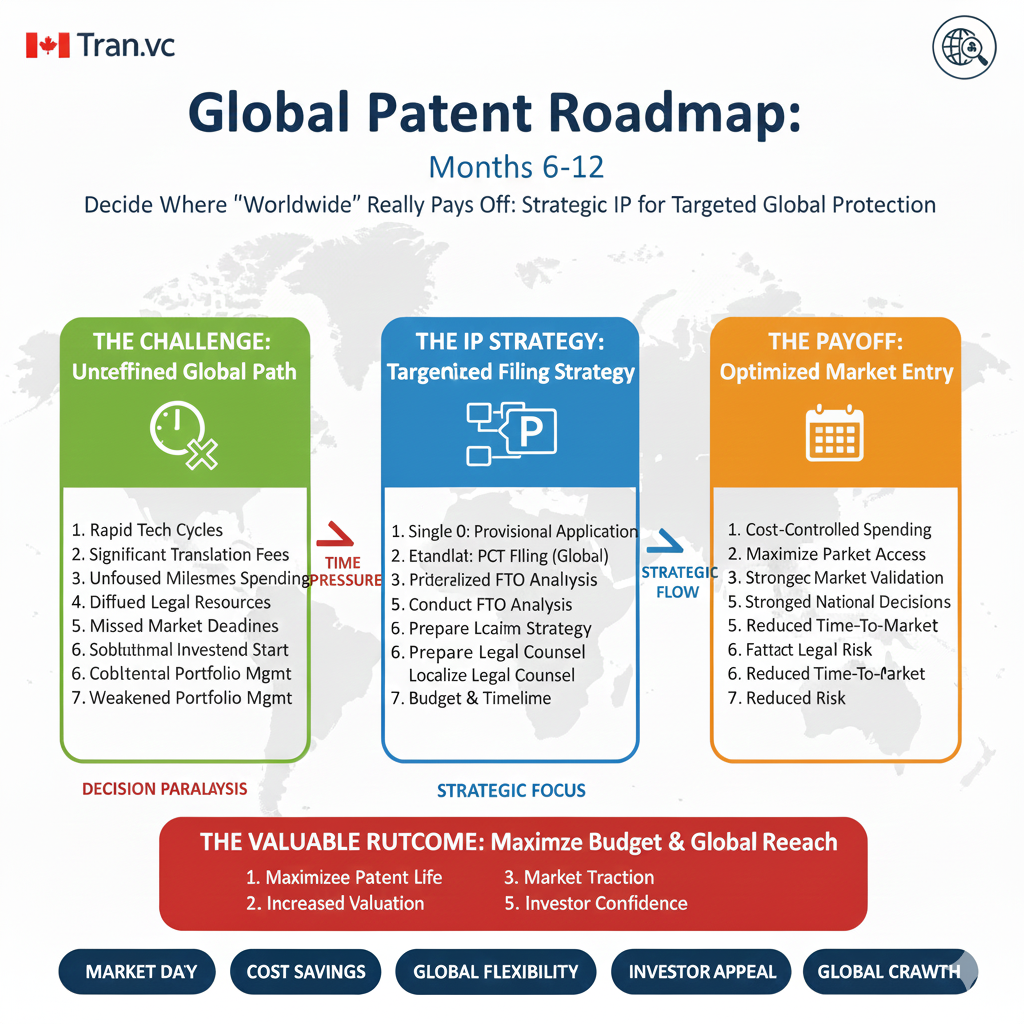
By this point, you should have a clearer view of your market and your go-to plan. This is where you decide which regions deserve real spend. Many seed-stage biotech companies do not need ten jurisdictions. They need a few strong ones that map to buyers, trials, and manufacturing.
This is also when you decide what to add. Maybe you discovered a better variant. Maybe you found a new use case. Maybe your manufacturing process became a real differentiator. These developments can justify new filings that sit next to your first one, giving you a deeper wall rather than one thin fence.
Months 12 to 18: prepare for serious scrutiny
When you move into later stages, you should assume real scrutiny from investors, partners, and sometimes competitors. People will ask for your filing details. They will look at whether your claims align with your product. They will notice if you filed late, filed narrowly, or missed key regions for your market.
This is where clean IP hygiene matters. You want clear inventor records, clear assignment documents, and a clear story about how each filing protects a real part of the business. When the story is coherent, diligence is smoother. When it is messy, deals slow down.
Months 18 to 30: expand the moat around what is now proven
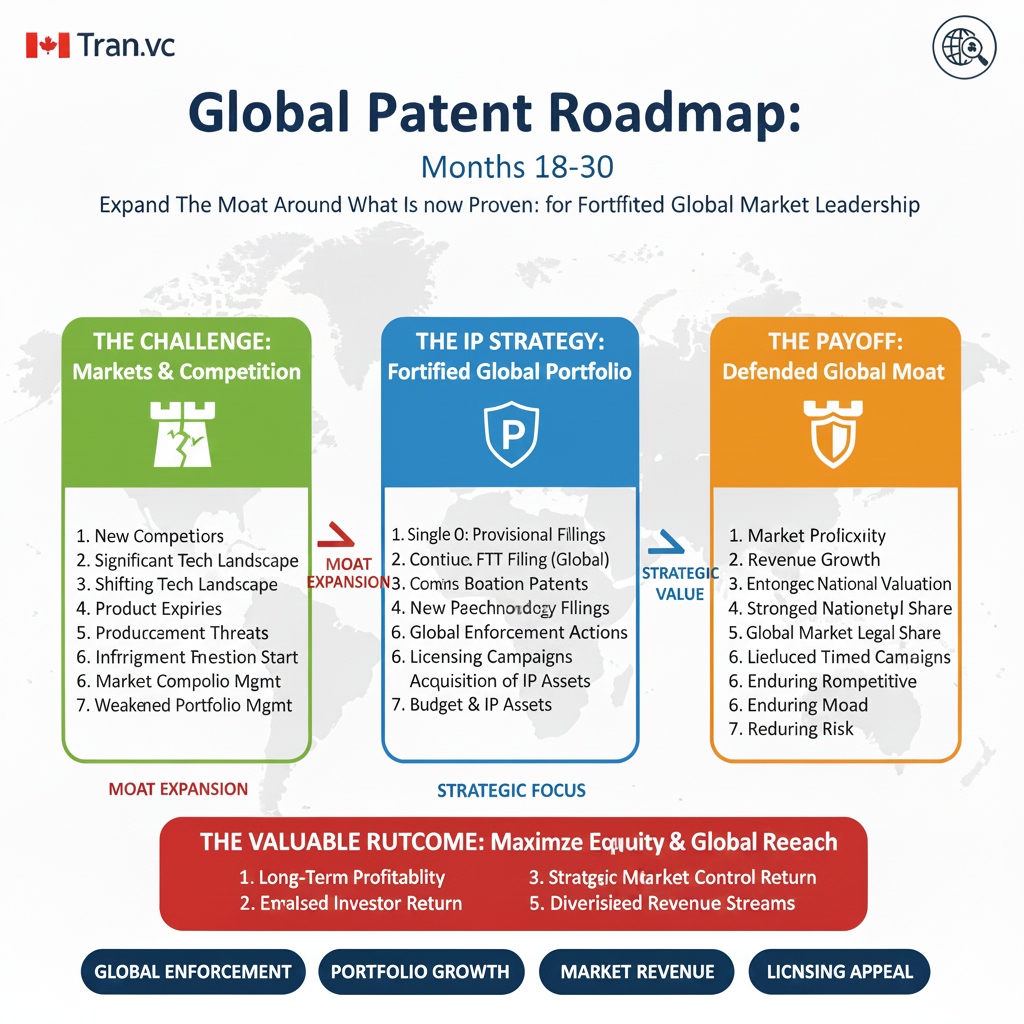
If your biotech startup is progressing, this is the phase where you should protect what became real. Your core platform may be clearer. Your best product form might be chosen. Your clinical or pilot path might be defined.
At this point, you can file patents that are more targeted and more confident. These filings often become valuable because they are tied to the version of the invention that the world will actually see. Early patents secure the date. Later patents secure the market-ready reality.
Choosing countries without wasting money or missing leverage
Market-driven choices that investors understand
Investors tend to value patents that match future revenue. If you plan to sell primarily in the United States, a strong US position is often the baseline. If you plan to sell in Europe as well, European coverage becomes a clear signal that you are building for global reach.
This does not mean you must file everywhere big. It means you should file where your buyers will be. The cleanest story is when your patent map matches your market map. It tells investors you are not guessing. You are planning.
Manufacturing-driven choices that protect supply advantage
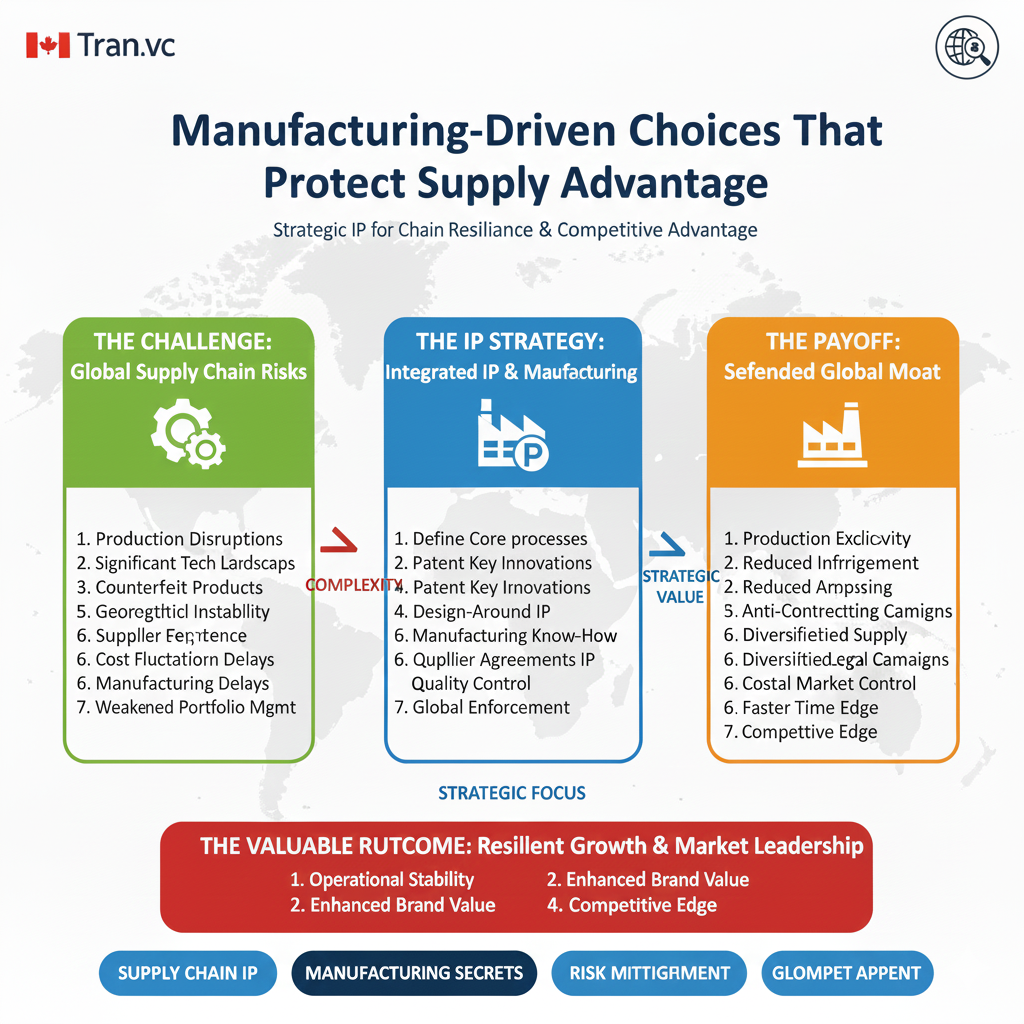
In biotech, manufacturing is often the hidden advantage. If your process gives better yield, better purity, lower cost, or better stability, it can be the difference between a real business and a science project.
If manufacturing is likely to happen in certain regions, it can make sense to protect there. This is not only about stopping someone from selling. It is also about limiting them from making cheaply, or from copying your process without consequences.
Competitor-driven choices that reduce copy risk
Some fields move so fast that competitors appear in certain places early. If you are building in a space where rapid imitation is common, ignoring those regions can be risky. Even if your first customers are elsewhere, competitors can build similar products and later enter your markets.
This is where strategy matters more than habit. You do not file in a region because “everyone does.” You file because it changes how easy it is for a competitor to follow you.
The “don’t decide today, but don’t lose rights” mindset
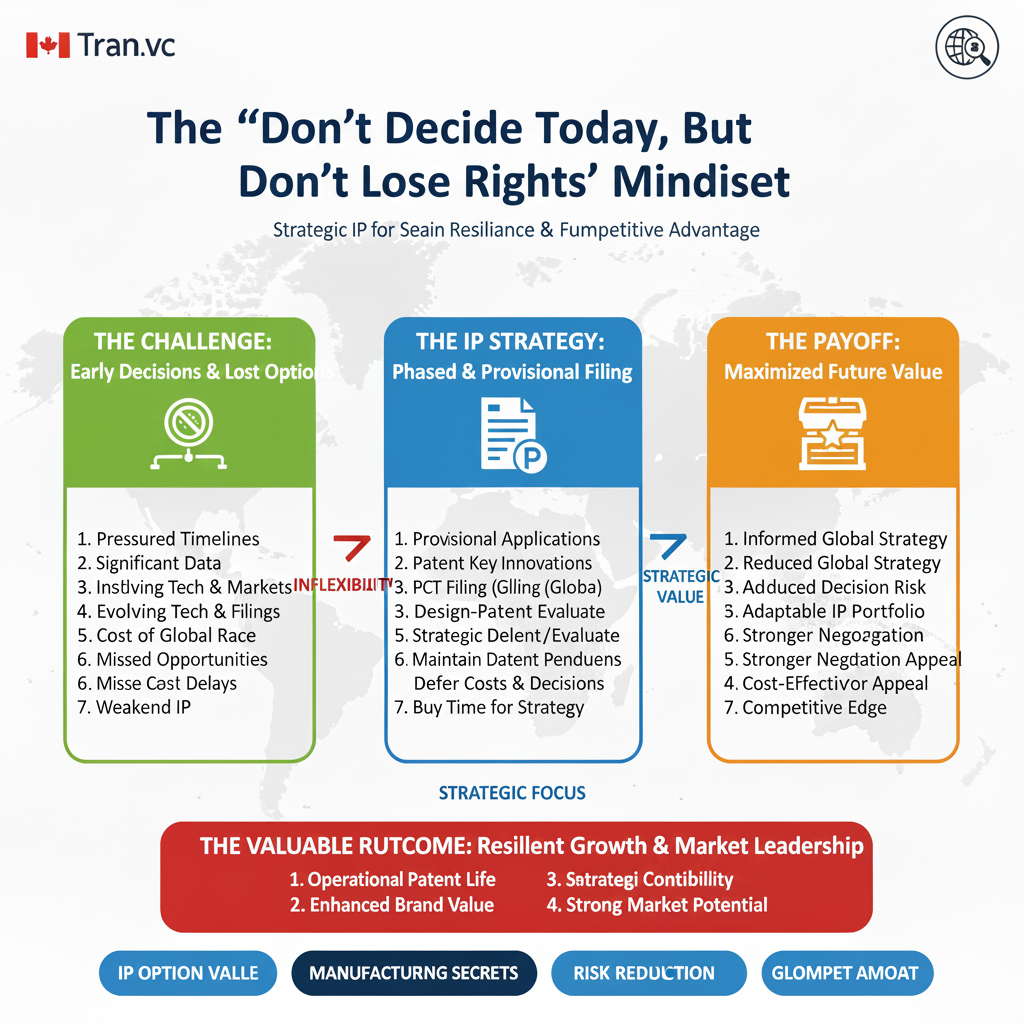
Seed-stage founders often feel pressure to decide every country early. That is usually the wrong pressure. The better goal is to preserve options while you learn.
The practical way to do that is to choose a filing path that keeps major regions open long enough for you to gather data and funding. Then you make fewer, stronger decisions later. This reduces waste and improves confidence.
The most expensive biotech filing traps and how to avoid them
Trap one: publishing before filing, even by accident
In biotech, you can lose rights faster than you think. A conference slide deck, a public grant database entry, a preprint, or a shared demo video can count as public disclosure. In many places, once it is public, you cannot get the patent later.
The fix is simple but strict. Treat enabling details as confidential until you file. If you must share, share the “what” and “why,” not the “how.” Keep the recipe private. File first, then speak freely.
Trap two: filing too early with too little detail
Founders sometimes rush to file before they can explain the invention well. They worry about being first. But a filing that does not teach the invention properly can fail to support the claims you need later.
The best seed-stage filings strike a balance. They are early enough to lock the date, but detailed enough to support broad protection. In biotech, that often means including multiple examples, describing variants, and explaining why the invention works.
Trap three: writing claims that do not match the business
A patent that protects the wrong thing is a silent failure. You can spend years and money, then discover your claims do not cover the product you are building. This happens when founders file around what is easiest to describe, not what is most valuable.
The fix is to start with the business driver. What is the core value? Is it a composition, a delivery system, a diagnostic workflow, a manufacturing process, or a device? Then you draft around that, and you build backup coverage around it.
Trap four: treating patents like a checkbox for fundraising
Some teams file because they think investors demand it, then they never use the patents as a business tool. That leads to shallow filings and poor planning.
Strong investors can tell the difference. They look for a patent story that matches the product story. They want to see that you are building a moat, not chasing a label.
Tran.vc is designed for founders who want the moat early, without burning cash. If you want that support, apply here: https://www.tran.vc/apply-now-form/
How to handle biotech inventions that evolve week by week
The reality: your first invention will change
In seed-stage biotech, changes are not a sign you were wrong. They are a sign you are learning. Your lead molecule might shift. Your target might change. Your delivery method might improve. Your assay might get replaced.
Your patent strategy should expect this. Instead of trying to write one “perfect” patent, you plan a family of filings over time. The first anchors the idea. The next ones track the real product as it becomes clearer.
Using follow-on filings to capture upgrades
As you learn, you will create improvements that deserve protection. These might be better sequences, better formulations, better dosing schedules, better manufacturing steps, or better models that reduce wet lab work.
The mistake is to treat improvements as “too small to patent.” In biotech, small improvements can be the difference between winning and losing. A careful IP plan turns your learning into assets, not just notes in a lab book.
Keeping the story consistent across science, product, and patents
Consistency is what helps in diligence. If your patent claims cover one thing but your deck sells another, people notice. If your filings do not align with your product milestones, partners get nervous.
A practical habit is to review your IP map every quarter. You do not need a heavy meeting. You need a short check: what changed in the science, what changed in the product, and what needs protection next.