
Most founders chase product-market fit like it is the finish line.
It is not.
Product-market fit is a powerful signal, yes. It means people want what you built. They use it, they pay for it, and they come back. But here is the part many teams learn the hard way: even a “good” product can stall if the founders are not the right match for the market they picked.
That is where founder-market fit comes in.
Founder-market fit is the quiet force behind the scenes. It answers a different question: Are you the right person (or team) to win in this space? Not “Can you code it?” Not “Can you raise for it?” But “Can you stay in this game long enough, learn faster than everyone else, and earn trust in a hard market?”
In deep tech—AI, robotics, advanced systems—this matters even more. These markets punish guesswork. They reward teams who know the real problem, in the real world, with real limits like safety rules, edge cases, messy data, supply chains, and long sales cycles. If you have never lived close to that pain, you can still win, but you will spend more time and money learning what others already know.
Tran.vc exists for this exact early stage. We help technical founders turn real invention into real leverage. Not hype. Not pretty slides. Actual assets investors respect and competitors cannot copy. Tran.vc puts up to $50,000 in in-kind patent and IP services so your work becomes protected value early—before you give away control or rush into a seed round too soon. If you are building in AI, robotics, or other deep tech and you want to build a moat from day one, you can apply anytime here: https://www.tran.vc/apply-now-form/
Now let’s make the terms simple.
Founder-market fit is about you and the market. Product-market fit is about the product and the market. They sound close, but they fail in different ways, and they create different kinds of risk.
If you only have founder-market fit, you may have a clear story and strong skills, but no one is buying yet. That is frustrating, but it is fixable with better testing and tighter focus.
If you only have product-market fit, you might get early demand, but you may not understand why it works, how to sell it again, or what moves will break it. That can create a short burst of traction that fades. Investors often see this as “good early numbers, unclear engine.”
The best outcome is when both are strong. Then you are not only building something people want. You are also the team that can keep shipping, keep selling, and keep learning until you own a category.
In this article, we will go deep on both. We will keep it practical. You will learn how to spot founder-market fit in yourself, how to test product-market fit without fooling yourself, and how to use IP to reduce risk while you search. We will also cover a truth many founders avoid: sometimes the product is fine, but the market is wrong for the founders. And sometimes the founders are great, but the product is aimed at the wrong buyer.
Founder-Market Fit vs Product-Market Fit: Why Both Matter
Why these two ideas get mixed up
Founder-market fit and product-market fit sound similar, so many teams treat them like the same thing. They are not. One is about the people building the company and how well they match the market. The other is about the thing you built and whether the market truly wants it.
Most founders chase product-market fit first because it feels more concrete. You can build, ship, test, and measure clicks, trials, or revenue. Founder-market fit feels more personal, so it gets ignored until things get painful. That is often too late, because weak founder-market fit creates slow, costly learning.
The goal is not to “pick one.” The goal is to understand both, strengthen both, and know which one is the real problem when growth stalls. This makes every next step clearer, from what to build to how to sell it.
A simple definition you can remember
Founder-market fit is the match between the founder and the market problem. It answers: “Are we the right people to win here?” This includes knowledge, access, credibility, and the ability to stay in the fight long enough to earn trust.
Product-market fit is the match between the product and the market need. It answers: “Do enough customers want this, buy it, and keep using it?” It is proven through repeatable demand and real retention, not just polite interest.
If you remember one line, remember this: founder-market fit helps you find the truth faster, and product-market fit is the truth showing up in customer behavior.
Why deep tech makes this more serious
In AI and robotics, markets are less forgiving. Demos can look great while real use fails in messy settings, with edge cases, safety limits, and hard rules. Buyers often want proof, testing, and reliability before they commit serious money.
That means founder-market fit matters more, earlier. If you do not understand the real world around the problem, you can spend months polishing the wrong “solution.” Product-market fit also takes a different shape in deep tech, because trust and reliability are part of the product, not a bonus.
Where Tran.vc fits into this early stage
When you are early, you are building more than a product. You are building belief, leverage, and a defensible edge. Tran.vc helps technical founders do that by investing up to $50,000 in in-kind patent and IP services, so your innovation becomes an asset.
Strong IP work is not “paperwork later.” It can clarify what is truly novel, what is hard to copy, and what you should lean into. If you want to build in AI, robotics, or deep tech with protection from day one, you can apply anytime at https://www.tran.vc/apply-now-form/
Founder-Market Fit
What founder-market fit really means

Founder-market fit is not a buzzword and it is not a trophy. It is a practical advantage that shows up when you make hard calls. It means you understand the market problem in a way that helps you choose better paths than a smart outsider would.
This fit can come from work experience, research, a personal pain, or years close to the buyer. But the key is not the origin story. The key is whether your closeness to the problem helps you learn faster, sell with more trust, and build with fewer wrong turns.
Founder-market fit is also about motivation that lasts. If you picked a market that you do not actually care about, you will drift when things get hard. In deep tech, things will get hard, and often for longer than you expect.
Signals you have it
A strong sign is that you can describe the customer’s world without guessing. You know what they fear, what they get rewarded for, and what gets them fired. You understand the workflow before your product exists, and you can point to where the pain is sharp enough that people will pay.
Another sign is that you can explain buying, not just using. Many teams can talk about features and users, but B2B success often depends on the buyer, the budget owner, the legal gate, and the security gate. If you already understand those roles, you avoid many early traps.
You may also notice that conversations go deeper faster. When you speak with customers, they do not stay on the surface. They share real constraints and give you real numbers. That usually happens when they feel you “get it” and will not waste their time.
Signals you do not have it yet
If every customer call feels like starting from zero, that is a sign. If you keep hearing “interesting” but not “we need this now,” you may be in a market where urgency is low, or you may be speaking to the wrong buyer. If you cannot tell the difference, founder-market fit may be weak.
Another signal is that your story changes too often. You keep shifting between problems, buyers, and industries because you are still searching for where you belong. Searching is normal, but constant shifting often means you do not have a clear anchor in the market.
In AI and robotics, weak founder-market fit often shows up as lab-first thinking. The product is designed around what is technically elegant, not what is operationally acceptable. Then pilots fail because the customer needs uptime, service, safety, and integration more than a perfect model score.
How to build founder-market fit on purpose
You can build founder-market fit, even if you did not start with it. The fastest path is to spend focused time where the problem lives. That means shadowing the workflow, sitting in the room where decisions are made, and learning what constraints are real.
You also need a “learning loop” you can run every week. Talk to the same type of buyer again and again, not a random mix. Ask about past attempts, budget timing, and what would make them switch. Keep your notes structured so you can see patterns instead of remembering only the loudest feedback.
Over time, your judgment improves. You stop reacting to every opinion and start weighting feedback based on who said it and what they control. This is the real outcome of founder-market fit: better decisions under uncertainty.
Product-Market Fit
What product-market fit really means

Product-market fit is when the market pulls your product forward. Customers do not just try it. They adopt it, they keep using it, and they are willing to pay because it solves a problem that matters.
In B2B, product-market fit is not only usage. It includes renewals, expansion, and a sales motion that becomes repeatable. You do not need every deal to be easy, but you should see a clear path that works more than once without miracles.
Product-market fit is also “truth in behavior.” People can say they love your idea and still not buy. Fit shows up when they sign, pay, and keep paying, or when they rely on the product enough that stopping hurts.
What product-market fit is not
A pilot is not product-market fit by itself. A pilot can be paid or unpaid, but it is still an experiment. Many companies run pilots to learn, to compare vendors, or to delay a decision. Unless a pilot converts and repeats with similar buyers, it is only a sign, not proof.
High interest is not product-market fit either. If people take meetings but avoid commitment, you may be offering something “nice to have.” In enterprise settings, nice-to-have tools get cut, delayed, or buried in procurement.
In AI, a high accuracy number in a demo is not product-market fit. Customers care about reliability in their environment, not your environment. Fit includes how your system handles messy inputs, drift, edge cases, and the cost of maintenance.
Early signs you are getting closer
One early sign is when customers start pulling you into their process. They introduce you to the budget owner. They ask about pricing and timelines. They ask hard questions about security, deployment, support, and liability. That is work, but it is a good kind of work, because it means the product is becoming real to them.
Another sign is when your message gets simpler. You can describe the value in the same way to the same buyer, and it keeps landing. Your product pitch stops changing every week, because you finally understand what the customer is truly buying.
You may also see faster cycles. Even if the sale is not instant, the steps become clearer and the stalls become predictable. Predictable is progress, because it means you can design around it.
The Key Differences
The real subject of each “fit”
Founder-market fit is about people, context, and judgment. It is the foundation that shapes your choices, your speed of learning, and your credibility. It is present even before the product is ready, and it often determines whether you choose the right wedge to start.
Product-market fit is about the product’s pull in the market. It is proven by customer action: adoption, payment, retention, and referral. It depends on delivery, but also on trust, reliability, and timing.
One can exist without the other, but that is risky. If you have founder-market fit without product-market fit, you may be close to a real problem but still building the wrong solution. If you have product-market fit without founder-market fit, you may get traction but struggle to repeat it or defend it.
How each one fails
Founder-market fit fails through slow learning. You build features customers do not value. You chase buyers who cannot purchase. You misunderstand the real blockers. You waste time solving problems that feel exciting but do not move revenue.
Product-market fit fails through weak pull. You have interest but not urgency. You get pilots but not conversions. You get small deals but no expansion. You get usage but no willingness to pay. The product might be “good,” but it is not essential.
Knowing which failure you are facing is a superpower. It tells you whether the next move is more customer discovery, a sharper wedge, a pricing change, an operational rebuild, or a market shift.
Why Both Matter in the Same Company
Founder-market fit helps you reach product-market fit faster

When founders fit the market, they ask better questions. They choose a narrower starting point and avoid broad claims. They understand which constraints matter, so they design tests that reveal the truth faster.
They also waste less time on bad signals. They can tell when a customer is being polite versus serious. They can tell when a buyer is blocked by process versus blocked by value. That reduces the “false hope” cycles that kill momentum.
This is why two teams can build similar tech, but one team reaches traction months earlier. The difference is often not code quality. It is market judgment.
Product-market fit makes founder-market fit real
Founder-market fit can still be a story until the market confirms it. Product-market fit is the confirmation. It proves that your understanding of the market is not only internal confidence, but external validation through customer behavior.
Once you have product-market fit, you also gain a stronger platform for hiring, partnerships, and fundraising. You are not pitching potential. You are showing pull. That changes how people treat you.
In deep tech, it also changes the IP story. When you combine real customer demand with clear defensible claims, you look less like a project and more like a company that can own a space.
How IP supports both fits
Good IP work can strengthen founder-market fit because it forces clarity. You must define what is novel, what is core, and what creates a durable edge. That reflection often improves the product roadmap, because you stop building “nice extras” and focus on what only you can deliver.
IP also supports product-market fit by reducing buyer risk and investor risk. In B2B, buyers want to know you will still exist in a year, and investors want to know you can defend your advantage. Strong IP does not replace execution, but it can make your position harder to copy while you keep learning.
Tran.vc invests up to $50,000 in in-kind patent and IP services for AI, robotics, and other technical startups so founders can build defensibility early. If you want to raise with leverage instead of desperation, you can apply anytime at https://www.tran.vc/apply-now-form/
How to Measure Founder-Market Fit
The “truth test” you can run in two weeks

If you want to know whether you have founder-market fit, do not start with your pitch deck. Start with a tight set of real conversations with one buyer type. The goal is not to convince anyone. The goal is to see if you can predict what matters to them before they tell you.
Pick one narrow customer profile and speak to ten people who match it. Keep the same problem frame in every call. If your fit is strong, you will hear repeating patterns quickly, and you will be able to finish their sentences in a respectful way. If your fit is weak, every call will feel like a different universe, and you will keep changing what you think the problem is.
When founders do not fit the market, they often spread calls across many industries to “learn faster.” It feels productive, but it delays truth. Depth beats breadth at this stage. You want to see repetition, because repetition is what makes a business model possible.
The “access” check most founders ignore
Founder-market fit is not only knowledge. It is also access. Access means you can reach the right people without begging for weeks. It means you can get honest answers, not polite smiles. It means your network, reputation, or prior work opens doors that are normally shut.
If you cannot reach decision-makers, product-market fit becomes harder to prove, even if the product is good. You end up talking to friendly users who like the idea but cannot buy. That leads to false confidence and weak pipelines.
Access does not have to be perfect. But you should know your gap. If access is missing, you must solve it like an engineering problem. You build a repeatable outreach system, you partner with people who already have trust, and you design a wedge that is easy to say yes to.
The “credibility” check in regulated or high-risk markets
In AI and robotics, buyers often worry about risk. They worry about safety, downtime, liability, and reputation. Founder-market fit shows up when you can speak their language without acting. You understand why they are cautious, and you have a plan that respects their world.
A simple way to test credibility is to ask customers what would block them from deploying your solution. If you have fit, you will already know most blockers and you will have realistic answers. If you do not, you will feel surprised by basic questions like support, warranties, compliance, integration, or failure handling.
This is not about pretending you have everything solved. It is about showing mature thinking. Buyers trust founders who can say, “Here are the risks, here is how we reduce them, and here is how we learn safely.”
How to Measure Product-Market Fit
The difference between “interest” and “pull”
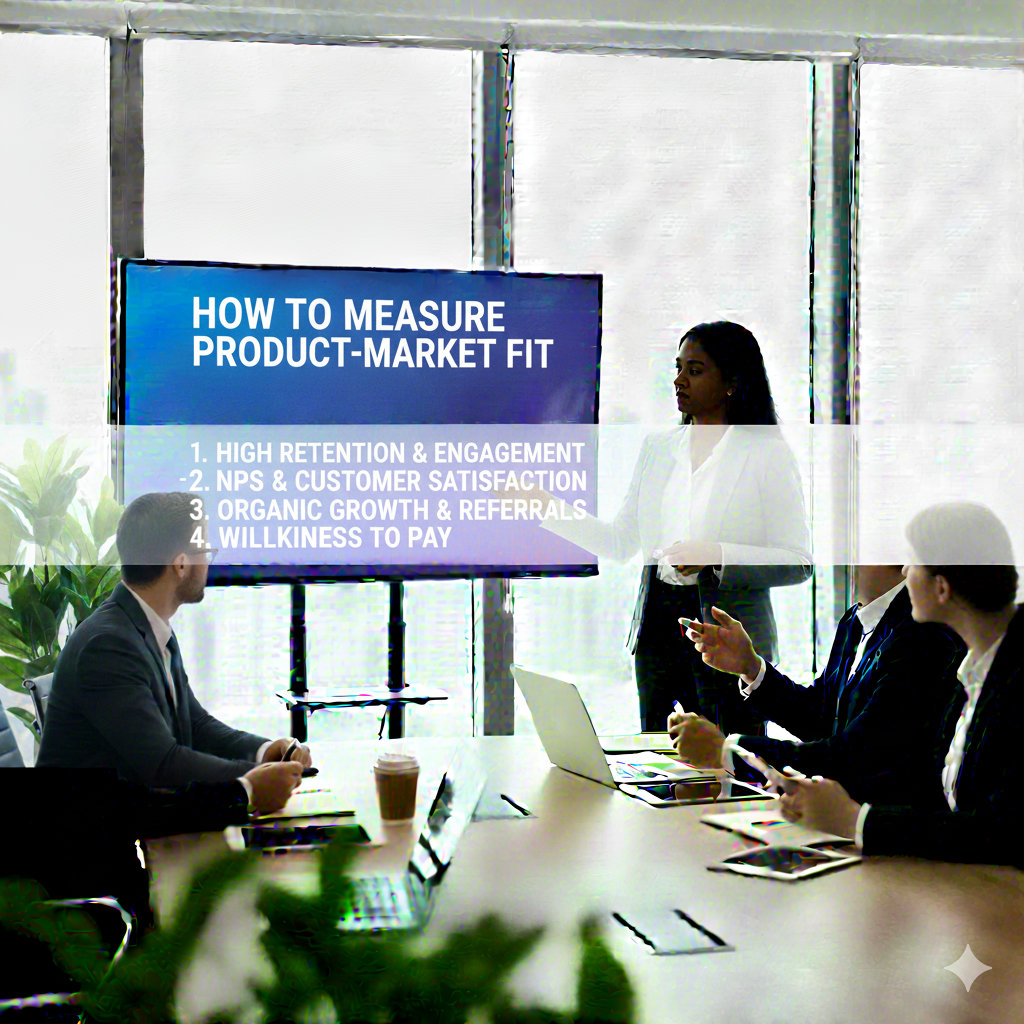
Many teams mistake attention for demand. Interest is when people take meetings, ask questions, or praise the idea. Pull is when they commit time, money, and political capital inside their company to make it happen.
Pull often looks like customers pushing the process forward. They introduce you to procurement. They bring in IT. They ask about rollout plans. They request a pricing model. They want timelines. They may even ask for terms that protect them, which is annoying, but it is a real buying motion.
If you keep hearing, “This is cool, check back next quarter,” you may have interest, not pull. Your job is to find out why. Sometimes the pain is not urgent. Sometimes your buyer is wrong. Sometimes the product does not reduce risk enough. Sometimes the budget is elsewhere. The reason matters, because the fix is different each time.
The “repeated yes” standard in B2B
Product-market fit is not one big customer. One logo can be luck, timing, or a champion who leaves later. Fit starts to show when you can sell the same promise to similar buyers and close more than once without changing the story.
That is why the best early goal is not “land a huge enterprise.” The best goal is “land two or three similar buyers with the same use case.” When the same type of customer keeps buying for the same reason, you are building an engine, not a one-off.
If each deal requires a new custom build, your product may be closer to consulting than a scalable company. That can still be a valid path, but it is a different business. If you want a product company, you must protect your time and build toward repeatability.
Retention in deep tech is not only “logging in”
In many software products, retention can be measured by weekly or daily use. In AI and robotics, retention can look different. A model may run in the background. A robot may operate on a schedule. A system may trigger only when something goes wrong.
So the right retention question is simple: do customers keep it in place, keep paying, and rely on it? Do they renew? Do they expand to more sites, more machines, more data sources, or more teams? Do they defend the product internally when someone wants to cut tools?
If your product is part of a critical workflow, customers will fight to keep it. If it is a “nice extra,” it will be easy to remove. Product-market fit shows up as dependency that creates budget protection.
How These Two Fits Create Different Company Risks
When founder-market fit is weak

When founders do not match the market, the company burns time in the wrong places. You may build a feature that feels important but does not change buying behavior. You may pick a buyer who cannot approve budget. You may price in a way that makes customers nervous or makes you look unready.
This type of risk is sneaky because it feels like progress. You are busy, you are shipping, you are meeting people. But the motion does not compound. The next month does not get easier than the last month.
The fix is not “work harder.” The fix is to narrow the market, learn the buyer deeply, and bring in missing context through advisors, early hires, or partners who live in the buyer’s world.
When product-market fit is weak
When product-market fit is weak, you can still have strong founder-market fit. You can know the market and still build the wrong product shape. That often happens when you aim too broad, try to solve too many problems, or pick a use case with low urgency.
The danger here is emotional. Founders start to doubt themselves because they “understand the space,” yet the product is not moving. In reality, this is often a design and positioning problem, not a personal failure.
The fix is to tighten the wedge. Choose one painful job to solve and deliver a result that is easy to measure. In B2B, buyers pay for outcomes, not for clever tech. Your product should feel like a reliable tool that reduces risk or saves money, not a science project.
When both are weak
When both are weak, you get noise without learning. The team tries random industries, random buyers, and random product changes. It becomes hard to tell what worked and why. Fundraising becomes harder because the story keeps shifting.
If you are in this zone, the most valuable move is to stop and pick a single lane for a short sprint. Two to four weeks of focus can create more clarity than six months of scattered effort. You do not need certainty. You need direction and a clear test.
Tactical Ways to Strengthen Both at the Same Time
Start with a narrow “job” and a clear buyer

The strongest early strategy is to solve one narrow job for one clear buyer type. This is not about limiting ambition. It is about building a doorway into a larger market.
In AI and robotics, narrow does not mean small. It means specific. For example, a robotics product might start with one operation inside one facility type, where the ROI is easy to prove. An AI product might start with one workflow where errors are costly and time is scarce.
When you start narrow, you can learn faster, ship faster, and sell with less confusion. That strengthens founder-market fit through deep learning and strengthens product-market fit by creating repeatable deals.
Turn your product into a “risk reducer”
Most B2B buyers do not buy because your tech is impressive. They buy because not buying feels risky. Your job is to make the product reduce a risk they already worry about.
That risk could be cost, downtime, safety incidents, missed deadlines, compliance failure, customer churn, or staff overload. The best products make one of those risks smaller in a way the buyer can explain to their boss.
If your pitch sounds like “new technology,” you will face slow cycles. If your pitch sounds like “less risk and clear ROI,” you will move faster. This is one of the most direct ways to turn interest into pull.
Use IP to lock in your edge while you learn
Early-stage founders often worry they should not file patents until everything is perfect. That creates a trap. In deep tech, the core invention can be clear early, even if the product packaging is still evolving.
A strong IP plan can protect the core method, the system design, or key workflow improvements. It can also keep competitors from copying what matters while you test and refine the market.
This is exactly where Tran.vc helps. Tran.vc invests up to $50,000 in in-kind patent and IP services so your early innovation becomes protected leverage, not just code sitting in a repo. If you want that support, apply anytime at https://www.tran.vc/apply-now-form/