If you are building a real product in AI or robotics, you are also stepping into a crowded field of patents. That is not good or bad. It is just true. A Freedom to Operate (FTO) check is how you avoid building something that later gets blocked, delayed, or forced into a costly redesign. It is not a “nice-to-have.” At the right moment, it is a survival move.
Tran.vc helps technical founders do this the right way, early enough to matter, without wasting months or burning cash. If you want help with FTO and patent strategy from day one, you can apply any time here: https://www.tran.vc/apply-now-form/
What “Freedom to Operate” really means (in plain words)
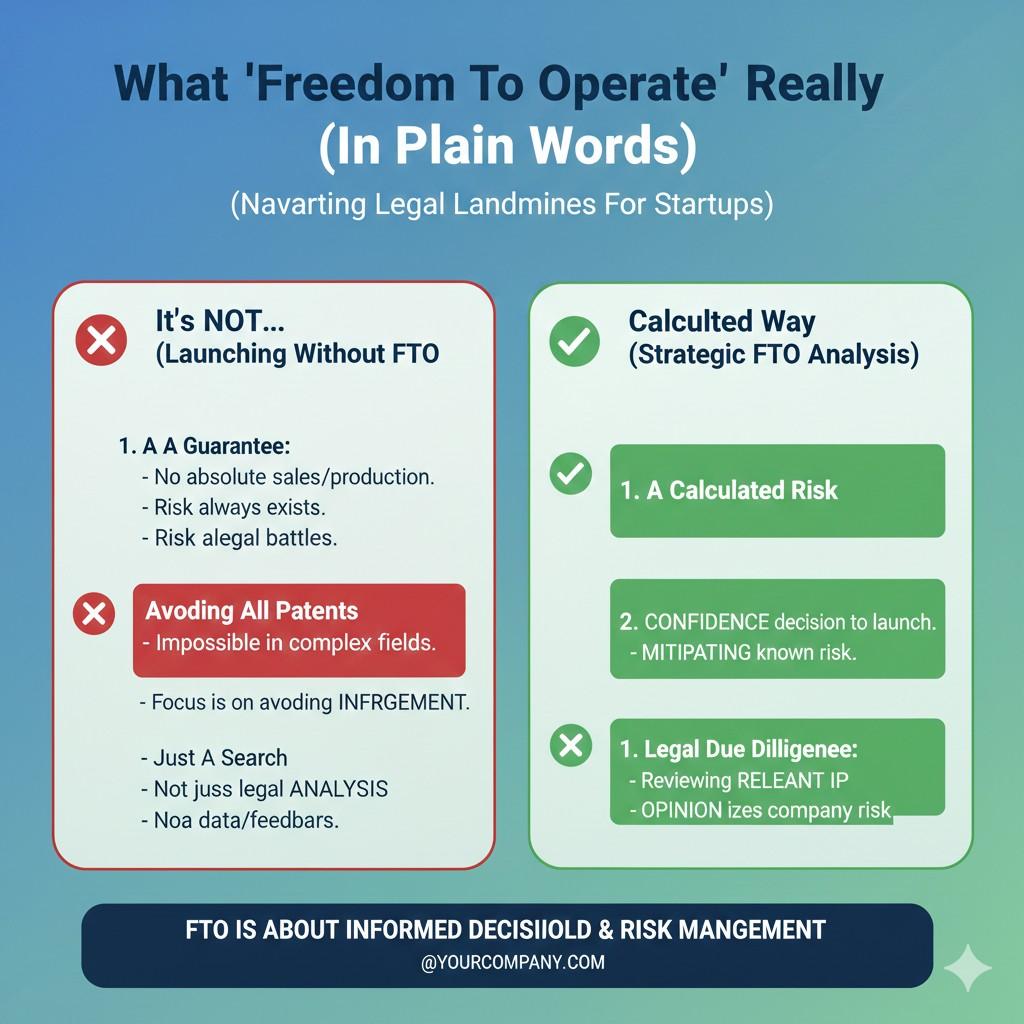
Freedom to Operate is a practical question:
Can you make, use, sell, or ship your product without stepping on someone else’s active patent rights in the places you will do business?
Notice what that is not. It is not “Is my idea new?” That is a different question. That is more like “Can I patent this?” FTO is about risk from other people’s patents, not about whether you can file your own.
Also, FTO is not a single yes or no. It is a risk picture. It tells you:
- where the landmines might be
- which parts of your product are most exposed
- which design changes can reduce risk fast
- what you should avoid saying in sales decks
- how to enter deals with a clear head
In robotics and AI, this matters more than most founders expect because products are built from many layers. Hardware pieces, control loops, sensors, mapping, planning, ML models, data pipelines, edge deployment, safety steps, user flows, and even the way you update firmware. Each layer may have patents around it.
So when someone says, “Just do an FTO,” the hidden truth is: the value is not the search alone. The value is the decisions you make after you see the risk.
Why founders often delay FTO (and why that backfires)
Most early teams delay FTO for simple reasons.
One, they think patents are a late-stage issue. They assume only big companies sue. But many patent fights start with something smaller and quieter, like a warning letter, a blocked partnership, or an investor who suddenly asks hard questions.
Two, they think FTO is only needed right before launch. That sounds reasonable until you remember how product work actually goes. Your first version becomes your base. Your architecture becomes sticky. Your firmware choices get baked in. Your data format becomes hard to change. If you wait too long, the “easy redesign” becomes a painful rebuild.
Three, founders worry that an FTO will scare them or slow them down. This is a fair fear. A bad FTO process can do that. But a good FTO process does the opposite. It gives you focus. It shows you what to ignore and what to adjust.
FTO should not turn you into a cautious company. It should turn you into a company that moves fast without walking blind.
The biggest FTO mistake: treating it like a one-time report
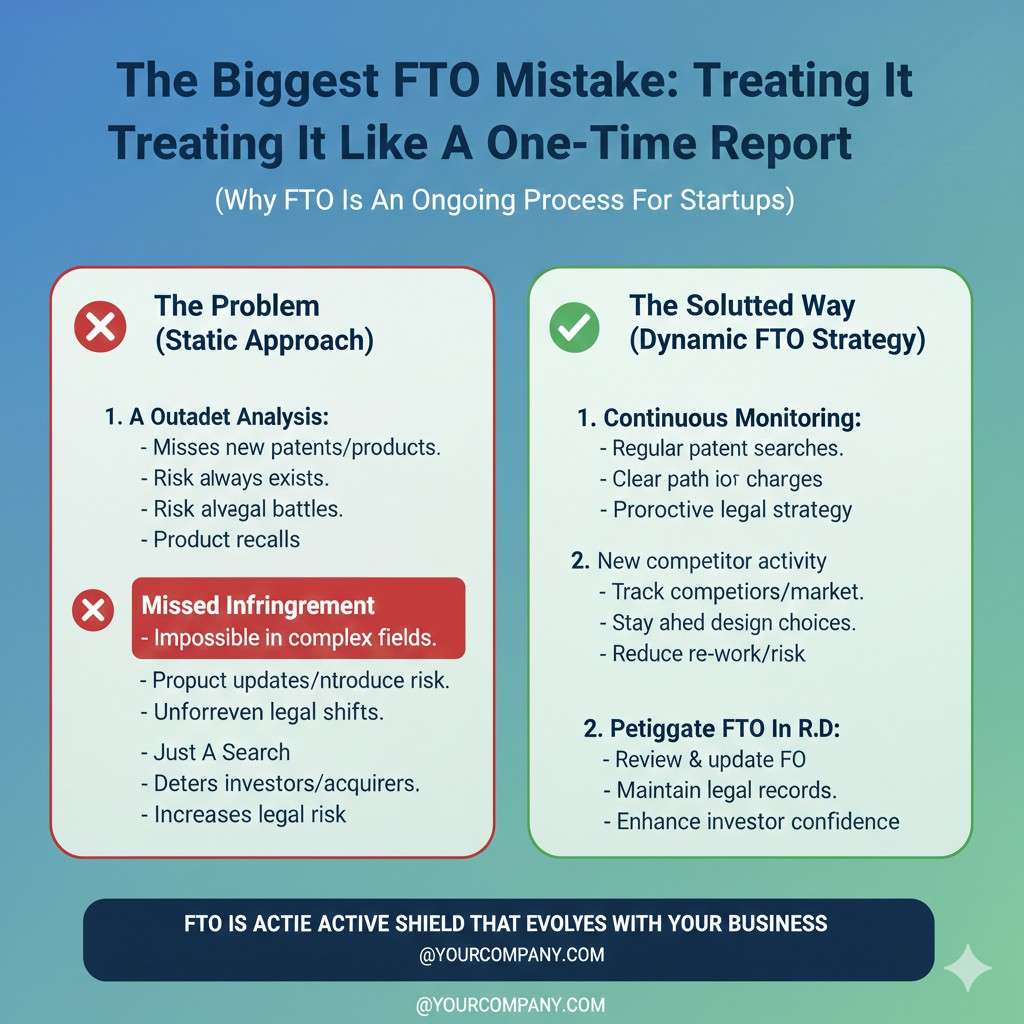
A lot of teams believe FTO is a document you order, put in a folder, and forget. That is not how it works.
Think of FTO like a map for a trip. If your destination changes, or you choose a new route, the map needs updates. Your product changes every month. Your features expand. You add integrations. You shift from on-prem to cloud. You move from pilot customers in one country to customers in three regions. Your risk picture changes with it.
A better mindset is this: FTO is a process, not a PDF.
There can be a big formal study later, yes. But early on, you want a lean approach that tracks with your build plan. You look at the highest-risk parts first, then update as your product becomes real.
So when do you actually need FTO?
Here is the truth most founders want: you do not need a full, expensive, “cover every claim on earth” FTO on day one. That is overkill when your product is still changing.
But you do need FTO thinking earlier than you think. You need it when your choices start to lock in. You need it when money, time, and reputation are about to get exposed.
Let’s walk through the moments where FTO becomes urgent.
1) When you are moving from a demo to a product
A demo is often a proof that something is possible. It is built to show a result. It is not built to scale, ship, or pass safety checks.
The moment you start turning a demo into a product, you choose real components. You pick a sensor stack. You pick compute. You pick a model type and a training flow. You pick a way of doing localization, mapping, perception, or planning. You pick your method for handling edge cases. All of those choices can sit inside patent claims.
If you wait until the product is “almost ready,” you may learn that a core method you relied on is covered by patents in the market you want. Then your options are ugly: redesign fast, license, or delay.
This is why a lean FTO pass is useful right here. Not a deep dive into every detail. Just enough to answer: “Are we building on a safe path, or are we walking straight into known fences?”
If Tran.vc supports you, this is where the work feels very real. You are still early, so you can change. But you are far enough along that your core approach is clear. That is the sweet spot for early FTO thinking. If you want to do this with a team that has done it before, apply here: https://www.tran.vc/apply-now-form/
2) When you sign your first real pilot with a known company
Enterprise pilots change the game. Suddenly there is a brand on the line. Legal teams get involved. Procurement starts asking for details. Some partners will ask directly: “Do you have freedom to operate?” Others will not ask, but they will assume you have done your homework.
Also, pilots create paper trails. Statements in emails, decks, and SOWs can later get pulled into a dispute. If you promise a specific method, a specific feature, or a specific implementation, you may box yourself in.
At this stage, you do not need to be perfect. But you need to be smart. You should know which parts of your product are more exposed and how to describe them without overcommitting.
A practical FTO approach here is about reducing business friction. It helps you avoid the awkward moment where a partner’s counsel pauses a deal because your answers are vague.
3) When your product looks like an “obvious category winner”
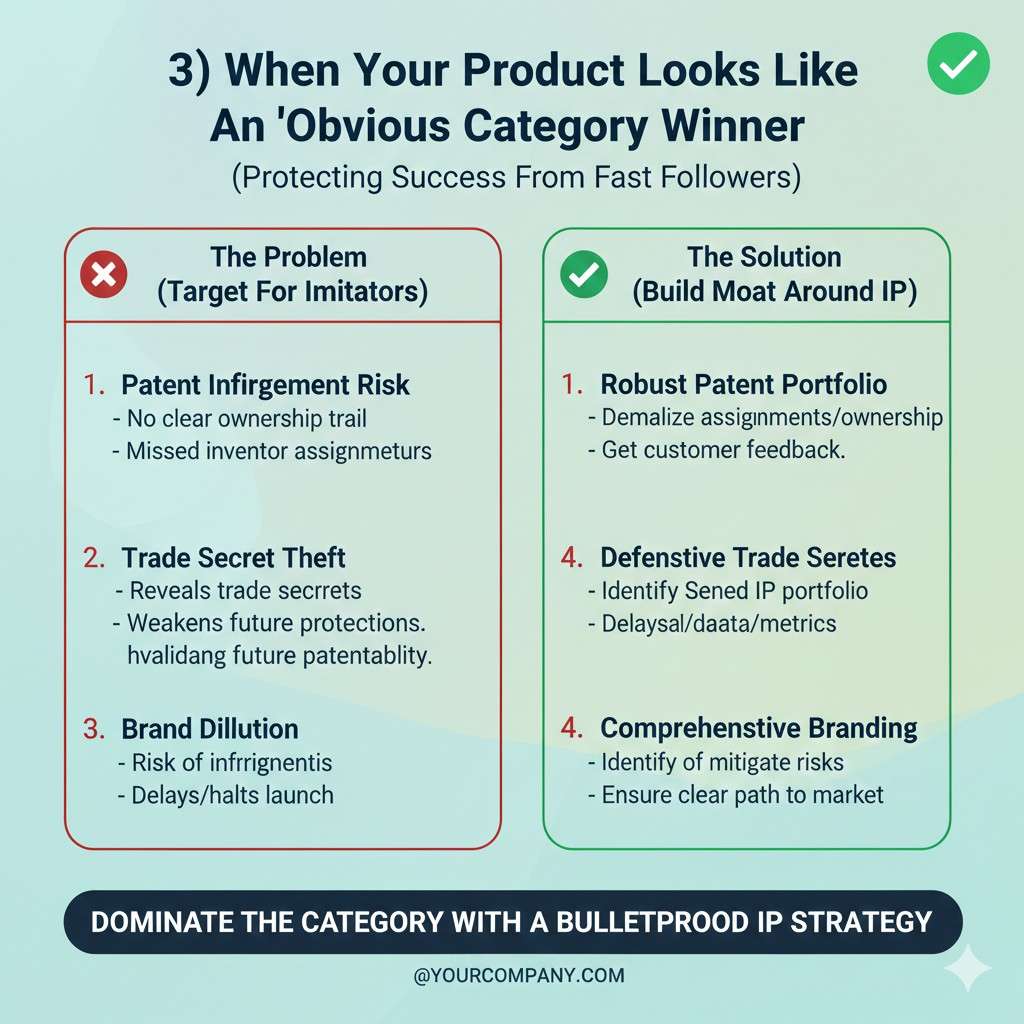
This is a strange trigger, but it is real. If your robotics or AI product starts to stand out, people notice. Competitors watch. Large incumbents take interest. Sometimes they reach out kindly. Sometimes they start building around you. Sometimes they try to pressure you.
FTO risk tends to rise with visibility. Not because you suddenly infringe more than before, but because you become worth chasing.
This is why strong IP strategy is a defensive shield and a negotiation tool. Your own patents do not automatically give you freedom to operate. But they can give you leverage in a cross-license discussion or a deal. And an FTO view helps you avoid stepping into avoidable traps.
Tran.vc is built for this moment. They help founders turn technical work into an IP base that investors respect and competitors hesitate to challenge. Apply any time: https://www.tran.vc/apply-now-form/
4) When you raise a priced round or talk to serious seed investors
Early investors care about risk. Some will ask directly about IP and FTO. Others will not ask, but they will do diligence later. And if a lead investor brings in counsel, you may get questions you did not expect.
Here is what makes this tricky. The goal is not to claim “We have zero risk.” That is rarely true. The goal is to show that you understand the space and you have made wise choices.
Investors like founders who can say things like:
“We focused our FTO effort on the features we plan to ship in the next two quarters. We found a few areas where the risk could be higher, and we already have design options to reduce that risk. Our product roadmap is built with this in mind.”
That statement reads as calm and controlled. It shows leadership. It also prevents last-minute panic.
A founder who says “We have not looked into it” may still get funded, but it can lower valuation, slow the round, or invite more control terms. Many founders do not realize this until it is late.
5) When you scale into new markets
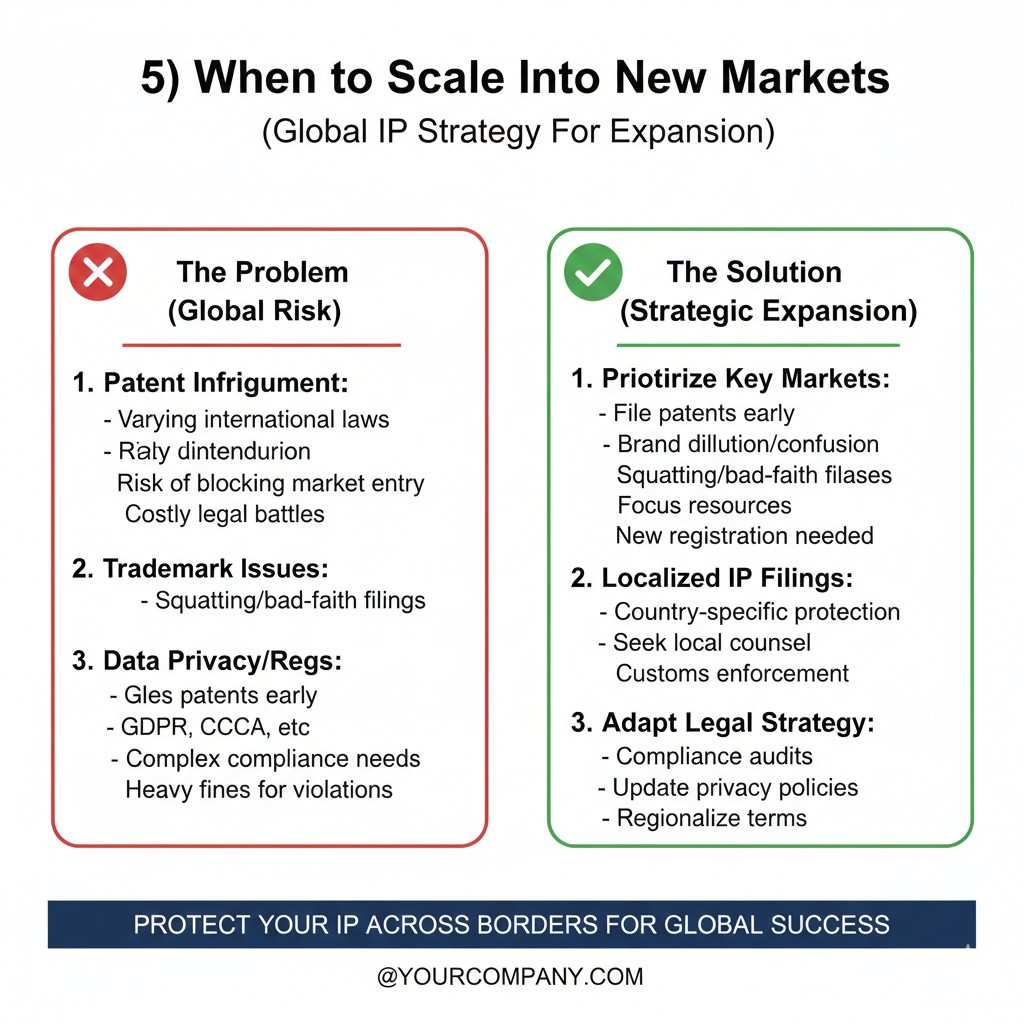
Even if your product is safe in one country, patents are territorial. A patent in the US does not automatically apply in Europe, and the other way around. A method may be blocked in one region but open in another. Also, claim scope differs by jurisdiction and by prosecution history.
If you plan to expand to the US, EU, UK, Japan, or other major markets, the “freedom” part of FTO becomes a moving target. You want to check the places you will actually sell, build, or host your system.
This is especially important for robotics companies that manufacture in one region and sell in another, or for AI companies that host in one region and serve customers globally. Where you “make” or “use” the invention can matter.
So the right time for deeper FTO work is often before a major expansion move, not after the move.
What happens if you ignore FTO until it is too late?
Let’s talk plainly.
If someone claims you infringe, you may face:
Delays. Your customer pauses. Your partner waits. Your team stops building new features and starts rewriting old ones.
Cost. Even if you are right, responding takes legal spend, leadership time, and stress. For early teams, this is expensive in the ways that matter most.
Forced design change. If the claim touches a core part of your product, you may have to redesign quickly. Quick redesigns create bugs and safety issues, which is extra risky for robotics.
Lost deals. Some companies will not take on the risk. They will choose the safer vendor.
Weak negotiating position. If you do not know what you are exposed to, you cannot negotiate with calm. You may pay more for a license or accept worse terms.
This is why the right answer is not fear. It is preparation.
A simple way to think about FTO timing: “locking choices”
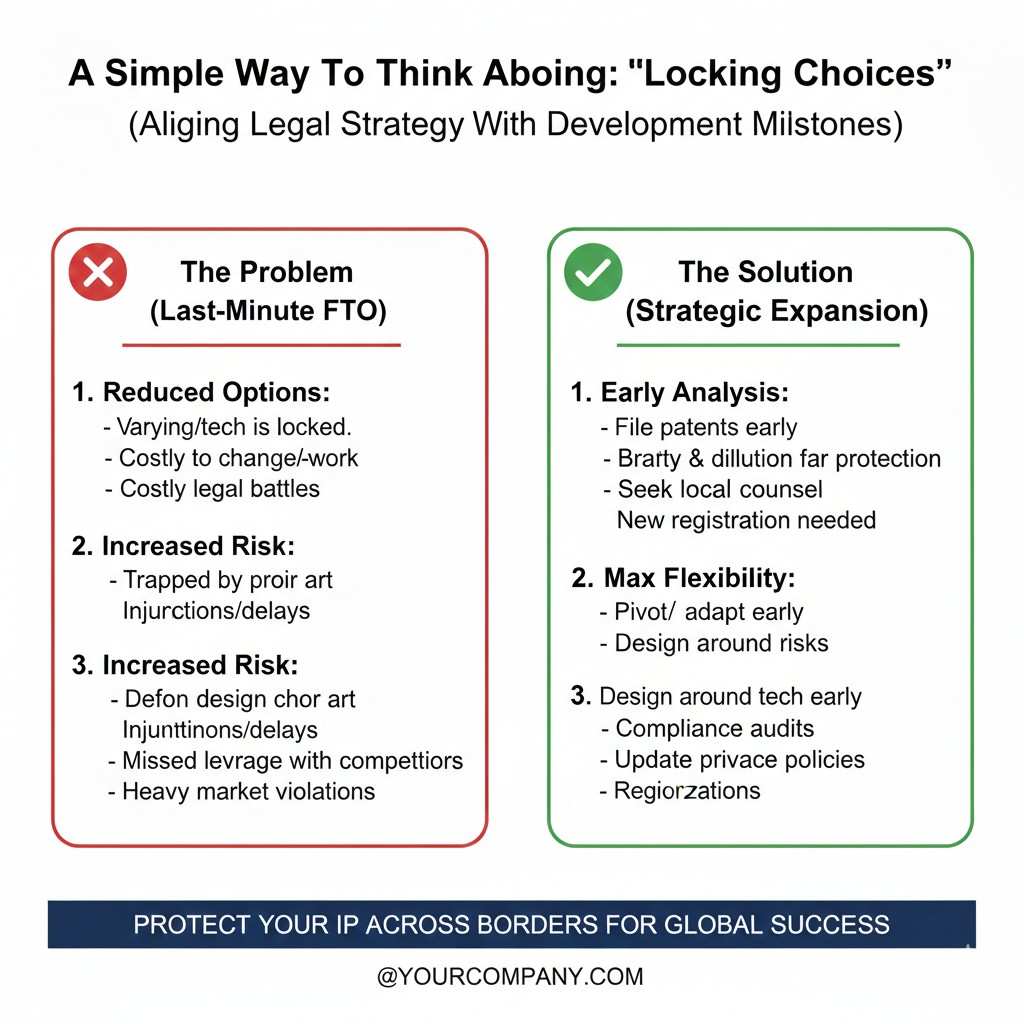
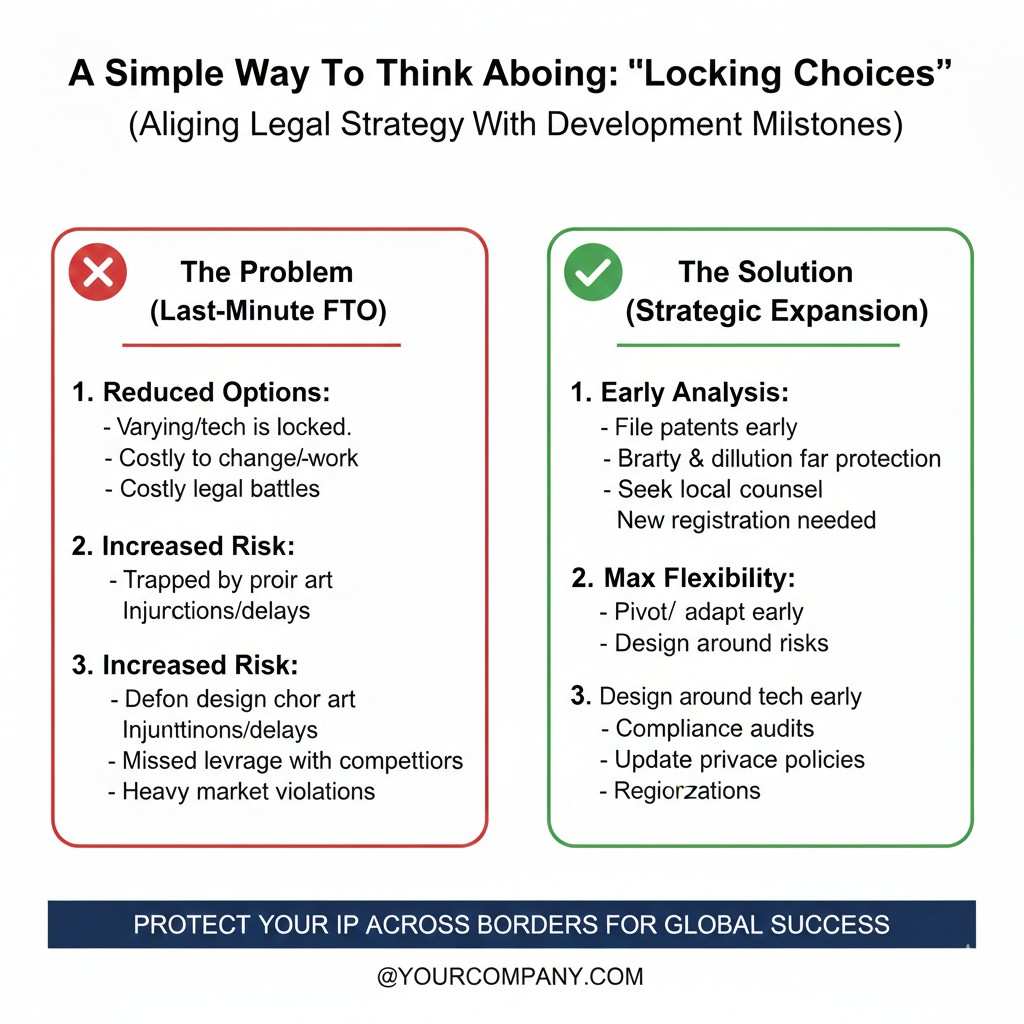
Here is a simple rule that works well for deep tech founders:
The moment a design choice becomes hard to change, it becomes worth checking.
In early research mode, you can test many methods quickly. In product mode, your choices lock. You buy parts. You write code that depends on those parts. You train models around certain assumptions. You build data labeling tools around your pipeline. You hire people with a certain approach. Every month makes change harder.
FTO is most valuable right before choices lock, not after.
What early-stage FTO can look like (without turning into a giant project)
A lean FTO effort is not a massive legal operation. It is a focused sprint with clear boundaries.
It starts with one question: what are you shipping first?
Not what you “could do later.” Not every feature you dream about. What you will put in a customer’s hands.
Then you break your product into a few key building blocks. Not a long list. Just the parts that make your product unique or essential.
For example, a robotics company might have:
- a perception method that handles a hard environment
- a planning method that makes motion safe
- a special way of fusing sensors
- a safety or recovery step
- a calibration method
- a human-in-the-loop workflow
An AI company might have:
- a model training approach
- a data pipeline method
- a retrieval or memory method
- a deployment method on edge devices
- a privacy or safety method
- a user feedback loop
The point is not the words. The point is choosing the few items that matter.
Then you look for patents that could cover those blocks in your target market. You do not need to read everything ever filed. You need to locate the closest patents and understand what their claims cover.
If you find risk, you do not panic. You ask: can we design around it? Can we shift the method? Can we change a step? Can we avoid a specific claim element? Can we narrow what we ship first? Can we license if needed?
This becomes a product strategy conversation, not just a legal one.
This is one reason founders like Tran.vc’s approach. They do not treat patents as separate from product. They treat IP as part of how you build your moat and how you keep your freedom. If that is what you want, apply here: https://www.tran.vc/apply-now-form/
The “hidden” value of FTO: better product decisions
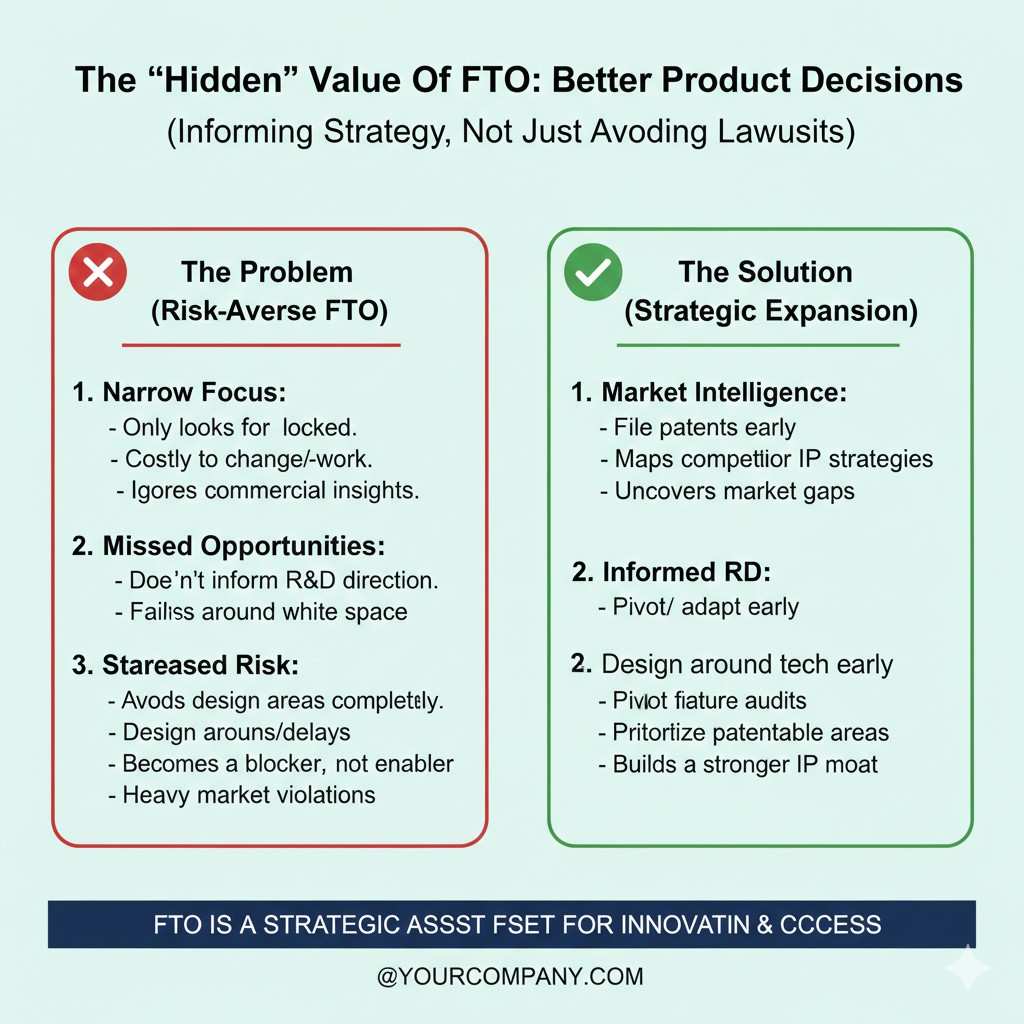
Teams often discover something surprising during an FTO review.
They find that the simplest approach is crowded with patents, but an alternative approach is cleaner and also performs better for their use case.
Or they find that a popular method is owned by a big company, which means if they build around it, they may be forced into a license later. That changes how they prioritize R&D.
Or they find that a competitor has patents that look broad, but the actual claim language is narrow, which means they can move forward with more confidence.
In all cases, FTO helps you choose the right battles.
A quick warning: your own patent filing does not equal FTO
This is a common confusion.
If you file a patent on your invention, that does not mean you are free to operate. It means you may have the right to stop others from using what you claimed, if the patent grants. But you can still infringe someone else’s earlier patent if your product includes their claimed invention.
Think of it like owning a lock design patent does not mean you have the right to enter every house. It just means you own that lock design.
This is why strong strategy often includes both:
- building your own patent wall (so you have leverage and assets)
- checking FTO risk (so you do not get blocked)
Tran.vc focuses on helping founders build that wall early, as real assets, not vanity filings. If you want that support, apply here: https://www.tran.vc/apply-now-form/
Freedom to Operate: When You Need It
Introduction
A fast truth before you build too far
If you are building a real AI or robotics product, you are stepping into a world full of patents. That does not mean danger is everywhere, but it does mean you should not guess. A Freedom to Operate check, also called FTO, is how you reduce the risk of getting blocked after you have already built the hard parts.
Tran.vc helps technical founders do this early, in a way that stays practical and focused. If you want support from people who do patent work for deep tech startups every day, you can apply here: https://www.tran.vc/apply-now-form/
What this article will help you do
This article will help you spot the exact moments when FTO becomes important. It will also show you how to approach it without turning it into a slow, costly project. The goal is to keep you moving fast, while keeping your product path clear.
What Freedom to Operate really means
The plain meaning of FTO
Freedom to Operate is a business question, not a theory question. It asks if you can make, use, sell, or ship your product without violating active patents owned by someone else in the places where you will do business.
It is not the same as asking if your idea is new. It is also not the same as asking if you can file your own patent. FTO is about other people’s rights, not yours.
Why “yes or no” is the wrong way to think about it
FTO is rarely a clean yes or no. It is more like a risk picture that changes as your product changes. You are trying to understand where you might be exposed, how serious that exposure is, and what you can do about it before it becomes expensive.
A good FTO view helps you make decisions with your eyes open. It shows what to adjust, what to avoid, and what is safe enough to ship.
Why AI and robotics teams feel this more
AI and robotics products are built in layers. A single product can include sensors, firmware, control logic, data pipelines, model training, safety systems, and update methods. Patents can exist around any of these layers.
That is why teams often get surprised. They think they are only “doing software” or only “doing hardware,” but patents do not care about your org chart. They care about what the product does.