
Engineers are the heartbeat of every deep tech startup. They build the thing. They fix what breaks. They make the product faster, safer, smarter, and cheaper. Yet when it comes to patents, many teams keep engineers at arm’s length.
That is a mistake.
Not because engineers should become lawyers. They should not. But because patents are only as good as the real invention details inside them. And the people who know those details best are the engineers who designed the system, wrote the code, trained the model, tuned the sensor stack, or built the robot that finally worked at 2:00 a.m.
If you want strong patents, you need engineers in the process in a way that feels natural, light, and worth their time. Not a slow “paperwork tax.” Not a random meeting that ruins their sprint. Not a last-minute fire drill when a demo is coming up. A clear rhythm that matches how engineers already work.
That is what this guide will show you.
And if you want hands-on help building an IP plan and filing patents without burning your team out, Tran.vc invests up to $50,000 in in-kind patent and IP services for robotics, AI, and deep tech founders. You can apply any time here: https://www.tran.vc/apply-now-form/
The real reason engineers avoid patents
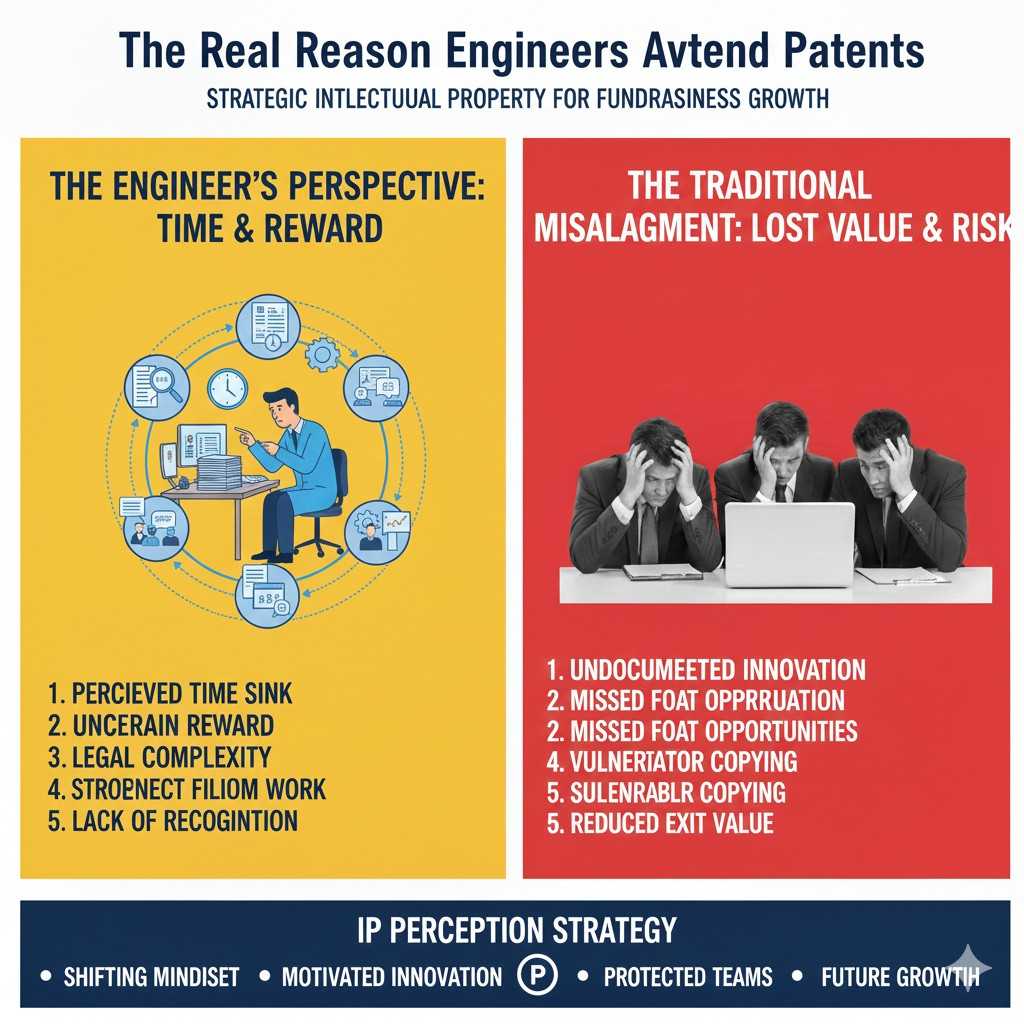
Most engineers do not hate patents. They hate bad patent process.
A lot of teams run patents like a surprise audit. Someone says, “We should patent this,” and then engineers get pulled into a meeting with no context. They are asked to explain a complex system in 30 minutes. People interrupt. Notes are messy. Then weeks later a draft shows up full of errors, weird terms, and missing parts. The engineer thinks, “This is not my job,” and checks out.
That cycle teaches engineers one thing: “Patents waste time.”
So your first job is not “get engineers to care.” Your first job is to remove the pain.
Patenting should feel like a smart extension of engineering work. Like writing a clean design doc. Like doing a short postmortem. Like documenting an API. The same habits, just aimed at protecting the invention.
When you build that bridge, engineers usually lean in. Because deep down, many engineers like the idea of building something no one can copy. They just do not want to drown in process.
What “involving engineers” really means
It does not mean engineers write patent claims. It does not mean they spend days formatting diagrams. And it does not mean they attend every call.
It means four simple things:
Engineers help spot what is truly new.
Engineers explain how it works in real terms.
Engineers sanity-check the draft so it matches reality.
Engineers keep a light record of invention steps so nothing gets lost.
That is it.
When those four things happen, your patents become sharper, broader, and harder to design around. And they get filed faster, because the attorney is not guessing.
Start by changing the story you tell engineers
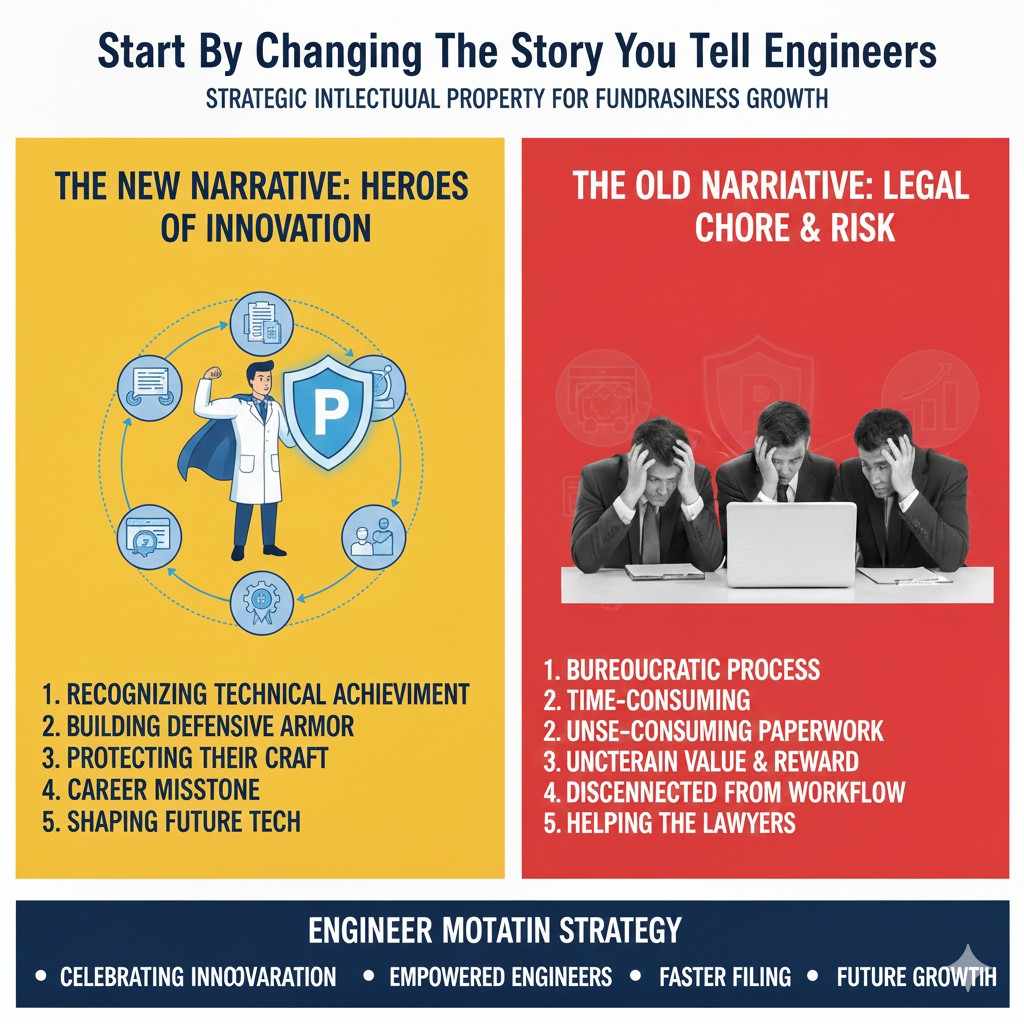
If you want engineers involved, you have to sell it the right way. Not with hype. With simple truth.
Tell them patents do three practical jobs:
First, a patent can stop a bigger company from copying your exact approach. You may never sue. But the patent can make others think twice, and it gives you leverage if talks get serious.
Second, patents can protect your fundraising story. Investors want to know you have a moat. A good patent plan shows you are not building a “feature,” you are building an asset.
Third, patents help hiring and pride. Engineers like to point to something they built that is recognized. A granted patent is a clean signal that the work mattered.
But do not pretend patents are magic. Engineers see through that. Be honest: patents are tools. Strong tools when used well. Weak tools when done rushed.
Then connect it to their world. If you say, “Patents help valuation,” it feels far away. If you say, “Patents help us keep our edge when others ship copycats,” it lands.
The biggest mindset shift: treat patents like engineering output
A patent is not “legal paperwork.” It is a technical spec written for protection.
That framing changes everything.
When you treat a patent like engineering output, the questions become practical:
What problem does this solve?
What is the system?
What are the key parts?
What is the flow?
What are the alternatives?
What are the limits?
That is how engineers already think. You are just turning that thinking into a document that can stand up later.
So the best way to involve engineers is to meet them on their ground: system diagrams, data flows, failure modes, trade-offs, constraints, edge cases.
Those are patent gold.
Pick the right inventions, or engineers will lose trust fast
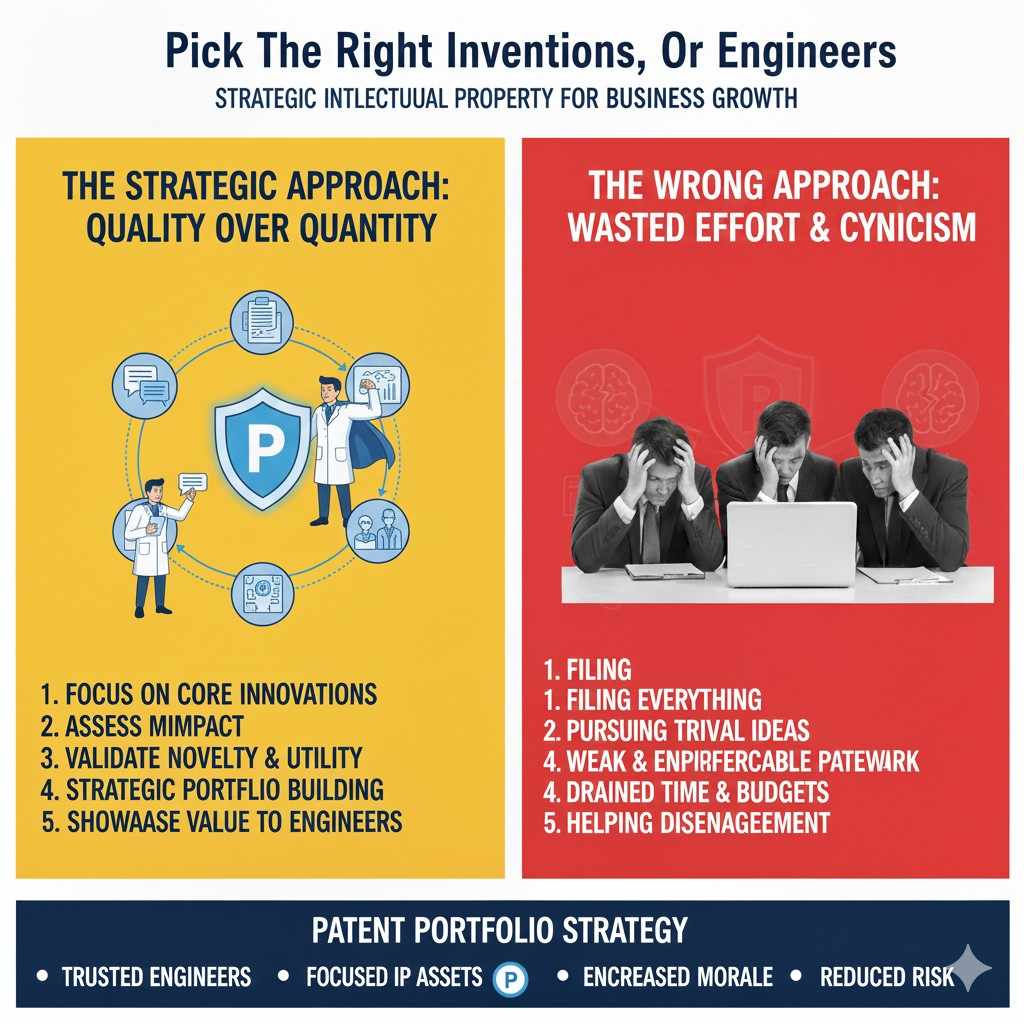
Nothing kills buy-in like filing patents on weak ideas.
Engineers know what is truly hard. They know what is routine. If you push them to patent something obvious, they will feel the process is performative.
So before you invite engineers in, set a high bar. You want to aim patents at the parts of your stack that are both:
Hard to build, and
Hard to copy without your insight
In robotics, that is often the messy intersection points: perception plus control, sensing plus planning, calibration plus inference, safety plus speed, hardware plus model.
In AI, that can be: training methods, data pipelines, model adaptation, system-level design, latency tricks, privacy methods, evaluation systems, agent workflows, or model-based decision logic.
A good invention is usually not “we used a transformer.” It is “we built a method that makes the transformer work under these constraints in this setting, with this result.”
When you choose strong targets, engineers feel respected. They begin to see the patent process as protection for the hard parts they sweat over.
Create one clear owner: the “IP lead” who speaks engineering
One reason patent efforts fail is no one owns the workflow. Attorneys are outside. Founders are busy. Engineers are focused on shipping. So patents become a “someday” project.
You need a single person to own the internal side. This can be a technical founder, a staff engineer, or a product-minded engineer. The role is simple: keep the rhythm, collect invention notes, and be the bridge to the patent attorney.
This person does not need legal skill. They need good judgment and good communication.
If you do this right, engineers do not feel like they are “doing patent work.” They feel like they are helping a teammate capture what they built.
That is a big difference.
Make the process tiny: the 30-minute invention capture
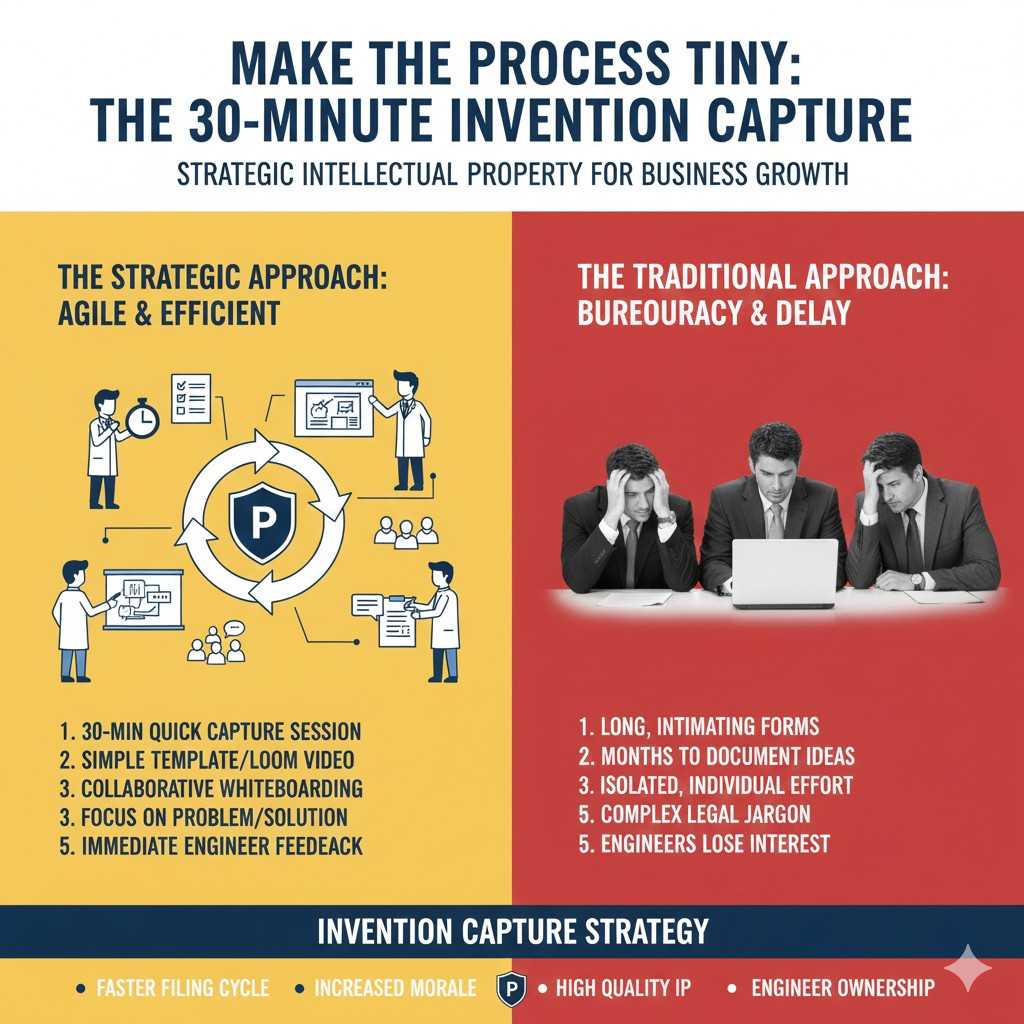
Here is the best way to involve engineers without dragging them down.
When an invention is ready, schedule one short capture session. Keep it small. The engineer who built it, the IP lead, and the attorney or patent strategist.
Do not invite ten people. That turns it into theater. You want signal, not noise.
Before the call, send the engineer one simple note: “Please bring a diagram or quick doc of how it works. No need to polish.”
On the call, you are not debating business strategy. You are extracting details.
A good capture session feels like a design review. The attorney asks questions like:
What is the input and output?
What problem did you have before?
What did you try first that failed?
What made the final version work?
What parts are required, and what parts can change?
Where are the boundaries?
What would a competitor do to copy this?
Engineers are great at answering these when the questions are concrete.
The IP lead should take clean notes, or record and summarize after. The engineer should not be asked to write a long summary the next day. If you put homework on engineers, participation drops.
The “two diagrams” rule that saves hours
If you want engineers involved, make it visual. Ask for two diagrams only:
A system diagram that shows parts and connections.
A flow diagram that shows steps over time.
That is enough for most patents to become strong. Those diagrams do not need to be pretty. A whiteboard photo works. A rough sketch in FigJam works. Even a screenshot from an internal doc can work.
Those pictures help the attorney write faster and with fewer mistakes. They also help claim scope because you can describe multiple paths and variations.
Engineers like diagrams. It feels like real work, not paperwork.
Use engineer-friendly language in the patent draft
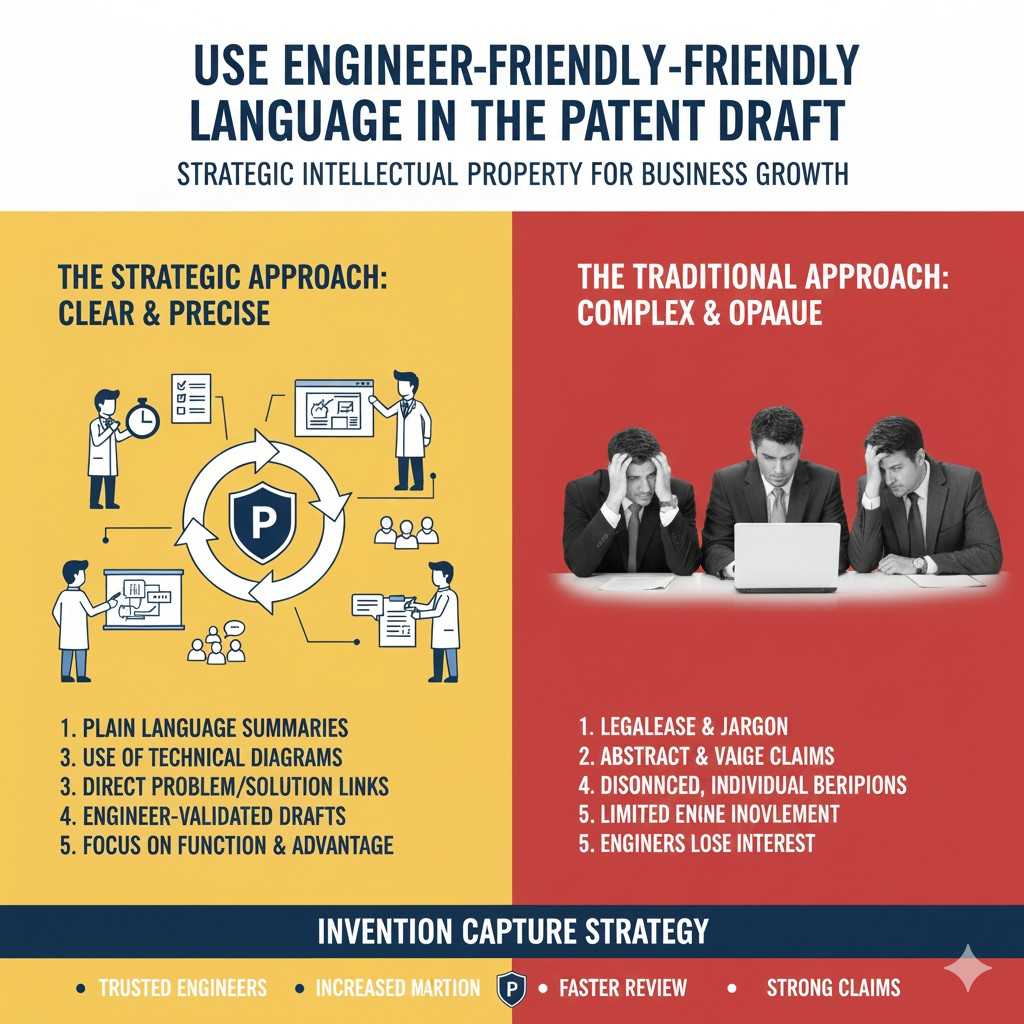
Engineers disengage when they see a draft full of strange phrasing.
The truth is, patent writing has its own style. Some of it is required. But a lot of confusion comes from drafts that drift away from the real tech.
You can fix this by setting a rule: the first version of the description should use plain engineering words. Then the attorney can translate into patent-safe form without losing meaning.
If your system has “planner,” “controller,” “state estimator,” “policy,” “feature store,” “embedding,” “latency budget,” or “safety layer,” use those words first. You can add more general terms later. But you do not want the core model to get diluted into “a module configured to…” everywhere. That style has a place, but not at the cost of clarity.
When engineers see their work described correctly, they trust the process. When they see sloppy descriptions, they stop caring.
Give engineers a fast, respectful review pass
Engineer review should not feel like editing a book.
Make it short and clear. Ask them to check only these things:
Is the system described correctly?
Are any key steps missing?
Are any steps stated in the wrong order?
Are there any wrong assumptions?
Are there any important variants we should include?
That is a technical review, not a legal review.
Give them a tight window, like two business days, and tell them it is okay to leave comments only on parts that matter. Do not ask them to rewrite sections. Do not ask them to wordsmith. That is not the best use of their time.
If they only fix the “big errors,” you will still get a huge quality jump.
Align patent timing with engineering timing
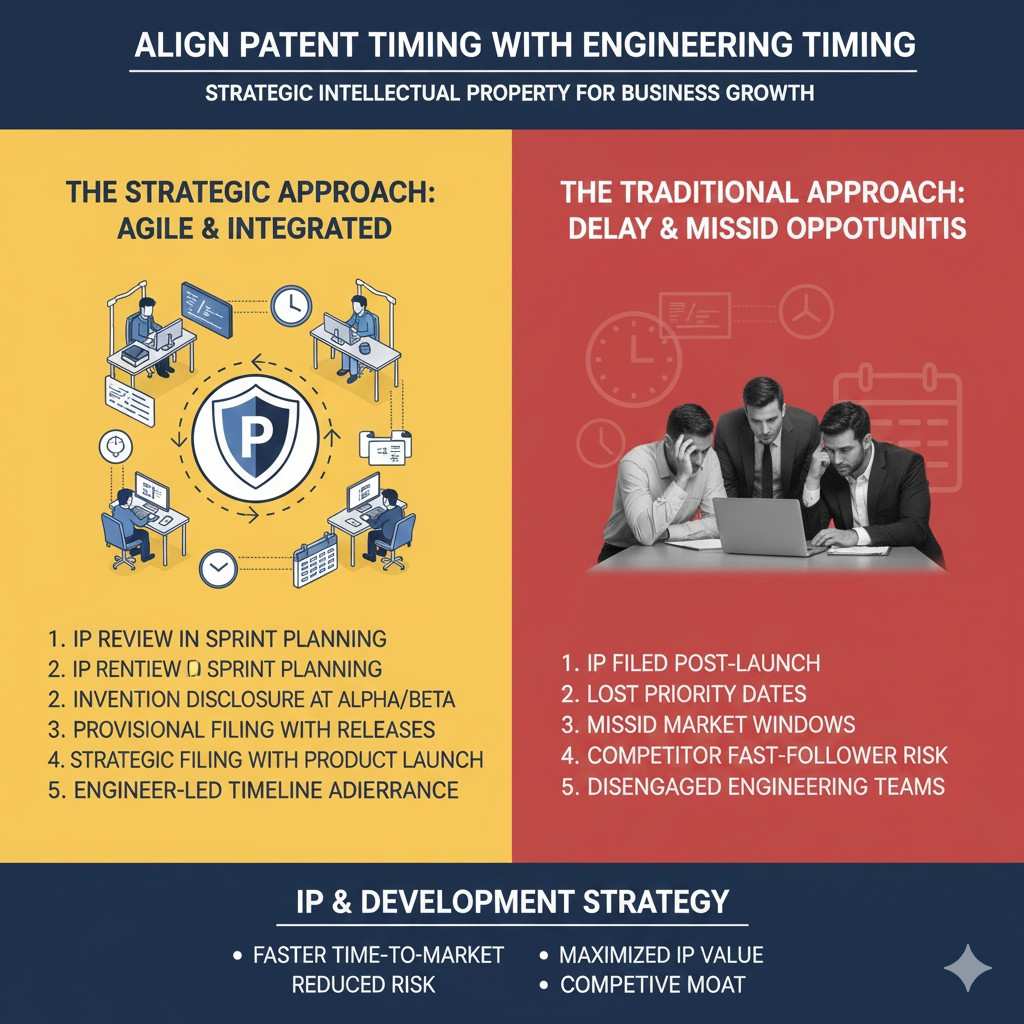
The best time to capture an invention is not when it is half-baked, and not when it is already old news.
A sweet spot is right after you get a result that proves the approach works. Not a dream. A real test. A benchmark. A field run. A stable demo. A real metric improvement.
That is when details are fresh, and the team can explain why it works.
If you wait six months, engineers forget the journey. The “why” fades. The early failed attempts get lost. Those failures matter, because they help you describe the problem space and show why your approach is not obvious.
How to Involve Engineers in the Patent Process
Why engineers matter in patents
Engineers are the ones who know what is truly new. They understand the real trade-offs, the edge cases, and the “this finally worked” moment that turned an idea into something real. A patent is only strong when it captures those details in a clear way. If engineers are not involved, the patent often becomes vague, narrow, or simply wrong.
Many teams think patents are a “legal task” that happens after product work. In reality, patents are a way to protect engineering work while it is still fresh. When engineers help shape the invention story, the patent reflects the real system, not a guessed version of it. That makes it harder for others to copy your approach.
The hidden cost of leaving engineers out
When patents are written without deep input, drafts come back with missing steps and wrong terms. That leads to long review cycles and frustration on all sides. Engineers feel like they are being asked to fix someone else’s work, and the patent attorney has to re-learn the invention over and over.
Even worse, weak patents can create false confidence. The company thinks it is protected, but the document is too thin to matter. That is a painful surprise later, often during fundraising, a partnership deal, or a competitive moment. Involving engineers early is a simple way to avoid that.
A simple promise you can make to your team
If you want engineers to take patents seriously, make one promise and keep it. Tell them you will protect their time, keep the process short, and only ask for their help where their technical input is truly needed. This builds trust fast.
When engineers feel respected, they tend to show up with more care. They may even start flagging ideas on their own, because they see the process as a way to protect the hard work they are already doing. That is the goal: low friction, high value.
Why engineers avoid the patent process
It often feels like a surprise meeting
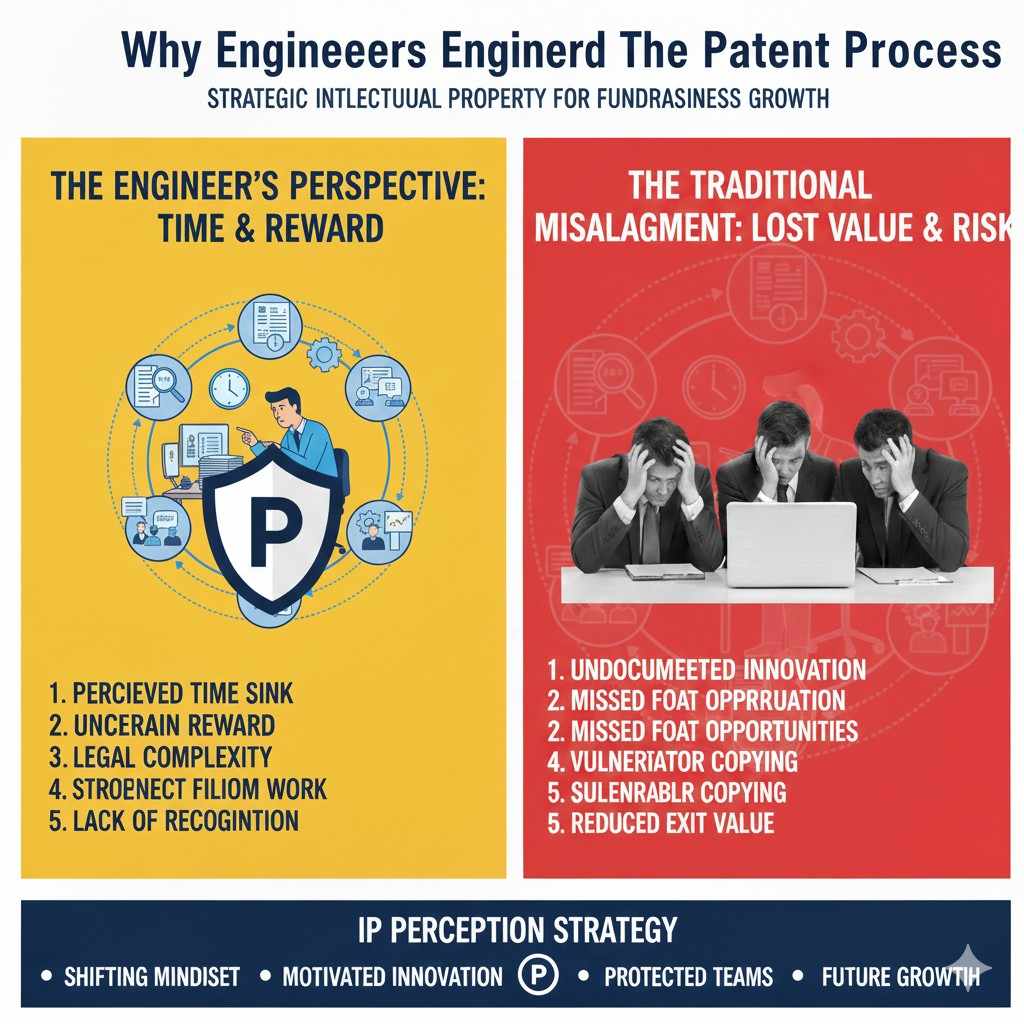
Most engineers are not against patents. They are against chaos. In many startups, patents appear out of nowhere. A founder says, “We should patent this,” and suddenly an engineer is in a call with little context and no prep.
The engineer is asked to explain a complex system quickly, often while juggling deadlines. The questions can feel broad, and the notes can feel messy. When the meeting ends, the engineer goes back to work and hopes it never happens again. That is not resistance to IP. That is resistance to a bad workflow.
Drafts can look nothing like the real tech
A common failure point is the first draft. Engineers open it and see wrong labels, missing steps, or a description that ignores key constraints. They do not feel seen. They feel like the work is being reshaped into something that does not match reality.
When that happens, engineers either disengage or they get pulled into heavy rewrite work. Both are bad. The fix is not “tell engineers to care more.” The fix is to make sure the invention capture is clear and the translation into patent language stays anchored to engineering truth.
Patents get framed as “paperwork,” not protection
If patents are introduced as a funding checkbox, engineers will treat them as noise. But if you frame patents as protection for the hardest parts of the system, the meaning changes. Engineers understand defensibility. They understand what is easy to copy and what is not.
When the team links patents to real competitive risk, it becomes practical. It is not about ego. It is about not losing a hard-earned edge. The language you use here matters more than most founders realize.
What it really means to involve engineers
Engineers should not do legal work
Involving engineers does not mean turning them into patent writers. They should not be asked to draft claims, debate legal terms, or learn formal rules. That is not their strength and it is not a good use of their time.
Instead, engineers should supply the technical backbone that makes a patent accurate and strong. They bring clarity on system design, data flow, failure cases, and the “why” behind decisions. That information is what makes patents real, and it is what lawyers cannot guess.
Four engineer inputs that make patents stronger
Engineers are most valuable at four points. They help spot what is truly new, because they know what was hard and what was routine. They explain how it works in plain terms, so the attorney can capture the invention with fidelity.
They also sanity-check drafts, because even small technical errors can weaken a patent. Finally, they help keep light records of invention steps so key insights are not lost. With those four inputs, engineers contribute without becoming buried in process.
A healthy division of labor
A smooth patent workflow looks like this. Engineers explain the system and confirm accuracy. The IP lead organizes inputs and keeps momentum. The attorney converts the invention into a patent that is broad, precise, and defensible.
When each role stays in its lane, the patent quality rises and the time cost stays low. Engineers stay focused on building, while still protecting what they build. That balance is the core of a scalable IP program.
Start by changing the story you tell engineers
Focus on what engineers already care about
Engineers care about solving hard problems and shipping real results. If patents are described as business theater, engineers will tune out. But if patents are described as a way to protect the hard-won solution, engineers lean in.
You do not need hype to do this. You just need honesty. Explain that patents are tools that can reduce copy risk, help fundraising, and create leverage in serious conversations. Engineers respect straightforward reasons.
Make the benefits concrete, not abstract
Saying “patents increase valuation” feels distant. Saying “patents help us stop copycats when we start winning deals” feels real. Engineers live in cause and effect. They want to know what changes in the world when a patent exists.
Tie patents to moments that matter: fundraising diligence, partner negotiations, customer trust, and competitive pressure. When engineers can picture the use case, they understand why the work matters. That understanding is what turns participation into habit.
Set the right expectations early
Be clear that a patent does not guarantee victory. It is not a shield against every competitor. But it can create a strong position and give you options. Engineers respect balanced truth more than sales talk.
Then add one more message: patents work best when captured early and captured correctly. Engineers do not need to “care about IP” as a topic. They simply need to contribute the information that makes protection possible.
Treat patents like engineering output, not admin work
A patent is a technical spec for protection
The easiest way to align engineers with patents is to treat patents like a technical document. Not a legal form. A technical spec that describes a system and a method, written so it stands up under scrutiny.
When you frame it this way, the questions become familiar. What problem are we solving? What is the system? How does data move? What constraints matter? What variations still work? These are engineering questions, and engineers already think this way.
Use the same habits engineers already have
Engineering teams already write design docs, run reviews, and keep notes on why decisions were made. A patent process can borrow that rhythm without adding heavy work. The key is to keep it light and focused.
Instead of asking engineers to produce a “patent document,” ask them for the same artifacts they already create. A diagram. A short explanation. A quick walkthrough. This feels normal and keeps quality high.
Protect time by keeping the process tight
Engineers will support patents if you protect their flow state. That means fewer meetings, fewer surprise tasks, and fewer long review cycles. It also means the patent work should not expand into a large side project.
The way to do this is to narrow what you ask for. Ask for the core details once, capture them well, and then bring engineers back only for quick accuracy checks. This reduces friction and raises trust.
Choose inventions carefully or you will lose engineer trust
Strong patents start with strong targets
Not every feature deserves a patent. Engineers know what is truly novel and what is a standard approach. If you push them to patent obvious work, they will see the process as a checkbox exercise.
The better approach is to focus on the parts that are both hard to build and hard to copy. This is often where constraints collide. In robotics, it might be the point where perception and control meet in a unique way. In AI, it might be a method that makes a model work under strict latency, privacy, or data limits.
Look for “why it works,” not “what it is”
Weak inventions sound like, “We used a model.” Strong inventions sound like, “We used this method that makes the model succeed under these limits, with this result.” Engineers can help you find that story, because they lived it.
When you ask engineers what changed from “not working” to “working,” you often find the real invention. That shift might be a training trick, a calibration step, a safety check, or a system-level decision that others would not guess. That is the heart of many strong patents.
Avoid patenting too early or too late
If you capture too early, the idea may not be stable and you may miss the best version. If you capture too late, the details get fuzzy and the team forgets the failed attempts that shaped the final solution.
A good time is right after you have a proven result. A benchmark, a field test, a stable demo, or a clear metric jump. At that point, engineers can explain the “why” clearly, and you can capture variations while the thinking is fresh.
Set one internal owner who speaks engineering
Why patents fail without ownership
Many startups want patents, but no one owns the internal workflow. Attorneys are external and will not run your internal process. Founders are overloaded. Engineers are focused on shipping. So patents drift and die.
A single owner changes that. This person creates the rhythm, chooses the right capture moments, and makes the process simple for engineers. The owner does not need to be a lawyer. They need to be organized and technical enough to understand the work.
What a good IP lead actually does
The IP lead gathers invention signals from the team without adding noise. They keep a short pipeline of ideas, schedule capture sessions, and collect diagrams and notes. They also keep a clean summary so the attorney does not have to re-discover the invention.
The IP lead is also the “translator” inside the company. They can explain to engineers what is needed, and explain to business leaders what the patent covers. This reduces confusion and keeps everyone aligned.
How to keep the role lightweight
This role should not become a full-time job in an early startup. It should be a small part of someone’s week, run with a simple routine. The routine might be a short check-in with engineering leads, plus a quick follow-up when an invention is ready.
If the role grows too heavy, the process will feel heavy. The aim is always the same: capture inventions with minimal drag, while keeping quality high.
Run a short invention capture that feels like a design review
Keep it small and focused
When an invention is ready, schedule a short capture session. Keep the group small: the key engineer, the IP lead, and the attorney or strategist. Too many people turns it into a performance. You want clarity, not a crowd.
The goal of the session is not to debate business strategy. It is to extract the technical truth, including variations and edge cases. When the session is focused, engineers stay engaged and the attorney leaves with what they need.
Prep the engineer with one simple request
Do not ask for a long write-up. Ask for a diagram or a short internal doc they already have. Tell them it does not need to look pretty. This reduces friction and raises participation.
Engineers usually have something: a design doc, a slide, a whiteboard photo, a repo note, or a quick architecture sketch. That is enough to guide the discussion and prevent misunderstandings.
Ask questions that unlock the real invention
The best capture questions are concrete. What is the input and output? What was the problem before? What approaches failed first? What made the final version succeed? What parts are required, and what parts can change?
These questions feel like engineering thinking, so engineers answer well. They also reveal the difference between the obvious path and the path you discovered. That difference is often where patent strength comes from.
Use the “two diagrams” rule to save time and raise quality
Diagram one: the system view
Ask for a system diagram that shows the major parts and how they connect. In robotics, this could show sensors, perception, planning, control, and safety layers. In AI, it could show data sources, training pipeline, inference services, and monitoring loops.
This diagram keeps the patent grounded. It helps the attorney describe the invention in a way that includes the full system, not only one narrow step. It also helps identify alternative placements of logic that still achieve the same outcome.
Diagram two: the flow over time
Ask for a flow diagram that shows the steps in order. It can be rough. The purpose is to capture sequence, decision points, and feedback loops. Many strong patents live in these flows.
Engineers often forget that small sequence choices matter. A method that checks safety before applying an action, or a method that adapts a model after a trigger, can be the difference between a generic approach and your unique one. A simple flow diagram brings that out.
Why this works so well in practice
Two diagrams reduce confusion more than five pages of text. They also shorten review time, because engineers can point to a box and say, “This part is wrong,” instead of writing long comments.
This approach respects engineering time and improves accuracy. It also gives the attorney a strong structure for writing the description and building broad coverage around variations.
Make drafts easy for engineers to review
Use engineering words first, then refine
Patent language has its own style, but the draft should still match the real system. If the first version is filled with vague “module” terms, engineers struggle to validate it. Clarity should come before legal polish.
A practical rule is to keep familiar engineering terms in the first pass, and then generalize where needed. This keeps the meaning stable while still allowing broad coverage. Engineers remain confident that the patent reflects reality.
Tell engineers what to check, and what to ignore
Engineers should not be asked to review legal phrasing. They should be asked to review technical truth. Make that explicit so they do not feel pressure to rewrite the draft.
Ask them to check whether key steps are missing, whether the order makes sense, whether the system description matches what was built, and whether important variants should be included. This is a clean, bounded review that engineers can complete quickly.
Keep feedback fast and focused
Give a short window for review and encourage engineers to comment only where it matters. Long review windows lead to delays, and engineers may forget what the invention looked like at the time.
When feedback is focused, the attorney can apply it quickly. This builds a positive loop: engineers see that their input fixes real issues, and they become more willing to participate next time.