
Human-robot interaction is where robotics gets real. It is the moment your robot meets a person and must act in a way that feels safe, clear, and helpful. It might be a robot arm that slows down when a hand gets close. A delivery robot that asks you to confirm a drop-off with a simple gesture. A home robot that knows when to speak, when to stay quiet, and how to move around kids and pets.
These “small” moments are often the part competitors copy first. Not the motor. Not the frame. The interaction.
That is why patents matter so much for HRI features. If you can protect how your robot senses people, decides what to do, and communicates that decision, you can turn your product experience into a real asset. One that investors respect and larger companies cannot easily clone.
In this guide, I will show you how to patent HRI features in a practical way, using plain words. We will focus on what counts as an invention in HRI, how to describe it, how to avoid common traps, and how to build a strong patent plan while you are still early.
If you are building in robotics or AI and you want help turning your HRI work into defensible IP, you can apply anytime here: https://www.tran.vc/apply-now-form/
What HRI Features Can Be Patented?
Understanding What “Counts” as an Invention in HRI
When founders think about patents, they often think about hardware first. They imagine gears, joints, and physical parts. But in human-robot interaction, the most valuable inventions are often in how the robot behaves around people.
An invention in HRI is not just a nice user experience idea. It is a specific technical solution to a real problem between a human and a machine. If your robot solves a safety issue, a timing issue, a confusion issue, or a trust issue in a new technical way, that can be patentable.
For example, if your system uses a mix of vision, distance sensors, and motion prediction to slow a robot arm before contact happens, that is more than design. It is a technical process. If your robot changes its speech tone based on stress signals detected in a user’s voice, that may also be a technical improvement.
The key is this: the patent system protects how something works, not just how it looks or feels. If your HRI feature is backed by algorithms, signal processing, control logic, or sensor fusion, you are likely sitting on real intellectual property.
This is where many robotics founders miss value. They build smart behavior, but they never stop to ask, “Is this protectable?” By the time they realize it is, someone else may already be filing.
If you want help spotting these opportunities early, Tran.vc works with robotics and AI teams to turn these hidden features into patent assets. You can apply here: https://www.tran.vc/apply-now-form/
The Difference Between a Product Feature and a Patentable Feature
Not every feature can be patented. A feature like “robot greets the user by name” is likely too broad and obvious. But the method the robot uses to recognize the user, confirm identity, and trigger the greeting in a secure way might be novel.
A product feature is what the user sees. A patentable feature is the technical engine behind it.
Let’s say you built a warehouse robot that projects a light path on the floor to show workers where it will move next. The visible part is the projection. But the real invention may be how the system calculates that path in real time based on human movement and dynamically updates the projection to reduce collisions.
That internal logic, that control loop, that prediction model, is where patents live.
As a founder, you need to train yourself to look under the surface. Ask yourself how the system makes decisions. Ask what data it uses. Ask how it blends that data. Ask how it reduces risk, improves speed, or increases trust.
If the answer includes a new method, a new architecture, or a new combination of steps, you may have something strong.
Common Types of HRI Innovations That Are Often Patentable
Human-robot interaction spans many layers. Physical safety systems are one area. If your robot detects human presence and changes force, speed, or path in a new way, that is often patentable.
Another area is perception. If your system combines camera input, lidar, audio, and touch signals to better understand human intent, and you have designed a new processing flow, that can be protected.
Communication methods are also powerful. This includes how a robot signals its internal state to humans. It might use lights, sounds, gestures, or screens. If you have created a new system that selects and times these signals based on context, that is more than user interface. It is technical coordination.
Intent prediction is another rich area. If your robot predicts what a human will do next and adapts before the action happens, the prediction model and control method may be novel.
Emotional response systems can also qualify. If you are using measurable inputs, such as voice stress patterns or facial cues, and translating them into adaptive robot behavior using a defined process, that is technical. It is not just “empathy.” It is a structured system.
The deeper your system ties sensing, decision-making, and physical response together, the stronger your patent position can be.
Why HRI Patents Are Strategic, Not Just Legal
Many founders see patents as legal paperwork. That mindset is costly.
In robotics, especially in HRI, patents shape your power in the market. They protect not just parts, but the experience layer. That experience is what customers remember and what buyers compare.
If your robot feels safer, clearer, or easier to work with, that is often due to your HRI system. If that system is protected, competitors cannot simply copy your behavior flow.
Investors also look at this closely. When they evaluate robotics startups, they ask one key question: what stops a larger company from rebuilding this in six months? If your answer is only speed or branding, that is weak. If your answer includes filed patents covering core interaction methods, that changes the conversation.
At Tran.vc, we help founders build these moats early. Instead of waiting for revenue to justify patents, we build protection around your technical core from day one. We invest up to $50,000 in in-kind patent and IP services so you can move fast without giving up control.
If you are building robotics or AI and want to protect your HRI edge before raising a large round, apply here: https://www.tran.vc/apply-now-form/
How to Spot “Patentable Moments” in Your HRI Design
Looking at Problems, Not Features
The easiest way to miss patentable ideas is to focus only on features. Instead, focus on problems.
Think about every moment where your robot had to solve a hard interaction issue. Maybe early tests showed that users were confused about when the robot would move. Maybe people stepped too close, creating safety risks. Maybe voice commands failed in noisy settings.
If you solved one of these problems in a new way, that solution is a strong candidate for a patent.
Write down the problem in simple words. Then write how others normally solve it. After that, describe how your system solves it differently. That gap between “normal” and “your way” is often the heart of the invention.
Patents are not about fancy language. They are about clear problem-solution stories supported by technical detail.
Reviewing Your System Architecture
Another strong method is to review your system architecture diagram.
Look at how data flows from sensors to processors to control systems. Ask where you made unique design choices. Did you create a new feedback loop between a camera module and a motion planner? Did you reduce latency by moving certain computations to the edge?
These design choices are rarely visible to users. But they are deeply technical. And they are often patentable.
Founders sometimes think, “This is just how we built it.” But your way of building it may not be obvious to others.
Sit down with your engineering team and walk through the system slowly. Ask them where they struggled the most. Ask what took the longest to get right. Those pain points often hide valuable inventions.
Studying User Testing Insights
User testing is not just for product improvement. It is also a gold mine for IP.
When users misunderstand the robot, you adjust the interaction. When they feel unsafe, you tune behavior. When they hesitate, you refine communication.
Each of these adjustments may involve new logic, new thresholds, new data processing steps. If those changes create a measurable improvement, they may support a patent.
Keep records of these changes. Document why you made them and how you implemented them. This history helps patent attorneys draft strong applications later.
At Tran.vc, we often sit with founders and go through past design decisions to extract hidden patent value. Many teams are surprised by how much protectable material they already have.
If you want that level of strategic support, you can apply anytime at: https://www.tran.vc/apply-now-form/
Avoiding the “It’s Just Software” Trap
Many AI and robotics founders assume their work cannot be patented because it is software-driven. That assumption is often wrong.
In many regions, software that produces a real technical effect, such as improved safety, reduced latency, better motion control, or more reliable human detection, can be patented.
The key is framing. You do not patent abstract ideas. You patent specific technical implementations.
If your HRI feature improves how a robot moves in a shared human space, and you can describe the data inputs, processing steps, and control outputs, you likely have a strong case.
The mistake is waiting too long. If you publish papers, release demos, or present at conferences before filing, you may limit your protection options.
Smart founders align their product roadmap with their IP roadmap. They decide what to file before going public.
This is part of building with intention, not rushing for attention.
What to Patent in Safety
Start with the safety promise you make
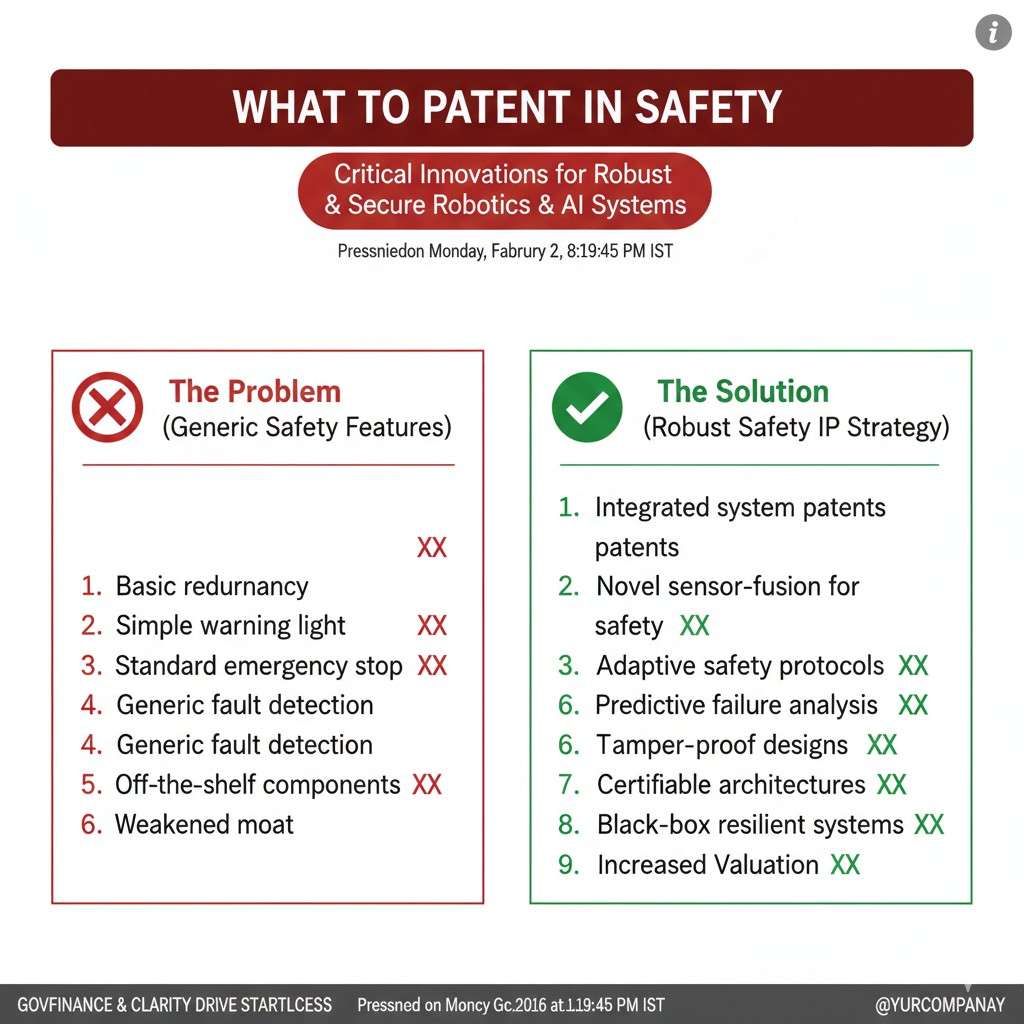
Every autonomous product makes an unspoken promise. “We will not hit people.” “We will not enter a restricted area.” “We will not drop a payload.” That promise shapes what customers trust, what regulators look for, and what buyers pay for.
Your patent work should begin by writing that promise in plain words. Then you map it to the exact logic that keeps the promise true. The invention is usually not the promise itself. The invention is the method your system uses to keep it, even when sensors drift, maps are old, or the environment changes fast.
Patenting safety thresholds that adapt
A fixed threshold is easy to copy. A threshold that adapts is much harder. If your system changes its safe distance, speed limit, or stopping rules based on context, that is often a strong place to protect.
Context can be simple and still valuable. It can be payload weight, floor type, lighting, weather, battery health, tire wear, or the number of moving objects nearby. The core is that your system does not treat every moment the same. It senses “how risky this moment is” and then shifts its limits.
A strong patent story here describes the input signals, how they are combined into a risk score or class, and how that result changes the envelope. It also explains how the envelope change leads to a safer output, such as reduced speed, increased buffer, or restricted actions.
Patenting sensor disagreement handling
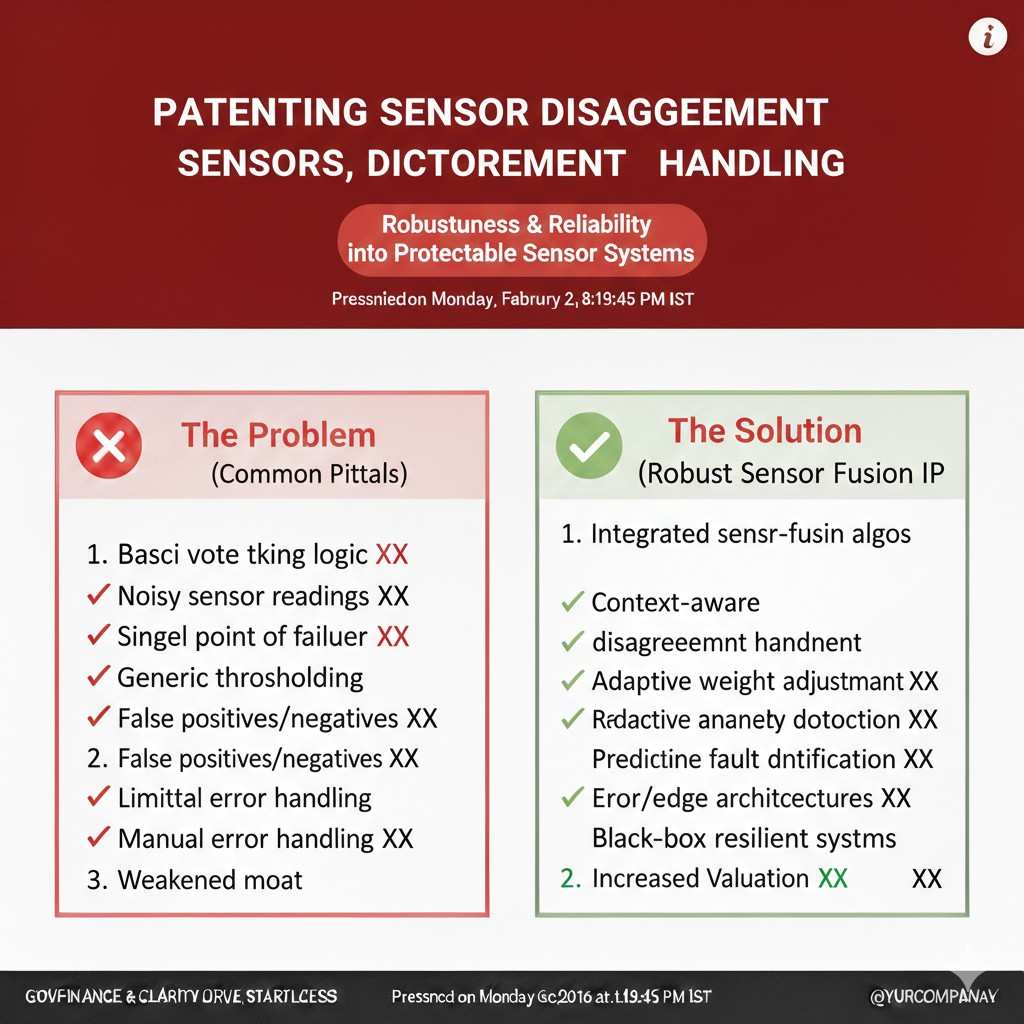
Sensors disagree all the time. Cameras get glare. Lidar gets noise. Radar sees ghosts. Encoders slip. A common weak design is to average everything and hope it works out. Strong designs detect disagreement and respond in a structured way.
If you have logic that measures disagreement and uses it to change behavior, capture it. This can look like comparing object tracks across sensors, measuring timing drift, or checking whether a detected obstacle fits the map. When disagreement passes a limit, your system may lower speed, widen buffers, or switch the planning method.
In patent terms, the novelty is often not “detect disagreement.” It is what you do next, and how you do it without shutting down the product. A well-drafted claim can cover the monitor, the disagreement metric, the mode switch, and the safety action that follows.
Patenting fallback behaviors that still complete work
Many teams think “safe” means “stop.” But stopping is not always safe, and it is often not acceptable. A robot that freezes in a doorway blocks people. A drone that stops midair is not an option. A car that stops in a lane can cause a crash.
If your fallback behavior is more thoughtful than “stop,” that is valuable IP. Examples include moving to a safe pull-over zone, switching to a slow crawl while seeking better perception, rerouting to a known-clear corridor, or asking for human help only after reaching a safe state.
The best way to write this is as a sequence. First, detect the safety fault. Next, choose a safe fallback mode. Then, execute a limited plan that moves the system to a safer condition. Finally, decide whether to resume autonomy or keep the limited mode. That story has clear steps, which is what patents love.
Patenting safety checks that run outside the main stack
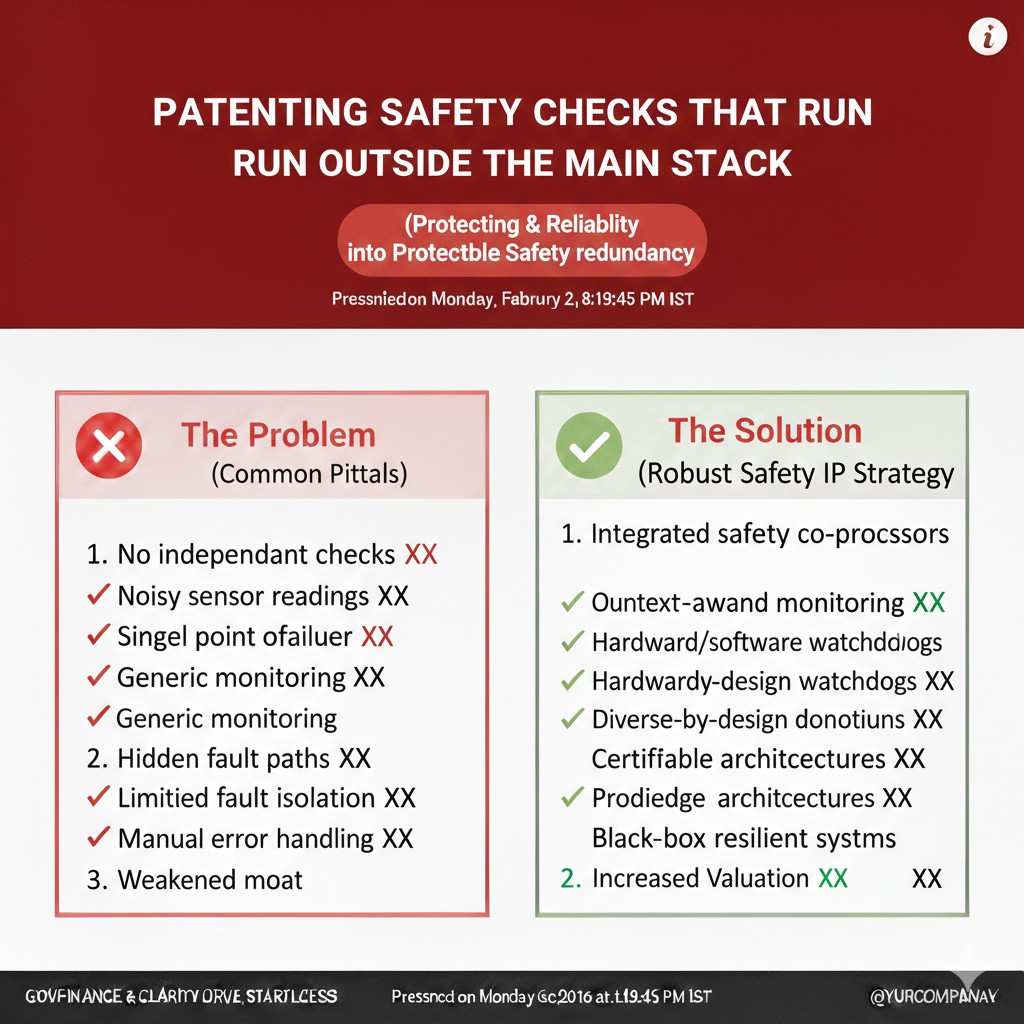
If your safety checks are independent from the main controller, you may have a strong structural feature. A separate process, separate hardware, or a separate simplified model can watch the main stack and stop unsafe actions before they happen.
This is useful because it reduces single points of failure. It also reads well to patent examiners and later to investors. It is a concrete system design, not a wish.
To make it patent-ready, document how the monitor receives data, what it evaluates, how often it runs, and what it can override. Also document what happens when it overrides. Does it issue a safe stop, a reduced speed command, or a switch to a safe policy? Those details matter.
What to Patent in Planning
Patenting planning constraints that match your real world
Planning becomes unique when it meets reality. The “real world” for your product includes your environment, your payloads, your users, your speed goals, and your failure costs. That is why generic planning papers often do not match deployed systems.
If you have constraints that are specific and important, those can be patentable. In a warehouse, constraints may include aisle rules, right-of-way rules, and docking geometry. In a hospital, constraints may include quiet zones, patient areas, and elevator use. In farming, constraints may include row structure, soft soil, and slope.
When you write a patent story, you explain how your planner uses these constraints to shape the plan. You do not need to share every number. You need to share the method and the effect. The effect is that the plan avoids unsafe or costly outcomes while still reaching the goal.
Patenting replanning triggers that prevent jitter
Replanning too much creates a system that cannot be trusted. Replanning too little creates a system that misses changes and becomes unsafe. Many good autonomy stacks solve this with careful triggers and stability rules.
If your system replans only when certain signals cross a threshold, that can be claimed. If you have a “plan confidence” score that must fall before replanning starts, that can be claimed. If you hold a plan stable unless the new plan is better by a margin, that can be claimed.
The tactical tip is to document the stability logic as clearly as you document the planner itself. The stability logic is often the part competitors copy once they see it working in the field. Protecting it can keep your advantage longer.
Patenting prediction-to-planning integration
Many systems predict others, but fewer systems do it well. A strong approach makes prediction useful to planning, not just a side display in a debug tool.
If your planner creates predicted occupancy zones over time and assigns costs to them, that is one pattern. If your planner selects plans that maximize a safety margin across predicted futures, that is another. If you choose a plan that stays robust even when predictions are uncertain, that is also valuable.
A patent story needs to show the flow. First, build predictions from sensor data. Next, represent predictions in a way the planner can use. Then, evaluate candidate plans against those predictions. Finally, select a plan and update it as predictions change. That sequence gives you clear claim structure.
Patenting hierarchical planning interfaces
Hierarchical planning is common: global planning sets direction, local planning handles near-term motion. The interface between them often becomes the “secret sauce.” It can be a corridor, a sequence of waypoints, or a target lane with a desired speed profile.
If you have a special interface that makes local planning safer or faster, protect it. For example, your global plan may include risk labels along the route, and the local planner may use those labels to set limits. Or the local planner may send “feasibility feedback” to the global planner so it can change routes earlier.
These are practical and defensible inventions because they describe how two modules cooperate. That is harder to design around than a single algorithm.
What to Patent in Decision Logic
Patenting the action selection pipeline
Decision logic often looks like a simple output, but inside it is a pipeline. It may include candidate generation, filtering, scoring, and final selection. It may also include safety veto and smoothing to avoid sudden changes.
If your pipeline is unique, that is patent material. The uniqueness can be in how you generate candidates, how you remove unsafe candidates, how you score tradeoffs, or how you choose the final action under time limits. Even small details can matter, such as how you prioritize safety vs speed when uncertainty is high.
The most important thing is to describe the pipeline in steps that could be implemented. Patents favor “do A, then do B, then do C.” Your job is to translate your code structure into that kind of clear method.
Patenting mode switching with clear gates
Mode switching is a common source of bugs. Systems can switch too early, too late, or back and forth. A strong decision logic design uses gates, meaning it does not switch modes unless conditions are met in a stable way.
If you use time windows, hysteresis, repeated confirmation, or multi-signal agreement before switching, document it. If your system refuses to enter a risky mode unless safety monitors are healthy, document it. If your system exits a mode only after the next mode is confirmed safe, document it.
These are not “minor implementation details.” They are the difference between a demo and a deployable product. They are also the kind of details that can support strong patent claims because they are specific and tied to safety outcomes.
Patenting how you handle “unknown unknowns”
Edge cases are not rare in autonomy. They are daily life. The question is how the system responds when it sees something it cannot classify or predict well.
If your system uses a structured “caution behavior,” you may have something worth protecting. That could be a slow probe action, a stand-off distance while gathering more data, or a controlled retreat to a known-safe zone. It could also be a method for asking for help in a way that does not create new risk.
To draft this as IP, focus on triggers and outputs. What signals tell you the system is confused? What actions are allowed in that state? How does the system decide it is safe to resume normal behavior? Those are clear, claimable steps.
How to Document Your Invention Without Slowing the Team
Use “one-page invention notes” tied to real incidents
You do not need a long document to capture patentable work. What you need is a consistent habit. The best method is a one-page note that ties a feature to a real failure or near-failure.
Write what happened in the field or in simulation. Write why the old logic failed. Write what you changed. Then write what improved, even if the improvement is “fewer emergency stops” or “less oscillation at intersections.” This is the material patent attorneys need to draft a strong story.
If you are working with Tran.vc, these notes become the raw fuel for filings. You can apply anytime here: https://www.tran.vc/apply-now-form/