
University tech transfer can feel like a gift: you get access to a lab, an invention, maybe even a professor who wants to help. But the paper you sign can quietly decide whether your startup becomes valuable… or stuck.
This guide is about the contract language that matters most. Not the “legal theory.” The real clauses that decide who owns what, who gets paid, what happens in an acquisition, and whether future investors will run away.
If you want a strong, clean IP base from day one, Tran.vc can help. We invest up to $50,000 in-kind in patent and IP work so your company is built on solid ground—not fragile paperwork. You can apply anytime here: https://www.tran.vc/apply-now-form/
The hidden risk in “standard” tech transfer contracts
Most founders assume the university’s agreement is “standard” and therefore “safe.” Standard only means the university has used it before. It does not mean it works for your business.
Universities are not trying to be unfair. They are trying to avoid risk, follow policy, and protect their mission. Their contracts are written for that goal. Your contract needs to support a different goal: building a company that can ship, raise, and grow.
That is why this topic matters. Investors do not just look at your product. They look at whether you truly control the core invention. If the answer is “sort of,” the deal slows down or dies.
And the hard part is this: the biggest problems are often not in the headline terms like “license fee” or “royalty.” The biggest problems hide in plain sight, inside IP clauses that look harmless.
So, let’s walk through the clauses that most often hurt founders—and how to spot them early, ask for changes, and protect your upside.
1) “What is being licensed” is almost never as clear as it looks

A tech transfer office may tell you: “You’re licensing the patent.” That sounds simple. But the contract might define the licensed property in a narrow way that leaves you exposed.
Here is what happens in real life:
You build a product. You improve the invention. You write code. You collect data. You create a new method that works better than the original lab version. You file new patents. You think, “Great, our moat is growing.”
Then later, the university says: “Those improvements are also ours,” or “Those improvements must be licensed back to us,” or “Those improvements are automatically included in the license, so your new patents do not really help you.”
The key is the definition section. It often includes terms like:
- “Licensed Patents”
- “Licensed Technology”
- “Licensed Know-How”
- “Associated Materials”
- “Improvements”
- “Derivative Works”
- “Related IP”
- “Future patents”
You do not need to become a lawyer to read this. You need to ask one question while reading: Does this definition let the university reach into work we do later?
A clean setup usually does two things:
First, it clearly lists what is included today. That means patent numbers, applications, and named lab materials.
Second, it clearly explains what happens to future work. The best outcome for a startup is that future inventions you create belong to you, not the university—unless they are made using university resources or by university employees within their job scope.
Some universities push for a broad definition that says any “improvement” is included. That sounds okay until you realize “improvement” can mean almost anything. Even a tiny tweak could be called an improvement. Even a new product version could be called an improvement.
A practical way to push back is to narrow the improvement language so it covers only what the university inventors create inside the university after signing, and only if it falls within a tight technical area. Your goal is not to starve the university. Your goal is to avoid a clause that makes your company’s future IP unclear.
If you are a robotics or AI founder, this matters even more. Your product will evolve fast. If the contract lets the university claim rights in the evolution, you will feel it later when you raise a priced round or sell.
If you want help building a clean “what is included” scope—and a safe “what happens next” rule—Tran.vc does this kind of IP structuring work every day. You can apply anytime: https://www.tran.vc/apply-now-form/
2) Options to future IP: the clause that scares investors quietly
Many university agreements contain an “option” clause. It says the university has the right to offer you a license to future inventions that relate to the same research area. This can sound friendly: “We’ll give you first access.”
But options often come with a hidden cost: uncertainty.
An investor wants to know the company owns or controls the core IP. If there is an open-ended option hanging over future related inventions, it can create a question mark. Will the company have to pay more later? Will it be forced to take on extra patents with extra royalties? Will a competitor get access if the company says no?
Options become dangerous when they are:
- too broad in scope (“related to” is a red-flag phrase)
- too long in duration (options that last many years)
- too vague on pricing (university decides “fair market value” later)
- triggered by your work (your improvements cause a new university filing, and now you must negotiate again)
A safer structure is an option that is narrow and time-boxed. For example, an option only on inventions made by the same named inventors, funded by the same grant, within a defined technical field, for a limited time, with a pricing method you can predict.
If the option clause can’t be fixed, the next best move is to make sure it cannot block you. That means the option should not stop you from operating, raising, or selling. It should be a right to negotiate, not a right to control your future.
The founder mindset here is simple: you want fewer “later” negotiations. Early-stage companies die from “later.” Later fees, later approvals, later disputes, later paperwork. Clean deals now keep you fast later.
3) “Sublicense” rules can decide whether you can raise money or get acquired
Even if you never plan to sublicense your IP, your investors and acquirer do.
A sublicense is any grant of rights to someone else. That includes:
- letting a strategic partner use your tech
- letting a manufacturer use your process
- letting a customer embed your model in their product
- letting a big company acquire you (some deals treat acquisition as a sublicense or require consent)
Some university contracts require that every sublicense be approved by the university. That can slow deals. Worse, some contracts give the university a cut of sublicense revenue in a way that effectively taxes your fundraising or acquisition.
Here is the trap: contracts sometimes define “sublicense income” broadly. It might include:
- upfront payments from a partner
- milestone payments
- equity given in a partnership
- even “non-cash consideration,” which can include shares in an acquisition
If the university claims a percentage of “sublicense income,” and then an acquirer buys your company, the university might argue they are owed a percent of the purchase price because the IP license was part of the deal. That is not theoretical. It happens.
A more founder-friendly approach is:
- No university approval for sublicenses, only notice (or approval not unreasonably withheld)
- A clear carve-out that acquisition and financing are not “sublicenses”
- A revenue share that is limited to true IP out-licensing income, not product revenue, not financing, not M&A consideration
- A cap on what the university can receive from sublicensing, or a structure where royalties replace any sublicense share
You want clean language that allows standard startup moves without asking permission.
The hidden risk in “standard” tech transfer contracts
Why “standard” is not the same as “safe”

Most founders assume the university’s agreement is standard, so it must be fine. Standard only means the university has used it before. It does not mean it fits your startup, your market, or your funding plan.
Universities are built to reduce risk and follow policy. Startups are built to move fast and build value. When those two goals collide, the contract language decides who wins later.
The investor lens you should copy
Investors do not only ask, “Is the tech good?” They ask, “Does the company really control the tech?” If your rights are weak, unclear, or easy to block, many investors will pause or walk.
This is why small lines in the contract matter more than the big numbers. A low royalty can still be a bad deal if the agreement makes your future IP messy.
How Tran.vc helps before it becomes expensive
Cleaning up a bad university license after you start raising money is painful. It takes time, costs legal fees, and can scare off good partners. Fixing it early is almost always easier.
Tran.vc invests up to $50,000 in-kind in patent and IP services so you can build a clean IP base early. If you want help reviewing or shaping a tech transfer deal, apply anytime: https://www.tran.vc/apply-now-form/
1) What is being licensed is almost never as clear as it looks
The clause that sets the borders of your company
Tech transfer offices may say, “You’re licensing the patent,” as if that ends the story. In the contract, the licensed item is usually defined in a long section that quietly controls your future freedom.
This definition decides what you are allowed to build, what you can protect later, and what you might have to hand back. If the borders are drawn wrong, your company can grow while your control stays small.
“Licensed patents” versus “licensed technology”
Some agreements license only a list of patent filings. Others add broad terms like “technology” or “know-how,” which can sound helpful but can also create confusion.
If the agreement licenses broad “know-how,” you must confirm what that means in practice. Is it lab notes? Data? Source code? Methods? If it is vague, it can lead to arguments later, especially when your product changes.
The improvement trap that catches founders late
A common line says you must grant the university rights to “improvements.” This can sound fair until you realize “improvement” can be interpreted very widely.
In a fast-moving startup, nearly everything you build could be called an improvement. New training methods, better control loops, safer robotics behavior, new sensor fusion logic, and new model tuning can all be framed as improvements.
A practical way to test the definition
Here is a simple test when you read the definition section. Ask: “If we spend two years building and filing new patents, can the university claim they are included, or demand rights in them?”
If the answer is not a clear “no,” you have risk. You want language that keeps future work you create inside the company, unless it was created using university resources or by university employees acting in their job role.
How to narrow “improvements” without starting a fight
You usually do not need to remove improvement language completely. The stronger move is to narrow it.
A safer setup often limits improvements to inventions created by university inventors after signing, within a defined technical scope, and only if they are created in the course of university work. This keeps the deal fair while protecting the startup’s future.
Why this matters more in AI and robotics
In AI, the “real invention” is often in the training pipeline, data choices, and the way the model is used. In robotics, the value can shift to control software, integration, and safety systems.
If the definition section lets the university reach into those evolving parts, you risk building a product whose best parts are not fully yours. That can reduce valuation and slow down deal
2) Options to future IP can create long-term uncertainty
What an “option” clause really does
Option language often says the university has the right to offer you a license to future inventions related to the same research. On the surface, this sounds like a benefit: you get first access.
The problem is that options can create a moving target. If your company grows around a research area, the option can keep opening new negotiations just when you want speed and clarity.
The words that make options dangerous
Options become risky when they use broad phrases like “related to” or “in the field of.” Those phrases can stretch far, especially in AI where many methods overlap, and in robotics where hardware and software blend.
Another risk is timing. Some options last many years, which means you can still be negotiating university rights long after your company is operating at scale.
Pricing uncertainty is the core issue
Many options do not lock in pricing. They say fees will be “fair market value” at the time of licensing.
That sounds reasonable until you realize the value of the invention may be higher later, and the university may have leverage. Investors do not like open-ended future costs, especially costs tied to core IP.
How options can block you even without meaning to
Even if the university is friendly, the option clause can still create friction. Your investors may ask whether future university filings could affect your roadmap.
If your answer is “maybe,” that can lead to longer diligence, more legal work, and extra deal terms that reduce your control. This is how “small” clauses quietly grow into real problems.
A more founder-safe option structure
If an option must exist, it should be narrow and predictable. It should be limited to a clear group of inventors, a clear grant or lab project, and a clear field description that does not cover your entire business.
It should also be time-boxed and have a pricing method that you can estimate. The goal is not to win a debate. The goal is to remove uncertainty so your company can raise and partner without fear.
3) Sublicense rules can decide whether you can raise or get acquired
Why sublicensing is bigger than it sounds

Many founders say, “We will never sublicense.” But sublicensing often shows up in normal startup life.
If you partner with a manufacturer, let a customer embed your system, or let a platform integrate your model, you may be granting rights that count as a sublicense under the agreement.
University approval requirements can slow real business
Some contracts require university consent for every sublicense. That can turn a normal commercial deal into a slow process.
Even if the university responds quickly, your partner may not want a third party involved. In high-stakes enterprise sales, extra approval steps can kill momentum.
The “sublicense revenue” definition can be a hidden tax
Many agreements require a share of sublicense income. The danger is how “income” is defined.
If the contract includes non-cash value, milestone payments, equity, or acquisition consideration, the university might claim a slice of money that was not really a license sale. This is where surprise payouts happen in acquisitions.
M&A and financing should not be treated as sublicenses
A clean agreement makes it clear that financing and acquisition events are not sublicenses. Your investors should be able to invest without the university taking a cut of the round.
Your acquirer should be able to buy the company without needing a fresh approval step that could create leverage at the worst time. If the contract is vague here, you are taking an avoidable risk.
What healthier sublicense language looks like
Founder-friendly language often allows sublicenses without prior approval, or limits approval to rare cases and says consent cannot be unreasonably withheld.
It also clearly excludes product revenue, financing proceeds, and M&A consideration from any sublicense revenue share. If the university wants value, it should be through clear royalties or clear fees, not a broad claim on every major event.
Why this matters in AI and robotics deals
In AI, customers may want on-prem deployment, model embedding, or special rights to use the model outputs in their own products. In robotics, integrators may need rights to deploy and service your system.
These are normal business moves. If your license agreement makes them hard, you may lose deals you should have won.
4) Assignment and change-of-control clauses quietly shape your exit
Why assignment language matters more than founders expect

Assignment clauses control whether you can transfer the license to someone else. That sounds rare, but it happens every time your company is acquired or merges with another entity.
If the agreement restricts assignment, your exit may require university approval. That gives the university leverage at the exact moment you want the process to be clean and fast.
The danger of “consent required” language
Many university licenses say the agreement cannot be assigned without prior written consent. Even if the university promises to be reasonable, the consent requirement alone creates risk.
Buyers and investors do not like third-party approvals. They prefer certainty. A clause that forces consent can reduce deal value or delay closing.
Change-of-control triggers can act like hidden vetoes
Some agreements treat a change of control as an automatic termination or as an assignment that needs approval. This can surprise founders late in diligence.
If the university can renegotiate terms or fees when your company is acquired, you lose leverage. The best time to fix this is before you sign, not when a buyer is waiting.
Founder-safe ways to structure assignment
A cleaner structure allows assignment in connection with an acquisition, merger, or sale of substantially all assets, without consent.
If consent is required, it should be automatic for reputable buyers or limited to situations where the buyer is a direct competitor of the university’s mission. The goal is predictability.
Why this clause shapes investor confidence
Investors often scan for assignment language early. If they see risk, they may add conditions, demand escrow, or ask for price protection.
Strong assignment language tells investors your company can exit without friction. That confidence often shows up in better terms and faster closes.
5) Publication rights can conflict with startup secrecy
The university’s need to publish versus your need to protect

Universities exist to publish research. Startups exist to protect competitive advantages. Tech transfer agreements often try to balance these goals, but the balance can tilt too far.
Publication clauses can allow professors or students to publish details that hurt your patent strategy or reveal product direction.
How publication can damage patent rights
Public disclosure before filing can kill patent rights in many countries. Even after filing, disclosure can narrow your protection.
If the agreement allows publication without a strong review and delay process, your IP strategy may be weakened without you realizing it.
Review periods that are too short
Some agreements allow the university to publish after a short notice period, such as 30 or 60 days. That may not be enough time to prepare filings or adjust strategy.
For deep tech, robotics, and AI, filings often involve multiple inventions and careful claim drafting. Rushed filings are weaker filings.
A healthier publication structure
Founder-friendly agreements allow you to review proposed publications and request delays long enough to file patents.
They also limit publication of confidential business information, product plans, and proprietary data that goes beyond academic results.
Why this matters after the company grows
Early on, publication risk may seem small. Later, when you have customers, partners, and competitors watching, leaks become costly.
Clear publication controls protect not just patents, but also your commercial story.
6) Confidentiality clauses must work both ways
When confidentiality language favors only one side

Some university agreements focus heavily on protecting university information, while giving less protection to company secrets.
This imbalance can expose your roadmap, customer plans, or technical details shared during collaboration.
The risk of student and lab access
Universities involve many people: students, postdocs, visiting researchers. If confidentiality obligations are weak or unclear, information can spread unintentionally.
This is especially risky in competitive fields where ideas travel fast.
Making confidentiality practical, not theoretical
Strong confidentiality clauses clearly define what is confidential, how long it stays confidential, and who is responsible for protecting it.
They also require the university to ensure that anyone with access understands and follows the obligations.
Why investors care about this detail
Loose confidentiality can signal weak operational discipline. Investors want to see that you can protect sensitive information as the company scales.
Clear clauses help show maturity, even at an early stage.
7) Audit rights can turn into silent pressure points
What audit rights are meant to do
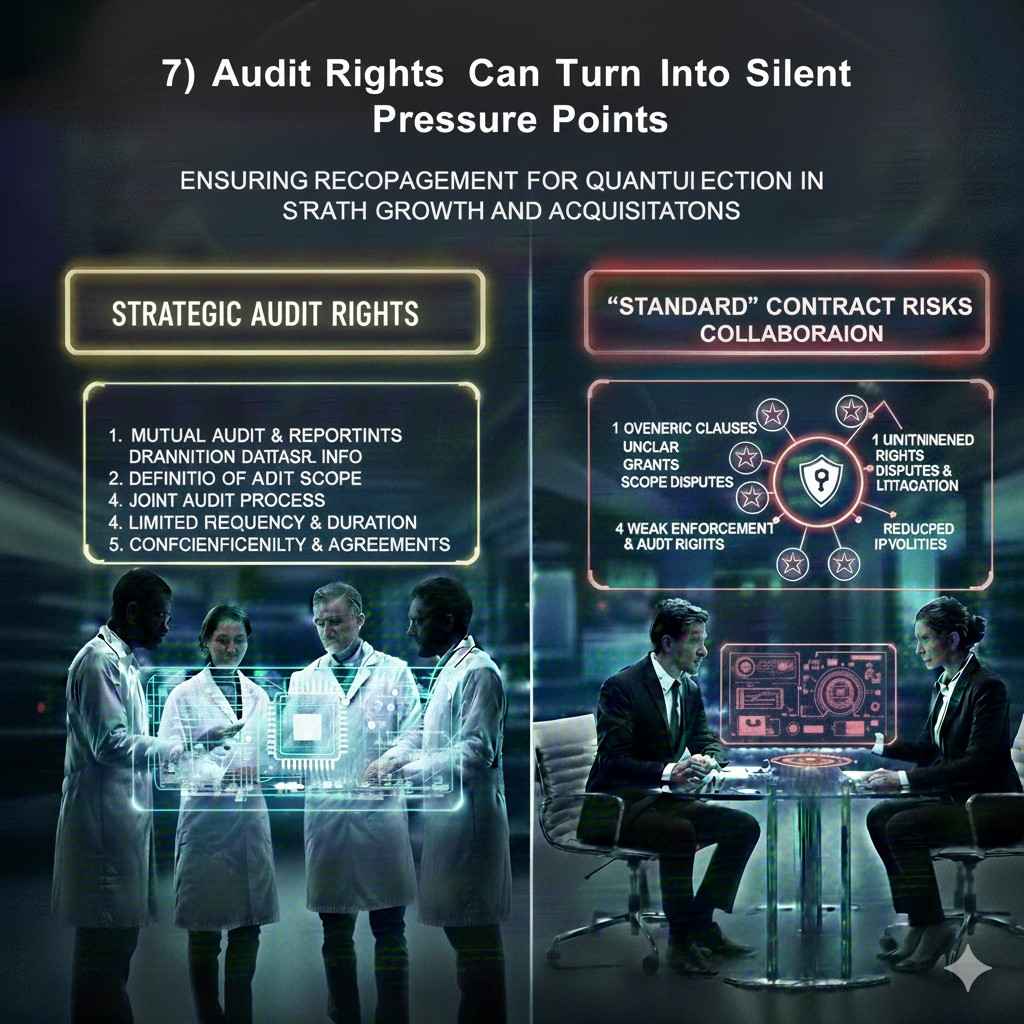
Universities often include audit rights to verify royalty payments. In theory, this is reasonable.
In practice, broad audit rights can feel invasive and distracting if not carefully limited.
When audits become disruptive
Some agreements allow audits at any time, with little notice, and at the university’s discretion. This can interrupt operations and create stress.
If audit costs are placed on the company even when no issue is found, the burden increases.
Setting fair audit boundaries
Founder-friendly audit clauses limit audits to reasonable frequency, require notice, and restrict scope to relevant records.
They also shift audit costs to the university unless a meaningful error is found.
Why this matters as revenue grows
As your company scales, audits become more complex. Clear limits prevent unnecessary friction and protect your team’s focus.
8) Enforcement control decides who defends the IP
Who can sue, and who decides
Some agreements give the university control over patent enforcement. Others require joint decisions or give the company first rights.
If the university controls enforcement, your ability to stop competitors may depend on their priorities, not yours.
The risk of slow or misaligned enforcement
Universities may move slower than startups. They may also weigh broader relationships and reputational concerns.
If a competitor is copying your core tech, delay can be fatal.
A structure that supports real defense
Founder-friendly agreements give the company the right to enforce, with notice to the university and reasonable coordination.
Cost sharing and recovery sharing should be clear, so enforcement does not become another negotiation.