
If you build robotics hardware, you are not just building a product. You are building a machine advantage. The hard part is not only getting it to work. The hard part is making it hard to copy.
Patents can help you do that—if you file the right things, in the right way, at the right time.
This article will walk through how to think about patenting robotics hardware, with a clear focus on sensors, actuators, and mechanisms. No legal fog. No big words. Just practical steps you can use while you design, prototype, test, and ship.
And if you want help doing this the smart way, Tran.vc can invest up to $50,000 worth of in-kind patent and IP services so you can build protection early—without raising too soon or giving up control early. You can apply anytime here: https://www.tran.vc/apply-now-form/
Sensors
Why sensor patents are different from software patents
Sensors sit in a special place. They touch the real world, then turn that messy real world into signals your robot can act on. That makes sensors easier to explain than pure software, but also easier for others to copy if your design is visible.
A strong sensor patent is not “we use a camera” or “we use LiDAR.” That is too broad and too common. The goal is to protect the specific way your sensor setup gets better results, like better accuracy in fog, lower drift, faster sampling without noise, or more stable readings when the robot shakes.
If your sensor makes your robot safer, faster, cheaper, or more reliable, you likely have something worth protecting. The trick is describing it as a system, not as a feature list.
The first question: what problem does your sensor solve in the real world?
Before you write anything, you need a clear problem statement. Not a marketing line. A plain problem that happens in real use. For example, a warehouse robot that reads pallet edges wrong when plastic wrap reflects light, or a home robot that loses depth readings on black surfaces.
This problem becomes the “why” of your patent. It gives the examiner a reason to care, and it gives your claims a shape. If you skip this step, your patent will often drift into vague language that does not hold up.
A good habit is to write the problem like a bug report: what conditions, what failure, and what harm. You want the reader to see the pain without needing to imagine it.
Where the real patent value is in sensing
Most robotics teams think the sensor itself is the invention. Sometimes it is. But most of the time, the value is in the sensing pipeline and arrangement. That includes where the sensor is mounted, how it is shielded, how it is calibrated, and how signals are cleaned before use.
If you built a mount that reduces vibration so the readings stop drifting, that is invention. If you designed a sensor placement pattern that removes blind spots while keeping cost low, that is invention. If you used a timing method so multiple sensors stop interfering with each other, that is invention.
You are looking for the small choices that create a big result. Patents are very good at protecting those choices when you explain them clearly.
Sensor fusion is patentable, but only when it is specific
“Sensor fusion” alone is not new. Everyone says it. To make it protectable, you need to state a clear structure and a clear method. For example, when exactly you trust one sensor more than another, and what triggers that shift.
If your robot uses IMU readings to detect micro-slips, then changes how it weights wheel encoders, that is a very concrete story. If your system adjusts camera exposure in real time based on LiDAR return strength, that is also concrete.
The more your fusion logic is tied to real physical conditions, the easier it is to defend. Tie it to thresholds, timing rules, known failure modes, and measurable output improvements.
Calibration and self-check features can become a “moat patent”
Many robotics products fail slowly. Sensors drift. Connectors loosen. Dust builds up. Temperature changes. A sensor that works in the lab can behave badly in the field, and that is where your real customers live.
If you invented a way for the robot to self-check sensor health, that can be highly valuable. Maybe it runs a quick reference scan at startup. Maybe it uses a known motion pattern to verify alignment. Maybe it detects lens fogging based on histogram shifts and switches to a backup mode.
These are not flashy features, but they are the features that make your robot dependable. A patent on reliability can protect your position even when competitors copy the surface design.
Mechanical design around sensors often gets ignored, and that is a mistake
Robotics is physical. That means your sensor performance is often shaped by brackets, housings, gaskets, cable routing, and shielding. If you solved a real constraint—like keeping an encoder readable while preventing grease from entering—you may have a strong hardware claim.
A common example is using a sensor window that stays clean due to airflow created by the robot’s own motion. Another is a protective cover that blocks glare without blocking field-of-view. Another is a mount that forces repeatable alignment even after service.
These details are easy to dismiss as “just mechanical.” But in patents, they can be the exact thing that competitors cannot copy without getting caught.
What to capture in your invention notes before you talk to a patent team
When you are building fast, you forget what you tried and why. Later, when it is time to file, you only remember the final design. That is dangerous, because the earlier failed versions often contain the best patent ideas.
Write down what was failing, what you changed, and what improved. Take photos of test setups. Save plots that show noise reduction or drift reduction. Keep a short log of “we tried A, it failed because B, we did C, and now it works.”
This is not paperwork for the sake of it. This becomes evidence. It also gives your patent attorney the material they need to draft claims that match the real value.
How to avoid the most common sensor patent mistake
The biggest mistake is being too generic. Saying “a robot uses a sensor to detect an object” is not protectable. You need the how and the why, and you need the real structure that makes it happen.
Another mistake is describing only one exact design. If you do that, a competitor will change one part and walk around you. Your patent should describe a core idea and a few workable variations, so the “center” stays protected even if the edges change.
A third mistake is waiting too long. If you demo the robot, ship units, publish papers, or show the inside design to partners without protection, you can limit your options. Timing matters more than most founders think.
How Tran.vc helps founders protect sensor inventions early
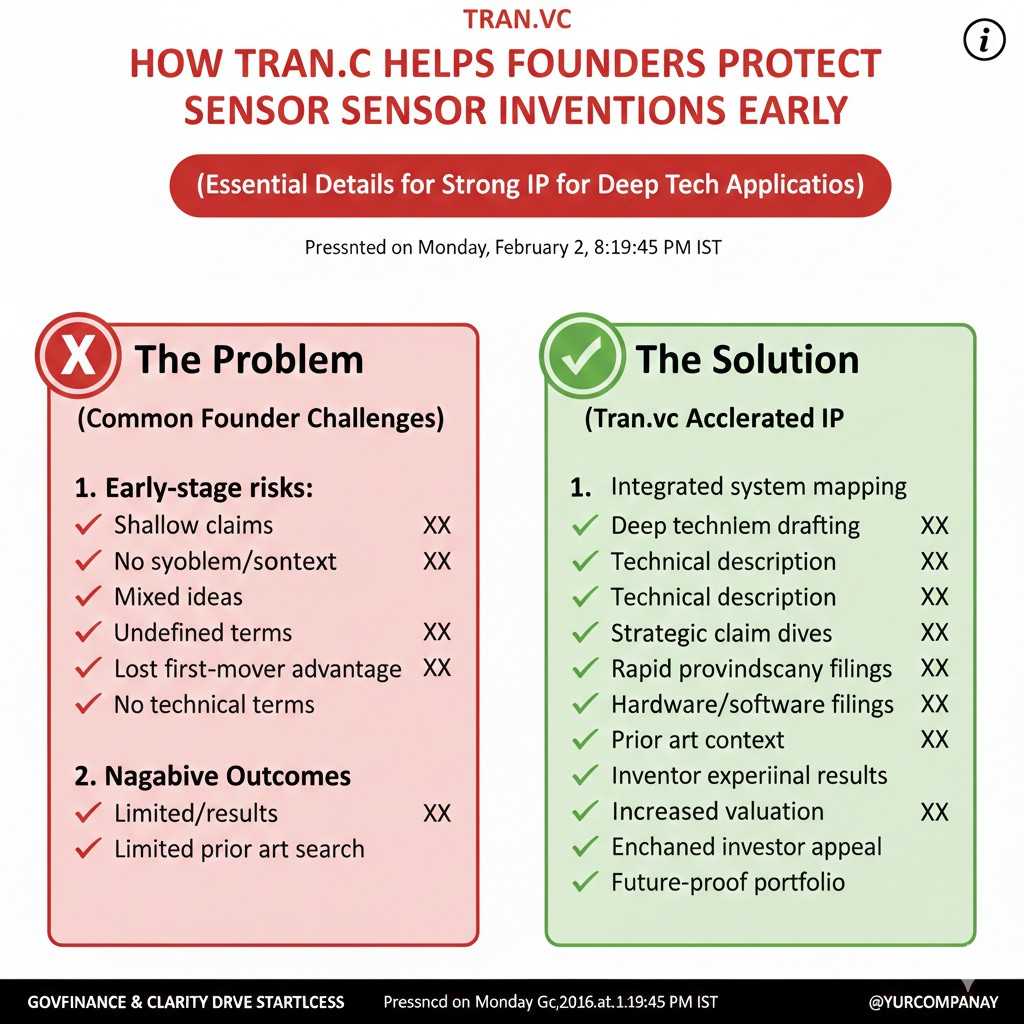
Most founders do not need “more patents.” They need the right patents. Tran.vc helps you map your sensor inventions into a small set of filings that protect what actually drives performance and reliability.
Tran.vc invests up to $50,000 in in-kind patent and IP services, so you can build defensible protection while you are still building the product. If you want to explore that, you can apply here anytime: https://www.tran.vc/apply-now-form/
Actuators
The actuator is not just a part, it is your robot’s behavior
Actuators turn decisions into motion. In practice, actuators shape the “feel” of the robot. They decide how smooth it moves, how safe it is near people, how much it can lift, and how long it can run before overheating.
Patenting actuators is often powerful because it sits right at the heart of performance. But you need to claim more than “we use a motor.” What matters is the actuator design choices that create your advantage.
This is where many robotics teams have hidden invention, because they had to solve hard tradeoffs under real constraints.
Where actuator invention usually hides
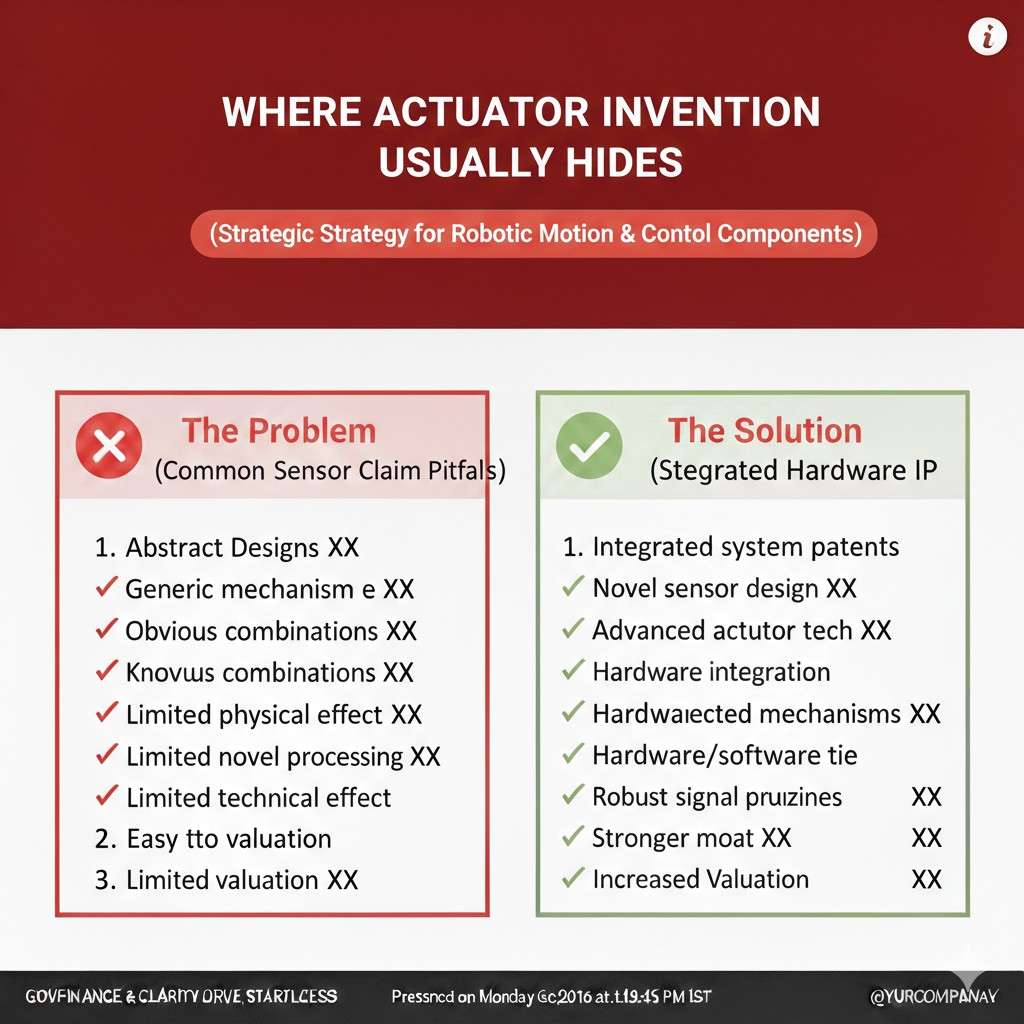
Actuator patents are often strongest when they cover a system that blends mechanics, control, and sensing. For example, a compact drive unit that includes gearing, cooling, and feedback in a tight package.
Another area is force control and compliance. If your actuator can safely interact with humans because it yields in a controlled way, that can be an invention worth protecting. The same is true if you can detect impact and switch modes fast enough to prevent damage.
Also look at manufacturing and assembly. If you designed an actuator that is easy to build, easy to service, and still high performance, competitors will copy it if they can. A patent can make that copying expensive.
Thermal control and efficiency features can be patent-worthy
Heat is one of the most common actuator limits. If you solved heat with a clever housing, airflow path, heat sink structure, or material choice, you might have a strong mechanical claim.
If you improved efficiency by reducing friction, reducing backlash, or optimizing gear contact, that can also be invention. If your design keeps torque stable across a wide temperature range, that can matter a lot for field robots.
In a patent, these improvements should not be described as “better.” They should be linked to a mechanism: what changed, how it changed heat flow or force flow, and what result you measured.
Safety features are often the best actuator moat
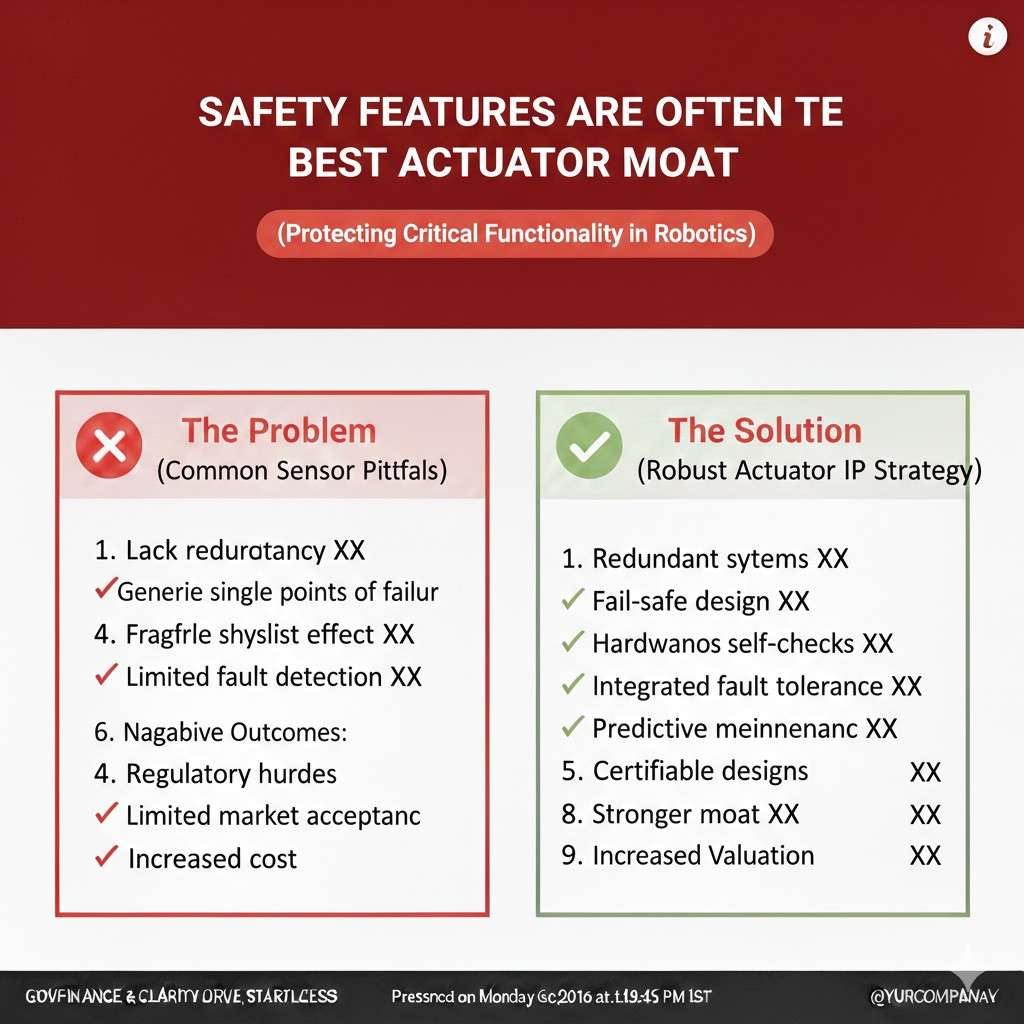
Robots that work near people need safety that is built-in, not layered on. If your actuator includes a mechanical stop, a clutch, a compliant member, or a braking method that prevents runaway motion, that can be highly valuable.
A safety-focused patent can be very hard to design around because safety is not optional. A competitor cannot simply remove it. If they do, their robot becomes less safe and less sellable.
This is one of the reasons “boring” actuator improvements can be the strongest patents. They touch requirements that the market will force everyone to meet.
The language that makes actuator claims stronger
Actuator patents become stronger when you describe structure and relationships. For example, how the sensor is positioned relative to the gear stage, how the housing supports load paths, or how the control loop uses specific feedback signals.
If you only describe high-level behavior, it can look like software. If you describe physical relationships—angles, axes, placement, coupling methods—you anchor the invention in hardware, which is often easier to defend.
You do not need to add fake precision. You just need enough detail to show the design is real and repeatable.
What to document while you are still prototyping
Actuator invention is often discovered during failure. A gear stage strips. A belt slips. A motor stalls under peak load. A thermal cutoff triggers too early. Each of these failures is a map to a patent story.
Save the test data. Save the broken parts. Save the pictures. Record what you changed and why it helped. These moments contain the “non-obvious” decisions that patent examiners care about.
If your actuator went through three redesigns, the earlier versions are not wasted time. They are proof that the final solution was not obvious.
How Tran.vc supports actuator patent strategy without slowing you down
Founders fear patents will slow product work. The right process does the opposite. A good IP strategy helps you decide what to build and how to build it, because it pushes you to define what is truly unique.
Tran.vc can help you turn actuator improvements into filings that protect your core advantage without drowning you in busywork. You can apply here anytime: https://www.tran.vc/apply-now-form/
Mechanisms
Why mechanisms are often the easiest hardware to copy
Mechanisms are what people see. A linkage, a gripper, a lift, a fold, a clamp, a wheel module. The moment you demo, someone can watch the motion and sketch the idea.
That visibility is why mechanism patents matter. If you wait until the robot is public, you may already be late. Even if a competitor cannot match your full product, they can copy the one motion that makes your robot special.
A good mechanism patent does not only describe the shape. It protects the motion path, the constraints that force that motion, and the parts that make it repeatable in real use.
The real invention is usually the constraint, not the movement
Many teams describe a mechanism by what it does. “It opens.” “It lifts.” “It rotates.” That is not enough, because those actions exist everywhere.
The protectable part is often the constraint that makes the motion reliable. For example, a cam that forces a specific sequence, a spring that keeps tension across a range, or a slot-and-pin path that avoids jamming.
When you write a mechanism patent, focus on what prevents failure. What stops binding. What keeps parts aligned. What makes the motion smooth even when the robot is dirty, or slightly bent, or under uneven load.
If your design still works when real life shows up, that is likely your invention.
Mechanisms that reduce parts can be very strong patents
A simple mechanism is often copied fast. But if your simplicity comes from a clever structure that replaces three parts with one, that is valuable.
Part count reduction can protect cost advantage. It can protect assembly advantage. It can protect reliability advantage. A competitor can copy your motion, but if they need more parts to do it, they often cannot match your margins.
In patents, you want to show how the reduced parts still meet the same requirements. For example, how one bent plate acts as a spring, a stop, and a guide surface. Or how one molded part provides alignment features plus cable routing plus sealing.
These claims often do well because they tie directly to manufacturing reality.
Mechanisms that solve “reset” and “recover” are worth extra attention
Robots fail. They bump into things. They get stuck. They lose calibration. A mechanism that can recover from a bad state is a hidden superpower.
If your gripper can re-seat itself after a slip, that is invention. If your joint can re-home without external tools, that is invention. If your latch can release safely under overload and then return to normal, that is invention.
Recovery is not glamorous, but it is where field robots win. It is also where patents are often strongest, because recovery features are very specific and hard to design around.
Tolerance handling is a mechanism story, and it is patentable
If you build hardware, you live with tolerance. Holes are not perfect. Bearings are not identical. Plastic warps. Metal bends. Many mechanisms work in CAD, then fail in production.
If you designed a mechanism that still works with wide tolerance bands, protect it. This can be done with compliant features, self-aligning geometry, floating mounts, or guiding surfaces that “pull” into alignment during motion.
When you write this into a patent, you do not need to talk in deep manufacturing terms. You can describe it as “accommodates variation” and then explain the structure that makes it possible.
This type of invention is hard for competitors to copy quickly, because it comes from painful build experience.
Cable routing and service access can turn into a defendable design
Many mechanisms fail because of cables. They pinch, twist, rub, and break. If you created a routing method that stays safe through full motion, you may have an invention that protects uptime.
Service also matters. If your mechanism allows fast replacement of a worn part without disassembling half the robot, that can be a market advantage. In real deployments, “easy to service” is often more valuable than “highly optimized.”
Patenting service-friendly structure can be smart because it ties to customer pain. Competitors trying to copy may end up with a design that is harder to maintain, which hurts them at scale.
How to think about claims for mechanisms without getting trapped
A common mechanism patent mistake is claiming the exact geometry. That can be easy to design around. Another mistake is claiming only the high-level goal. That can be rejected as too broad.
The balance is to claim the “core relationship” between parts. For example, “a first member coupled to a second member by a pin in a curved slot,” plus the function that relationship forces, plus a few variations.
You also want to describe more than one version. A metal version and a plastic version. A left-handed and right-handed version. A manual assembly and an automated assembly version. Not as a list, but as natural alternatives in the description.
This makes it harder for others to escape your patent by making a minor change.