
You can build the best tech in the world and still lose the right to protect it. Not because someone “stole” it. Not because you didn’t work hard. But because you waited too long to file your first patent.
A lot of technical founders delay patents for a simple reason: it feels like “later” work. You want to ship code, test with users, and get traction. Patents feel slow, legal, and far away from product.
But here’s the truth: delaying your first filing can quietly raise the cost of everything you do next. It can shrink your options. It can reduce your leverage with investors. It can force you into weaker claims later. And in some cases, it can remove your chance to patent at all.
This article is about the real cost of waiting—and what to do instead, in a way that fits how founders actually build.
Why “we’ll file later” becomes a trap
In the early days, most teams live in a tight loop:
You build. You test. You fix. You pitch. You build again.
In that loop, patents often lose. They sit on the “after we raise” shelf. But this is where the trap starts.
Because time does not just pass. Time changes the facts around your invention.
When you wait, you risk four things at once:
Your invention becomes harder to claim clearly because it keeps changing.
Your work becomes easier for others to copy because it gets exposed.
Your filing can get blocked by your own public moves.
Your story becomes weaker when you finally do talk to investors.
And the painful part is this: many of these costs show up only when you try to file. That’s when you hear, “We can’t cover that anymore,” or “This will be narrow,” or “This may not be patentable now.”
By then, you’ve already paid the price.
The first hidden cost: you may lose the right to patent
This one is simple but brutal.
If you publicly share your invention before filing, you can lose patent rights in many places. Founders often think “public” means a big press launch. It does not.
Public can mean:
A demo day pitch where the room has people you don’t control.
A blog post explaining how your model works.
A GitHub repo that reveals the key method.
A paper, preprint, poster, or talk.
A customer deck that gets forwarded.
A partner call where notes are shared.
Even if you do not “publish,” you may still disclose. And disclosure can destroy novelty.
Some founders rely on the idea that they can file after a public talk. Sometimes you can, sometimes you can’t, and it depends on where you want protection. If you plan to build a real company, you should not gamble your moat on rules you only half know.
The cost here is not money. It’s loss. You can’t buy back a missed chance.
The worst version of this story is common in AI and robotics:
A team shares a clever method to get attention.
The method spreads fast.
A bigger player files around it or improves it.
Now the original team is stuck with weak protection or none.
And then the founders say, “But we invented it first.”
The Cost of Delaying Your First Patent Filing
The “we’ll file later” habit is more expensive than it looks

Most technical founders delay patents for a simple reason. Patents feel like “later work.” You want to ship code, get a pilot, and prove the product. Legal work feels slow. It can feel like it pulls focus from the real job of building.
But the cost of waiting does not show up on day one. It shows up when you finally try to protect the invention and learn that time has changed the facts. Your system evolved, your team shared pieces of it, and the market moved. Now the patent path is narrower, weaker, or more risky than it needed to be.
That is why delaying your first filing is not neutral. It is not “doing nothing.” It is choosing to let your options shrink while your exposure grows. Even if your product is improving, your ability to protect it can be getting worse.
What this article will help you do
This piece is designed to be practical. You will learn the real ways teams accidentally lose patent rights. You will see how delay makes filings more costly later. You will also learn how to file in a way that fits fast product cycles, especially in AI and robotics where changes happen every week.
If you want Tran.vc to help you build a strong IP base early, you can apply anytime at https://www.tran.vc/apply-now-form/. The goal is to protect the core of what you are building before you are forced to fight from a weak position.
Why “Later” Turns Into a Trap
Time does not just pass, it changes your leverage
Early-stage work moves fast. The invention you have in month two is not the same as month eight. Features get added. Architecture changes. Data pipelines evolve. Hardware choices shift. The problem is that patents do not reward motion. Patents reward clear, defensible claims tied to a specific inventive idea.
When you delay, you often lose that clarity. You can end up with a messy story that tries to cover too many versions at once. That pushes your filing toward broad language that is harder to defend, or narrow language that is easy to design around.
A strong first filing is like a stake in the ground. It captures the key method while it is still clean and distinct. If you wait until the system becomes a bundle of patches, it becomes harder to explain what the true invention is.
Delay makes your invention easier to copy
The longer you build without protection, the more people see the edges of your system. Customers see behavior. Partners see interfaces. Recruits hear details. Advisors talk. Competitors study your product. Even if they do not know the full method, they can guess what is inside.
In AI and robotics, copying does not require your source code. Many teams can reproduce results from behavior alone, plus public papers, plus typical engineering patterns. If your advantage is a specific training method, control loop, sensor fusion trick, or deployment pipeline, delay gives others time to catch up.
Filing early does not stop all copying. But it creates a real threat. It tells the market you can enforce. That single signal changes how others behave, especially when they are deciding what to build next.
Delay creates quiet legal risk through everyday sharing
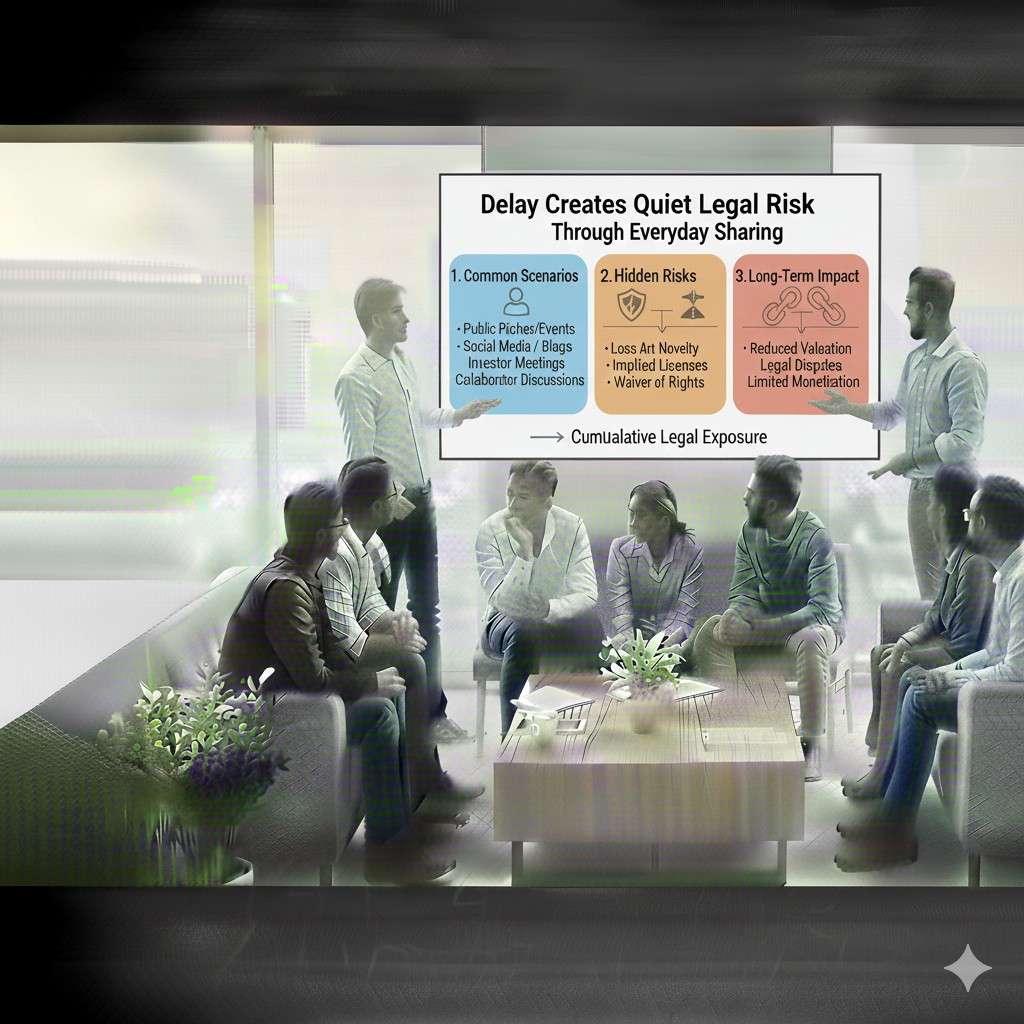
Delay also increases legal risk in quiet, normal moments. Most founders do not lose patent rights through a big announcement. They lose them through small, casual sharing that feels harmless at the time.
You explain your approach during a demo day pitch.
You show a system diagram to a potential customer.
You walk an advisor through the logic of your model.
Each moment feels safe. None of them feel like “publishing.” But legally, they can count as disclosure. Once disclosure happens, your clock starts ticking, and in some regions, your rights may already be gone.
Founders often assume they will remember what they shared and when. In reality, memory fades. Notes get lost. People repeat what you said. When you finally talk to a patent attorney, it becomes hard to prove what was private and what was not. That uncertainty alone can weaken a filing.
Why early filings reduce stress, not add it
Many teams believe patents add pressure early. In practice, the opposite is often true. An early filing creates a clear boundary. It tells your team what is protected and what can be openly discussed.
With that boundary in place, conversations become easier. You can pitch with confidence. You can recruit without fear. You can explore partnerships without worrying that one wrong slide will cost you your core asset.
The stress of patents usually comes from waiting too long, not from starting early.
If you want help setting that boundary without slowing product work, Tran.vc supports founders with in-kind patent and IP services from day one. You can apply anytime at https://www.tran.vc/apply-now-form/.
The Risk of Losing Patent Rights Without Knowing It
Public disclosure is wider than most founders think
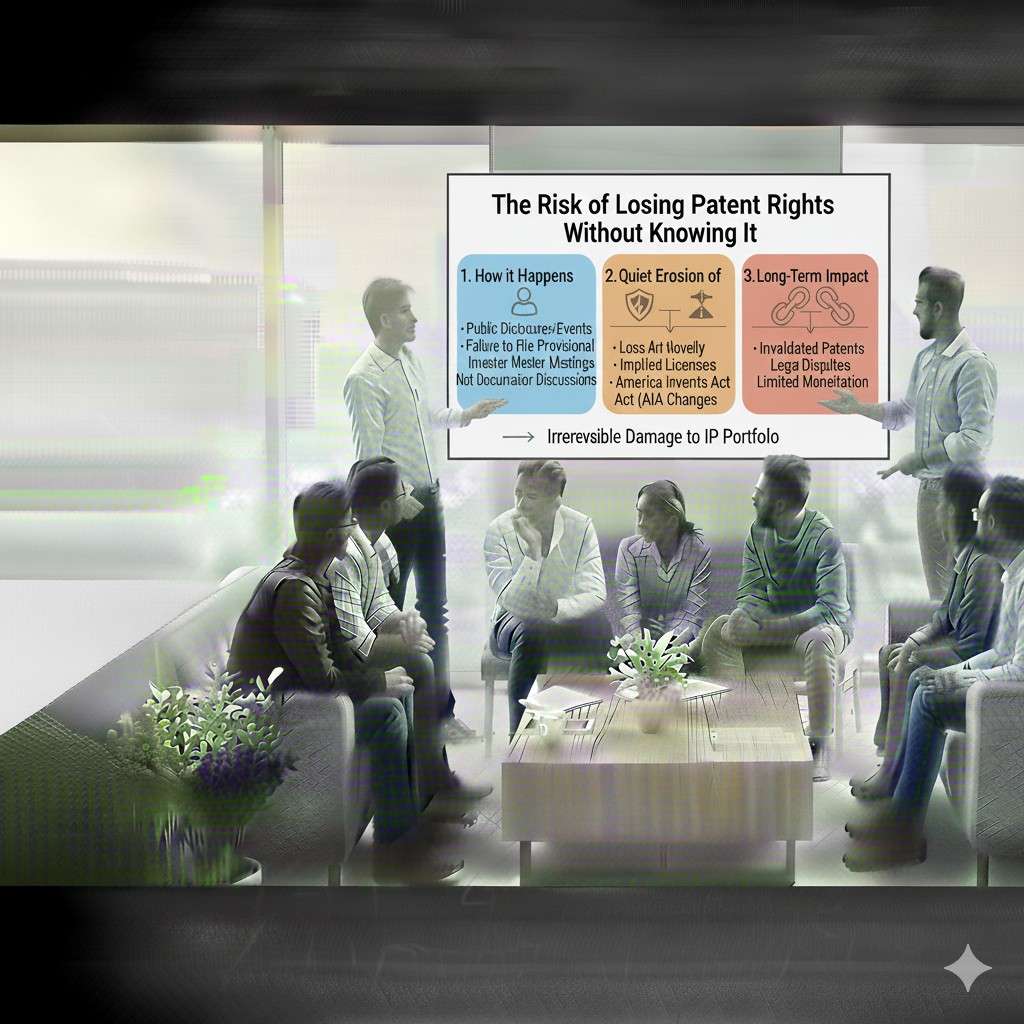
Many technical founders believe public disclosure only means a blog post or a press release. That belief is dangerous. Public disclosure includes any situation where information is shared without a clear duty of secrecy.
This can include pitch events, investor meetings without NDAs, conference talks, open Slack groups, and even customer pilots where documentation is shared. In some cases, a single slide showing system flow can be enough to reveal the inventive step.
Once disclosed, the invention may no longer be considered new. That alone can kill a patent, even if no one copied you yet.
Different countries, different rules, same problem
Some regions give you a grace period after disclosure. Others do not. If you want to build a company that can scale globally, you cannot rely on the most forgiving rule set.
Founders who delay often learn this too late. They file thinking they are safe, only to discover that their options are limited to a small set of markets. That can reduce company value, especially in AI and robotics where customers and acquirers are often global.
An early filing keeps your global options open. Even if you later decide not to pursue certain regions, you preserve the choice.
The false comfort of “we invented it first”
In patent law, being first to invent is not enough. What matters is what was filed, when, and how clearly. If another team files a similar idea earlier, or files a stronger version of it, they may win the right to protect it.
This is especially painful when the other team built on ideas that were floating in the ecosystem, including yours. Delay gives them time to formalize and protect what you only talked about.
That is why early filing is not about ego or credit. It is about control.
How Delay Makes Your Patent Weaker and More Expensive
Later filings often lead to narrower protection
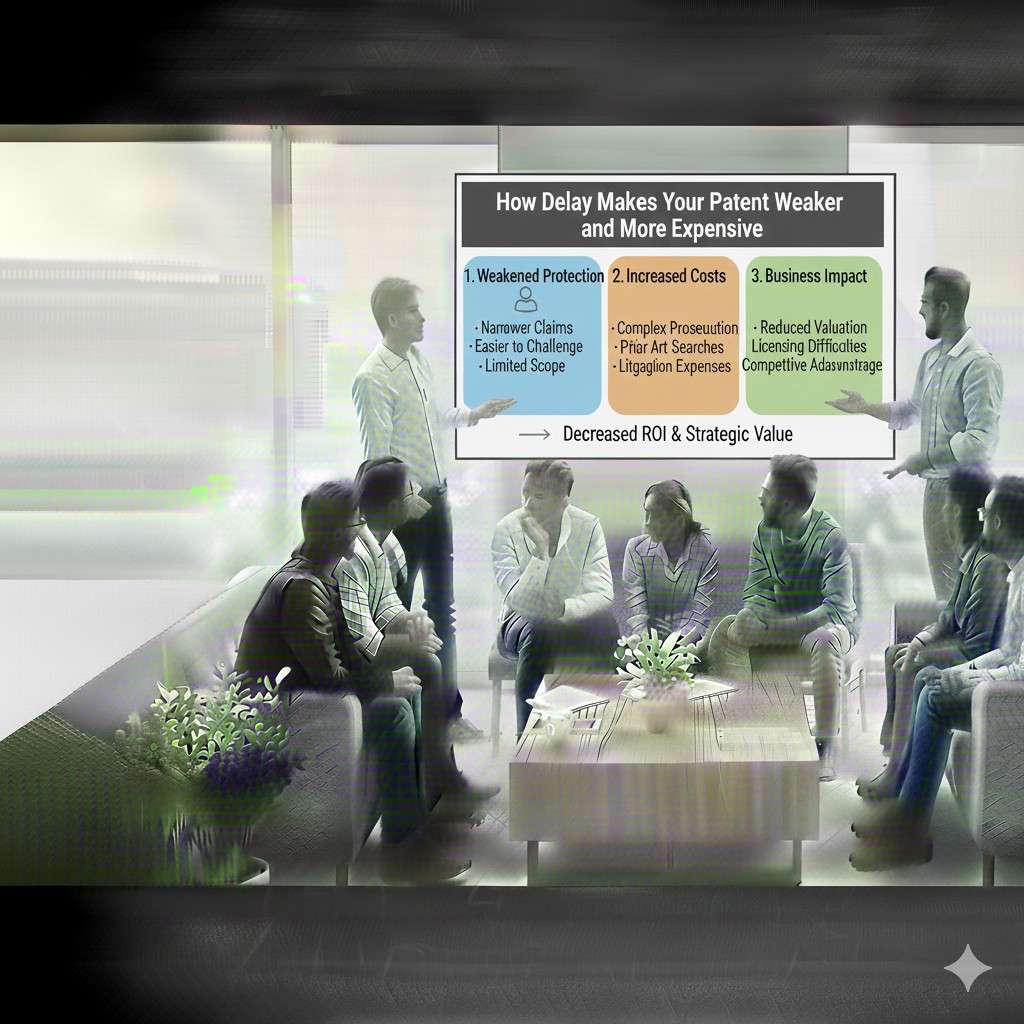
When you file late, you usually know more about the product. That feels like an advantage. In reality, it often forces you into narrow claims.
Why? Because by then, more prior art exists. More papers are published. More products are launched. More similar ideas appear. Your attorney has to carve around all of that, which can limit what you can claim.
An early filing often faces less resistance. It can claim the core idea broadly, before the space fills up. That broad base can then be refined in later filings as the product evolves.
Delay increases drafting and strategy costs
Early patents are often simpler. The invention is fresh. The system is cleaner. The story is easier to tell. That reduces time spent explaining, revising, and correcting.
Late patents often require more work. Attorneys need to untangle versions, map changes, and avoid disclosures that already happened. That means more hours, more back and forth, and higher costs.
Ironically, waiting to “save money” often leads to spending more for a weaker result.
Retroactive protection does not exist
One of the hardest lessons for founders is this: you cannot protect the past. A patent only protects what you file, from the filing date forward.
If you built value for a year before filing, that year is unprotected. If competitors copied during that time, you may have no recourse. Early filing sets the clock in your favor.
The Investor Cost of Delaying Your First Patent
Investors read delay as risk, not thrift
Many founders think investors will praise them for avoiding early legal spend. In reality, experienced investors often see delayed IP as a red flag.
They wonder what has already been disclosed. They worry about freedom to operate. They question whether the team understands how defensible businesses are built. Even if they love the tech, uncertainty around IP can slow or kill a deal.
A simple early filing often answers these questions before they are asked.
Strong early IP increases leverage, even pre-revenue
You do not need revenue to benefit from patents. What you need is a clear, protected invention that supports your story.
When you can say, “We filed on our core method early,” it changes the tone of conversations. It shows foresight. It signals seriousness. It tells investors you are building something that lasts.
Tran.vc focuses on exactly this moment. They help founders turn early technical work into real assets before a priced round. You can apply anytime at https://www.tran.vc/apply-now-form/.
Delay can force you into defensive fundraising
When IP is weak or uncertain, founders often raise from a weaker position. They accept worse terms because they need capital to “fix” problems that could have been prevented.
Early IP does not guarantee better terms. But it removes one major source of pressure.
How Patent Delay Hurts Your Product Strategy
Your roadmap becomes easier to predict

When you do not file early, you often compensate by hiding details. You avoid showing certain screens. You skip certain diagrams. You talk around the “how.” That can feel like smart secrecy, but it has a cost.
Your product roadmap becomes more limited because you are building while trying not to reveal the engine. You start making choices based on fear of exposure, not based on what users need most. Over time, this makes the product less sharp, because you are protecting the wrong thing: the conversation, not the invention.
A first filing gives you room to speak. You can still be careful, but you are no longer trapped into vague language that weakens your sales and partnership talks.
You postpone the moat until it is too late
Many teams treat moats like a “Series A problem.” They assume the moat comes after traction. But deep tech works differently. In AI and robotics, once a method is visible and proven, it spreads quickly.
If your edge is a control method, a training trick, a data loop, or a unique sensor-to-action pipeline, you want to protect it while it still looks new. If you wait until the market agrees it is valuable, you may find that others already filed around it, or that too many similar ideas exist.
The painful part is that you can still be the best team, and still lose exclusive rights. The market does not reward effort. It rewards timing and documentation.
You end up building “features” instead of protectable inventions
Founders often say, “We are still iterating, so we can’t file yet.” What they usually mean is that the product is not stable. That is normal. But patents do not require a finished product. They require a clear inventive idea.
When you delay, you sometimes drift into building a string of features without naming the real invention. You ship improvements that feel useful, but you never stop to define the core technical step that makes the system better than what existed before.
A good patent process forces that definition. It turns your engineering insight into a precise asset. That clarity can also help your team build faster, because everyone understands what matters most.
If you want support turning fast engineering into an IP foundation without slowing down, Tran.vc does this as in-kind patenting and IP services worth up to $50,000. You can apply anytime at https://www.tran.vc/apply-now-form/.
The Team Cost of Waiting
Engineers stop documenting the “why”

Early teams move fast. Decisions get made in a hallway chat, a late-night message, or a quick whiteboard sketch. That is normal. But patents rely on details, and details fade.
When filing is delayed, the team’s memory becomes the main record. People remember what they think happened, not what actually happened. The “why” behind a design choice is often the first thing to disappear. Months later, it becomes hard to explain the inventive step with confidence.
Early filing solves this in a quiet way. It creates a habit of capturing the key decisions while they are fresh. It does not need to be heavy. It just needs to be consistent and timely.
Key people leave, and the invention leaves with them
Startups change. People move. Co-founders part ways. Early engineers get hired away. When that happens, your ability to describe the invention can weaken overnight.
Yes, you still own what the company created. But ownership is not the same as understanding. If the person who designed the core method is gone, and you never captured it in a filing, you may struggle to reconstruct the full story.
This is one of the most overlooked costs of delay. Founders think patents are about competitors. Often, they are also about continuity inside your own team.
Your culture becomes “keep it in your head”
When teams avoid filing, they often replace it with informal secrecy. People stop writing things down. They stop sharing drafts. They avoid technical depth in meetings. They become cautious in ways that hurt learning.
That kind of culture can slow progress, especially in robotics where cross-functional work matters. Control, perception, hardware, and deployment teams need to communicate clearly. If everyone is afraid of creating a “paper trail,” the system design suffers.
Filing early can actually make culture healthier. Once the core is protected, people can collaborate more openly and more precisely.
The Market Cost: Others Learn Faster Than You Think
Competitors do not need your code to copy your approach
In software and AI, copying is often about patterns, not lines of code. If your product behavior is clear, a capable team can infer the method. In robotics, physical demos can reveal even more, because motion and timing expose the logic behind the system.
Founders sometimes assume that complexity is protection. They believe a competitor cannot replicate what took them months to build. But competitors often have strong teams too. They may have more resources, larger datasets, or better distribution.
Your best defense is not hoping they cannot copy. It is creating enforceable rights around the inventive step, and doing it early enough that the claim can be broad.
Partners can become future competitors
Many startups grow through partnerships. You integrate with a platform. You run pilots with a big company. You co-develop a solution. These are good moves, but they increase exposure.
Most partners are not trying to steal your work. But large companies are always learning. They may build adjacent solutions later. They may hire people who saw your system. They may invest in another team working on similar ideas.
An early filing makes these relationships safer. It allows you to collaborate without handing over your leverage.
Hiring and recruiting becomes harder without a clear moat
Top engineers and technical leaders often ask a quiet question: “Is this company defensible?” They want to join something that will not be copied in six months.
When you can show that you filed early on the key method, it signals seriousness. It tells talent that the company is not just building features. It is building assets that can survive competition.
This matters in AI and robotics, where the best people have many options.
What “Filing Early” Actually Means in Real Startup Life
You are not locking yourself into one design

A common fear is that filing early means committing to a design that may change. That fear comes from misunderstanding what a good first filing does.
A strong first filing focuses on the underlying idea, not on the exact implementation. It captures the core method and key variations. It describes alternatives that you may not build yet but could reasonably build later.
You can still iterate after filing. In fact, filing early often makes iteration easier, because you can explore without worrying that every new experiment must be hidden.
Your first filing should match your build cycle
Early startups often file a provisional first, then follow with a stronger non-provisional later. The key is not the label. The key is quality and timing.
If your “provisional” is thin and vague, it will not help much. If it clearly explains the inventive step and gives enough detail to support strong claims later, it can be a powerful move.
The right approach usually looks like this: capture the core innovation now, then add follow-on filings as the product evolves. That is how you build a real portfolio instead of a single fragile document.
Tran.vc helps founders build that kind of portfolio with hands-on patent strategy and filings as in-kind services. If you want to move early without getting distracted, you can apply anytime at https://www.tran.vc/apply-now-form/.