
Most founders think “seed funding” means one thing: raise a priced round, hire a team, and sprint. But if you are building robotics, AI, or deep tech, that path can push you into a corner fast. You may not be ready to price the company. You may not want a board. You may not want to spend months pitching while your product sits still. And you really do not want to give away a big chunk of your company before your best proof is even built.
Seed-strapping is a cleaner way to start. It means you fund the early build with smart, low-pressure money, while you stack real assets that make your company stronger. Two tools are perfect for this: grants and SAFE notes.
Grants are slow money, but they can be non-dilutive. That means you do not give up ownership. SAFE notes are fast money, but you must use them with care. They can help you move quickly without locking in a company price too early. Used together, grants and SAFEs can give you runway, leverage, and control.
This article is about how to do that in a real, practical way. Not theory. Not hype. It is about how to line up grants and SAFEs so you can keep building, keep learning, and keep your cap table clean while you create proof that investors can trust.
And because Tran.vc is built for technical founders, we will also talk about the part that many teams miss: turning your early work into protected IP. In deep tech, your moat is not your pitch deck. It is what you can defend. Tran.vc invests up to $50,000 in in-kind patent and IP services so you can build that moat early, before you raise a big round, and before copycats show up.
If you want to explore that path, you can apply any time here: https://www.tran.vc/apply-now-form/
Grants: the slow money that keeps your cap table clean
Why grants matter for deep tech teams

Grants are one of the few ways to fund hard engineering work without giving away ownership. This matters a lot in robotics and AI, where progress can be real but slow. Investors often want to see proof before they pay for the early, messy build stage. Grants can cover that stage, so you can keep moving without forcing a rushed fundraise.
A grant also makes you sharpen your plan. You must explain what you will build, why it matters, and how you will measure success. That work is not just paperwork. It becomes a clear map you can reuse for customer talks, pilot plans, and investor updates. When you do it well, you end up with a story that is easy to trust.
If you are building something that has to work in the real world, a grant can also give you a stamp of care. It signals that you can follow a process, manage a budget, and deliver what you promised. That kind of signal helps later when you raise on a SAFE or when you pitch a priced round.
What grants are best used for
Grants tend to work best when they pay for proof, not polish. Think about tasks that reduce risk in a way a buyer or an investor can understand. This could be test results, safety checks, prototype builds, data collection, or field trials in real settings. When the money funds proof, the output becomes a piece of evidence you can carry forward.
For AI teams, grants can support building a clean data pipeline, running controlled tests, and showing results that repeat across time. For robotics teams, grants can support hardware iterations, testing under real loads, and proving reliability. The goal is not to “research forever.” The goal is to prove one hard thing that unlocks the next stage.
A useful way to judge a grant is to ask what you will be able to say at the end. If the answer is clear and tied to value, it is worth the effort. If the answer is vague, you may end up busy but not closer to market.
The biggest grant mistake founders make
The most common mistake is letting the grant drive the company, instead of letting the company drive the grant. It is easy to chase what sounds fundable, even if it does not match what customers need. That can pull you away from a buyer problem and into a research project that looks good on paper but does not sell.
You avoid this by staying close to real users while you apply. Talk to customers before you write. Use their words, their pain, and their metrics in the application. Then when you win, the grant work supports a real path to revenue instead of creating a dead end.
Another mistake is treating grants like your only fuel. Grants can take time to win and time to pay out. If you build your whole plan around grant timing, you can get stuck waiting. A better approach is to keep a build plan you can execute in small steps, then let grant money speed up what you are already doing.
How to pick a grant without wasting months
The right grant fits your next milestone, not your long-term dream. Your next milestone should be something you can finish in a set time window, with clear proof at the end. When you pick grants that match that, the application becomes easier, and the work stays aligned.
A strong match also means the rules fit your team. Some programs want heavy reports and strict spending rules. Others are lighter and easier. If the paperwork load is too high for your stage, it will steal energy from building. The best grant is the one you can manage without turning your startup into an admin shop.
If you want to seed-strap well, create a simple rule: only apply if the grant funds work you would do anyway. When you follow that rule, even a failed application still leaves you with a clearer plan, better writing, and stronger thinking.
How grants and IP should work together
Grants can help you build novel work, but they do not automatically protect it. If you create a new method, a new training process, a new control loop, or a new system design, you should treat that as an asset. In deep tech, your advantage is often in the “how,” not just the “what.” That “how” can be protected if you handle it early and correctly.
This is where many founders slip. They publish details, share demos, or present results, then try to patent later. Timing matters. Strategy matters. The right filings can turn your early work into a moat that investors respect and competitors cannot easily copy.
Tran.vc is built around this need. Tran.vc invests up to $50,000 in in-kind patent and IP services so technical founders can protect what they are building while they are still early. If you want help building an IP plan that fits your grant and fundraising path, apply here: https://www.tran.vc/apply-now-form/
SAFE notes: the fast money that must be handled with care
What a SAFE really is

A SAFE is a simple deal where an investor gives you money now and receives equity later, when you raise a priced round. It can feel lighter than a full venture round because you do not set a valuation today. That can be helpful when your product is still forming and your proof is not complete.
The key point is that a SAFE is not free. It is a promise about future ownership. When the next round happens, the SAFE converts into shares. If you stack too many SAFEs, or if the terms are too founder-unfriendly, you can lose more ownership than you expected.
Used well, SAFEs buy speed and focus. Used poorly, they create cap table stress that shows up at the worst time, right when you are trying to close a bigger round.
The two terms that matter most
Most SAFEs use a valuation cap, a discount, or both. The cap sets the maximum price the investor will convert at later. The discount gives the investor a lower price than the next round investors pay. Both are ways to reward early risk.
The cap is usually the bigger lever. If the cap is too low, you may give away a large chunk of the company even if you do great. Founders sometimes accept a low cap because they want to “get it done.” The cost of that choice often appears later, when you do the math during the priced round.
A clean rule is to connect the cap to the proof you expect to reach. If you think you can hit a strong milestone that justifies a higher priced round later, do not lock yourself into a low cap today. Raise less money, hit the milestone, then raise again on better terms.
The SAFE stack problem
A SAFE stack happens when you raise multiple SAFEs over time, often with different caps and different side letters. It feels fine while you are raising, because nothing converts yet. But when you do raise a priced round, all those SAFEs convert at once, and the ownership math can surprise you.
This is not only about dilution. It is also about complexity. Too many SAFEs with different terms can slow down the priced round because new investors want to understand exactly what they are buying. If the answers take too long, you lose momentum and risk the round.
A safer approach is to keep your SAFE round tight. Use one clear set of terms. Keep the round size tied to one milestone. Then stop and reassess. You are not trying to “fund everything.” You are trying to buy the next proof point.
When a SAFE makes sense in seed-strapping
A SAFE is most useful when you already know what you will do with the money. That means you have a plan you trust, a product direction that is stable, and a short set of goals that unlock the next stage. If the company is still searching for the core use case, SAFE money can disappear into experiments that do not compound.
For robotics and AI, a good SAFE use is often about execution speed. It can fund the first pilot deployment, the first paid proof, the first compliance steps, or one key hire who makes the system real. The SAFE should not be used as a bandage for unclear strategy. It should be used as fuel for a clear build.
Another good use is bridging timing gaps. If grant money is coming but not yet in the bank, a small SAFE can keep progress steady. That can prevent the “stop-start” cycle that kills teams early.
How SAFE money and IP should connect
If you take SAFE money to build, you should also consider what you are creating that can be protected. Investors like SAFEs because they can move fast, but they still care about defensibility. If a competitor can copy your method quickly, future rounds get harder, and your cap becomes harder to justify.
A practical way to think about this is to map your technical edge. If your edge is in model training, your data strategy, your system design, your control logic, or your deployment method, you should decide what parts can be protected. Then you build and file in a way that supports your fundraising timeline.
Tran.vc helps teams do this early, without forcing a big cash round. Tran.vc invests up to $50,000 in in-kind patenting and IP services so your early work becomes an asset that strengthens your next raise. Apply any time here: https://www.tran.vc/apply-now-form/
Using grants and SAFEs together: the seed-strapping system
The simple model that works
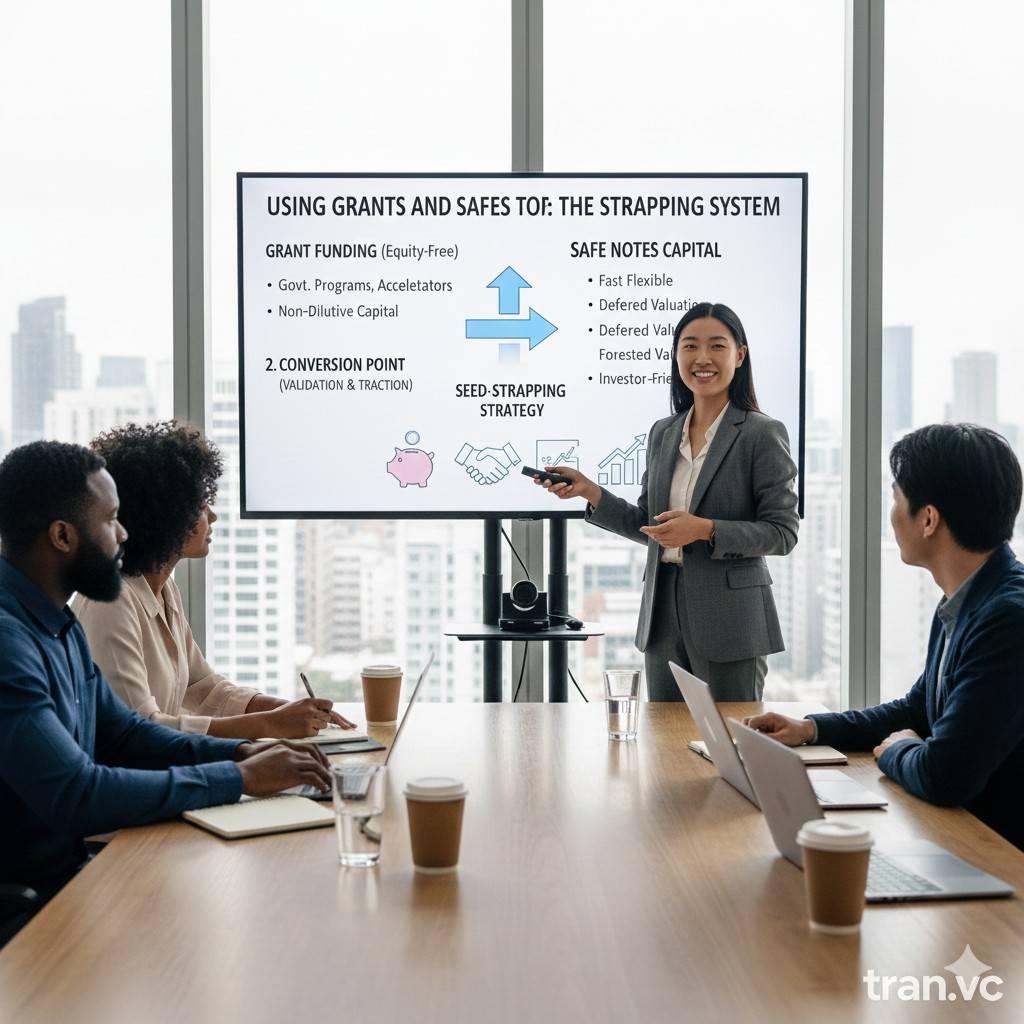
The cleanest way to combine these tools is to let grants pay for proof and let SAFEs pay for speed. Grants are better at funding testing, prototypes, and validation work that reduces risk. SAFEs are better at funding the moves that help you ship, sell, and deploy once the core risk is lower.
This model also helps you stay disciplined. You do not burn investor money on tasks that are hard to value early. And you do not try to force grant programs to fund growth activities they do not support. Each tool does its job, and your company benefits from both.
When you do this well, you build a story investors understand. You can show technical proof backed by grant work, plus market progress backed by SAFE speed. That mix often makes the next round easier, because the risk looks smaller from multiple angles.
A seed-strapping timeline you can actually run
In the first stage, your focus is the core technical proof. You pick one or two key risks and design tests that remove them. This is where a grant can be powerful, because it funds the work and gives you structure. You keep customer talks active at the same time, so your technical work stays tied to a real need.
In the second stage, you start pushing into the field. This is where speed matters. Pilots require travel, support, iterations, and sometimes quick fixes. This is where a SAFE can be a strong tool, because it can fund execution without forcing you to price the company too early.
In the third stage, you prepare for a larger raise or a priced round. At this point, your goal is to show repeatability. One demo is not enough. One pilot is not enough. You want evidence that you can deliver again, and that the path to revenue is real.
Through all stages, you treat IP as part of the build, not as a task you do later. When you protect the right parts early, you increase your leverage in every future negotiation.
How to keep control while you raise
Seed-strapping is about control, but control comes from choices you make early. One choice is how much money you raise at once. If you raise too much too early on a SAFE, you may lock into terms that do not match your future value. If you raise too little, you may stall. The sweet spot is a raise that funds one clear milestone with a small buffer for surprises.
Another choice is how you communicate your plan. A clear plan attracts better terms. It also reduces investor fear. When fear is low, investors are less likely to push for harsh caps or extra rights. Your job is to reduce fear with proof, with clarity, and with strong execution.
Control also comes from a clean cap table. Keep terms consistent. Avoid side deals that create confusion later. Treat every SAFE as part of a long story, not as a quick fix.
Where Tran.vc fits in this system
Tran.vc is built to support seed-strapping for technical founders. Instead of pushing you to raise big and fast, Tran.vc helps you build defensibility early. Tran.vc invests up to $50,000 in in-kind patent and IP services so you can turn your inventions into protected assets while you are still early.
That matters when you use grants and SAFEs. Grants help you create proof. SAFEs help you move fast. IP helps you keep your advantage when others start watching. When those three pieces line up, you build a company with leverage, not desperation.
If you are building robotics, AI, or deep tech and want to seed-strap with a strong IP base, apply here: https://www.tran.vc/apply-now-form/
Turning grants into customer proof, not lab work
Start with the buyer’s problem, not your tech

A grant application feels like it is about science. In reality, the best ones read like a business plan with clear tests. Even when the program is research-focused, reviewers still want to know the work will matter. The fastest way to make your grant useful for seed-strapping is to begin with the buyer’s pain.
That means you write down one real situation where your system will be used. You describe who is there, what goes wrong today, and what it costs. Cost can mean money, time, safety risk, failed quality checks, lost output, or missed deadlines. When you can name the cost, you can name the value.
Once you have that, your technical work becomes easy to frame. You are not building “a model.” You are building a system that reduces a specific failure. You are not building “a robot.” You are building a tool that finishes a task faster, safer, or with less waste.
Turn the grant into a set of measurable claims
A strong grant is built around claims you can test. A claim is not a dream. It is a statement you can prove or disprove. Reviewers like this because it shows discipline. Investors like this because it shows you understand risk.
A claim also keeps your team focused. Deep tech teams can spend months improving something that does not matter. A claim prevents that, because it tells you what “done” means. It gives you a finish line you can point to when you raise a SAFE or when you plan your next pilot.
If your claim is too broad, the project becomes endless. If your claim is too tiny, the work will not move the company forward. The sweet spot is one hard proof point that makes the next step easier. For example, proving reliability under load, proving accuracy under noise, proving safe operation near people, or proving performance on a real customer dataset.
Use the grant to build assets you can reuse
Seed-strapping works when work compounds. The best grant work produces assets you can reuse, not one-time results. That can include test rigs, data pipelines, eval scripts, simulation environments, integration tools, or deployment templates.
For AI, an asset might be a repeatable training and evaluation process that you can run on new data quickly. For robotics, an asset might be a calibrated test setup or a control stack that handles edge cases better each month. When you build assets, the grant does not just pay for a report. It pays for speed later.
This also helps your investor story. You can explain not only what you achieved, but why future progress will be faster. That is what investors really want. They are betting on your rate of learning.
Keep your grant scope narrow and time-bound
Grant programs often reward ambition, but startups must reward completion. You should write your scope so you can finish it with the team you have. That means you avoid promising ten big things. You promise one main outcome and a clear method to get there.
A narrow scope also protects you from delays. Hardware slips. Data access slips. Vendors slip. If your scope is tight, you can still deliver even when reality is messy. That is important, because missed grant milestones can damage trust and slow future funding.
Time-bound scope is also useful for your SAFE raise. If you can say, “In 12 weeks we will finish this test and show this result,” it becomes easier for an investor to say yes. Vague timelines create fear. Clear timelines lower fear.
Make reporting work for you, not against you
Grant reporting can feel like wasted time, but it can become a powerful tool if you treat it as content you can reuse. A good report can become a customer update, an investor memo, a pilot summary, or a proof packet for your next round.
The key is to write reports in plain words. You can keep the technical details for an appendix, but the main text should explain what you did, what changed, and what you learned. That is what both reviewers and investors care about.
If you do this consistently, you build a library of credibility. When someone asks, “Can you really do this?” you can show them a trail of evidence that is dated, measured, and backed by a real program.
Writing grants fast without turning it into a second job
Build a grant “base draft” once, then reuse it

Most founders waste time because they write every application from scratch. A better approach is to create one base draft that covers your core story. That base includes your problem, your approach, your team, your milestones, your test plan, and your impact.
Once you have that base, each new application becomes a light edit. You adjust the language to match the program. You adjust the milestones to match the budget and timeline. You keep the core consistent so you do not lose weeks.
This also protects your strategy. When you rewrite everything each time, your plan can drift. A base draft keeps you honest. It makes sure the grant work stays tied to the company’s direction.
Use customer language to reduce reviewer doubt
Reviewers may be technical, but they are still human. They still doubt big claims. The best way to reduce doubt is to include buyer language, even if the grant is not “commercial.”
Buyer language means you describe the current process in the field and show you understand it. You mention constraints like downtime, safety rules, sensor noise, staff training, maintenance cycles, and existing tools. When reviewers see that, they believe your plan is grounded.
This also helps you later with investors. Many investors have seen deep tech teams that never leave the lab. When your grant narrative shows real-world constraints, you stand out as a team that will ship.
Do not hide risk; show you can manage it
Many founders try to sound perfect in a grant. That is a mistake. Good reviewers know deep tech is risky. They want to see that you understand the risk and have a plan.
So you name the top risks in plain words. Then you show what you will do if the risk appears. Maybe you have two sensor options. Maybe you can switch to a different dataset. Maybe you can run a fallback method. This is not weakness. This is competence.
The same approach works in SAFE talks. An investor trusts you more when you can name what could fail and how you will respond. It signals maturity and reduces fear.
Plan the budget as a strategy tool
Many founders treat budgets like accounting. For seed-strapping, the budget is strategy. It tells you what you will prioritize. If the budget is mostly “people,” it means you need execution power. If the budget is mostly “testing,” it means proof is the main gap.
A budget can also protect your company. If you tie the grant money to key proof tasks and tooling, you reduce the chance the project turns into generic overhead. You can still pay yourself and your team fairly, but the line items should push toward outcomes you can show.
When the budget supports measurable proof, the grant becomes a bridge to better funding terms later.
Setting SAFE terms that do not surprise you later
Tie the raise size to one milestone, not your wish list
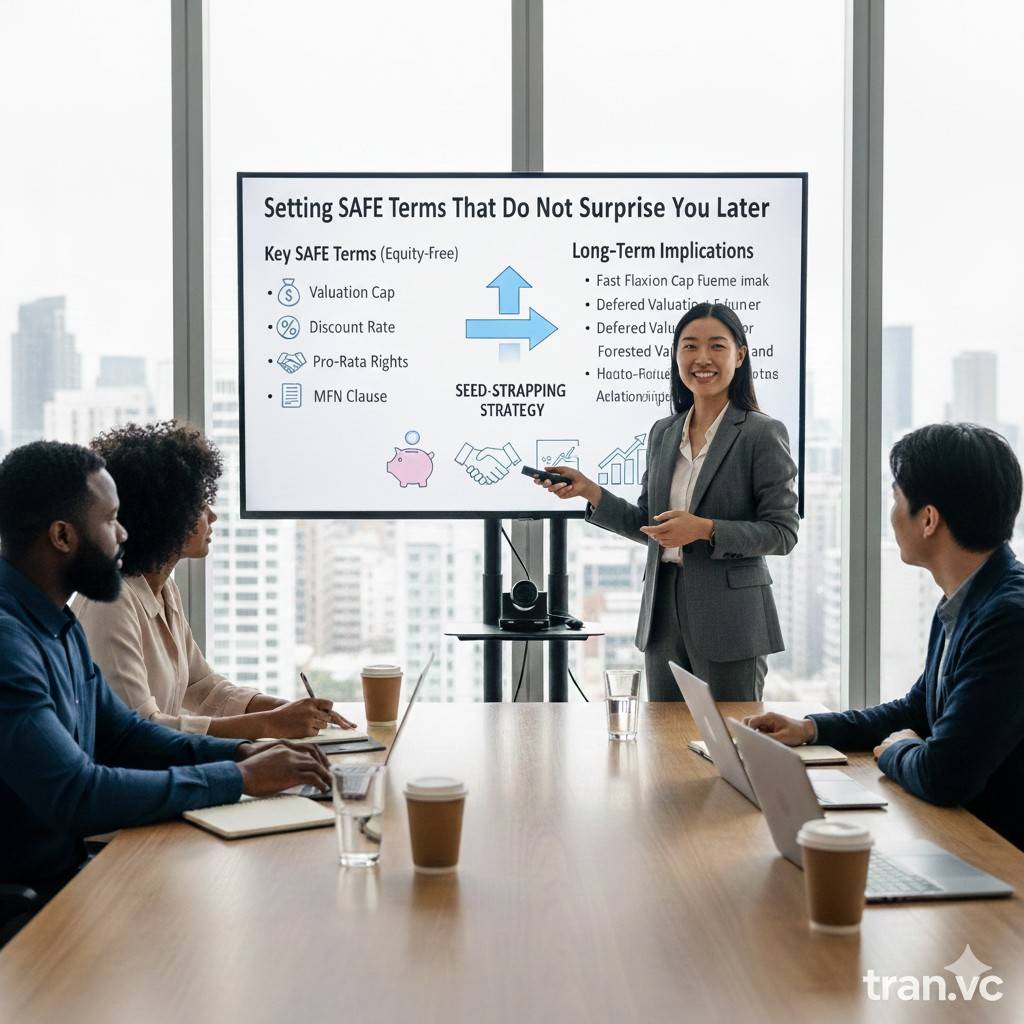
The safest way to use a SAFE is to raise only what you need for the next proof point. This keeps dilution predictable and keeps urgency high. It also reduces the chance you drift into spending on “nice to have” work that does not move the company forward.
A milestone should be something that changes how the market sees you. It could be a pilot signed, a deployment completed, a key metric hit, a paid proof of value, or a strong technical validation that removes a major doubt. When you raise to a milestone, investors understand the purpose of the money.
If you raise to a vague goal like “build more,” you invite pressure, questions, and term demands. Clear purpose makes the SAFE feel safer for both sides.
Think of the valuation cap as a future promise
A cap is not about what you are worth today. It is about what you might be worth at the next priced round if you deliver. If you set the cap too low, you lock in heavy dilution even if you succeed. If you set it too high, investors may say no.
The practical way to set it is to estimate what your next round could look like if you hit the milestone. You do not need perfect math, but you need honest ranges. Then you choose a cap that rewards early risk without punishing future success.
Founders often feel tempted to accept a low cap to close quickly. That can be a costly trade. Sometimes the better move is to raise less, keep the cap healthier, and get to the next milestone faster.
Keep terms consistent to avoid future friction
One of the biggest reasons priced rounds slow down is messy SAFE terms. If you give different caps to different people, or attach special side rights, you create a puzzle later. New investors do not like puzzles. They like clean structures they can understand fast.
For seed-strapping, you want speed later, not just now. So you keep one set of terms for a given SAFE round. You document everything cleanly. You avoid special deals unless they are truly necessary.
This also protects your relationship with early investors. When everyone is on the same terms, nobody feels tricked. That keeps trust high, which matters when you need help with intros, hiring, or the next round.
Use SAFEs
Use SAFEs to increase leverage, not dependence

A SAFE should make you stronger, not more fragile. If the SAFE money becomes the only reason you can survive, you lose leverage. Investors sense that. They push harder on terms. You end up giving away more.
Leverage comes from options. Options come from proof, customer pull, and defensible tech. This is why grants, pilots, and IP matter so much. When those pieces are in place, you can raise on fair terms because you can say no.
If you want a seed-strapping plan that builds those options early, Tran.vc can help by investing up to $50,000 in in-kind patent and IP services. That support helps you protect what you are building while you gather proof through grants and pilots. Apply here: https://www.tran.vc/apply-now-form/