
Seed money used to mean only one thing: a cheque in the bank and a race to spend it fast.
But if you are a technical founder today, you know that story does not always end well. You raise a small round. You rush to hire. You build fast. You chase growth. Then the market shifts, the next round is slow, and you are stuck with a team, a burn rate, and not much that is truly hard to copy.
That is why we talk about seed-strapping.
Seed-strapping is a calm, focused way to build a real company before you raise real cash. It is what happens when you act like a bootstrapped founder, but you still get help, leverage, and outside support. You do not waste your early years chasing a big round. You use that time to turn your code, your models, and your ideas into real assets that no one can steal.
At Tran.vc, we do this by investing up to $50,000 in in-kind patent and IP services for AI, robotics, and deep tech startups. Instead of wiring money and hoping for the best, we sit with you, look at your tech, and help you lock down what makes it special. You stay lean. You keep control. You step into your first priced round with proof that your work is more than a demo.
If you already feel that this is closer to how you want to build, you can apply any time at: https://www.tran.vc/apply-now-form/
In the rest of this article, we will break down what seed-strapping is, why it works so well for technical teams, and how to put it into practice step by step, even if you have never raised a dollar before.
What Seed-Strapping Really Means
Building Slow and Smart Instead of Fast and Fragile
Seed-strapping is a simple idea, but it changes everything about how a young tech company grows. It means you build like a bootstrapped founder, but you are not alone and you are not empty-handed. You get help, guidance, and support, but you still move with the calm and control of someone who is not rushing toward a burn rate.
This way of building lets you stay close to the work that matters. You spend more time with your product, your research, and your users, and far less time pitching to investors who may not yet understand your tech. You grow at a steady pace, not a frantic one, and you give yourself room to think and to set a clear foundation before you scale.
Many founders learn this the hard way after raising a small round too early. Seed-strapping helps you avoid that pain. You keep your early decisions light, your team tight, and your runway long. Most of all, you make sure that every step moves you closer to a company with real value and strong roots.
Turning Early Tech Into Long-Term Advantage
The early stage is when you do your most important technical work. It is also when you are most exposed. If you move too fast or you raise too soon, you can end up showing your best ideas before they are protected. Seed-strapping stops this from happening.
Instead of chasing growth before you are ready, you turn your early progress into assets. You take the code you wrote at night, the system you tested on weekends, and the ideas only you could have created, and you shape them into IP that proves your company owns a real invention. This is what makes a small startup stand tall next to big players. You do not need a massive team to build a moat. You just need to make sure your tech is something others cannot copy.
This is why Tran.vc supports seed-strapping with in-kind patent and IP services. You get expert help to identify what parts of your tech matter most, how to explain them clearly, and how to protect them in a way that gives you leverage. When you do raise, you walk in with an advantage that many founders never get.
If this sounds like the path you want—steady, strong, and in your control—you can apply anytime at: https://www.tran.vc/apply-now-form/
Why Seed-Strapping Works So Well for Technical Founders
You Keep Control Instead of Giving It Away Early
Most founders do not want to admit it, but early fundraising can take control out of their hands faster than they expect. A small round with the wrong terms or the wrong expectations can shape your next few years. You end up building for the next round, not for the right users.
Seed-strapping protects you from that trap. You focus on building, not selling equity. You make decisions based on what your product needs, not what an investor thinks you should do. This puts your vision back in the center. You are not stuck trying to prove you are a “fast grower.” You get to be a careful builder with long-term plans.
This is why so many technical founders find relief when they shift into seed-strapping. They no longer feel pulled in ten directions. They can return to their craft, move at the right speed, and build something that lasts.
You Start with a Product Moat, Not a Pitch Deck
Most founders walk into their first real fundraise with only a demo and a deck. Investors see potential, but not depth. It is hard to stand out when the thing that makes you special is still in your head or buried inside your repo.
Seed-strapping fixes this by helping you turn your invention into something solid. When you protect your early work, you create a moat. Your pitch then becomes clearer because it is not just an idea anymore—it is an asset.
When you speak with investors later, you do not need to explain why your idea is unique. You can point to actual protection that proves it. This shifts the tone of the whole conversation. Instead of asking for belief, you show proof. Instead of selling potential, you show ownership.
Most founders underestimate how powerful that shift is. It changes how investors treat you and how they value your company. It often leads to better terms, stronger partners, and more respect for your long-term vision.
You Raise with Calm, Not Pressure
Early fundraising often comes from fear—fear of running out of runway, fear of falling behind, fear of missing the “right time” to raise. But fear creates poor decisions. It leads to rushed deals and uncomfortable expectations.
Seed-strapping takes the pressure off. Because you stay lean and your foundation is strong, you do not raise out of worry. You raise when you are truly ready, when the story is clear, and when your progress speaks for itself. You walk into the room with confidence, not stress.
Investors feel that difference. They trust founders who are not desperate. They take their time. They listen more closely. They respect a team that has done the hard work without asking for too much money too soon.
You Use Your Time to Build, Not Explain
Technical founders lose countless hours trying to explain their technology to investors who may not fully grasp it. That time could be used to improve the product or move closer to real customer value.
Seed-strapping reduces this burden. You spend your early stage proving your tech with IP and engineering progress, not long pitches. When you do share your work later, you share clear, simple claims backed by patents and real prototypes. Investors do not have to imagine what you built. They can see it.
This saves time, energy, and mental space—three things that early founders never seem to have enough of.
If you want this kind of support and clarity in your own journey, you can apply anytime at: https://www.tran.vc/apply-now-form/
How Seed-Strapping Works in Real Life
Starting with the Problem, Not the Round

In real life, seed-strapping does not start with a term sheet or a deck. It starts with one hard problem you care about and a simple version of the solution you can build with the skills you already have. You sit down, map out what you can ship in weeks, not months, and you commit to learning fast from real users instead of chasing perfect plans.
You do not worry yet about “how big can this be.” You worry about “does anyone care enough to use this now.” You write code, test small features, and talk to early users over and over. Each cycle teaches you what part of your idea is real and what part needs to change. This honest, direct loop is the heart of seed-strapping.
When you work this way, you do not need a big team or a big round to feel like you are moving. You feel progress in working builds, clearer insights, and real feedback. That is a far stronger base than a large slide deck and a lot of vague interest.
Keeping Your Burn Low and Your Options Open
A key part of seed-strapping is staying light. This does not mean being cheap for the sake of it. It means spending only on what makes your product better or your IP stronger. You keep your monthly costs simple and easy to see. You know where every dollar goes and why.
You might stay small on purpose. You keep the founding team tight and bring in contractors or partners only when needed. You do not rush to sign long office leases, stack fixed salaries, or buy tools you do not truly need. This way, time is on your side. You can keep building even when markets slow down or investor attention shifts.
By keeping your burn low, you also keep your choices open. You are not forced into a fundraise just to keep the lights on. You can choose when to raise, who to raise from, and on what terms. That freedom is one of the biggest hidden gifts of seed-strapping.
Turning Every Build Cycle into an IP Moment
In most startups, IP is an afterthought. It shows up as a task on a long list once a big round closes or a lawyer nudges the team. In a seed-strapped company, IP is part of the build rhythm from day one. Each time you make a meaningful technical change, you pause and ask a simple question: is this something only we can do.
You look for new ways your system handles data, fresh tricks in your models, unique flows in your robots, or new control methods. You note how these pieces come together. You track what is novel, not just what is working. Over time, this habit gives you a clear record of your real technical edge, not just your shipped features.
This is where a partner like Tran.vc fits in. With up to $50,000 in in-kind patent and IP services, you get expert eyes on your work. Together, you choose which ideas to protect, how to group them, and how to write them in a way that stands up in front of both investors and examiners. You are not doing random filings. You are building a thoughtful IP story, step by step.
If you want help building this habit inside your own startup, you can apply anytime at: https://www.tran.vc/apply-now-form/
What Seed-Strapping with Tran.vc Actually Looks Like
From Raw Repo to Clear IP Map
When founders work with Tran.vc, they often begin with a messy but beautiful thing: a real codebase, a rough prototype, or a set of models that kind of work. They have done the hard part of building, but they have not yet turned that work into a clear map of what is new, what is special, and what is worth protecting.
The first step is simple but powerful. We walk through your tech with you. We listen as you explain how it works in plain language. We ask about the strange edge cases you solved at 2 a.m., the bug that led to a new method, or the clever shortcut you used in your model. These are often the seeds of strong IP, even if they feel small to you.
From there, we help you sort your ideas into themes. Maybe there is a core method that everything else depends on. Maybe there is a new way your robot senses the world. Maybe there is a special way you train or compress your AI model. This map becomes the base for your IP plan. It guides which filings to start with and how to build a family of protection around your most important ideas.
Turning Legal Work into a Product Advantage
Many founders see patents and IP as “legal stuff” that sits in a folder and does not touch the product. Seed-strapping flips that view. When done right, IP becomes part of how you think about your product edge. It changes how you talk to users, partners, and investors.
With Tran.vc, the legal work is never done in a vacuum. We tie every filing back to your product roadmap and company story. If we suggest a patent on a method, it is because that method helps your product do something others cannot. If we help you draft claims, it is so that you can later show a clear, simple line between your tech and the value it creates.
This connection turns something that could feel like paperwork into a real advantage. When a big company asks what makes you different, you do not just say “our AI is better.” You can point to a protected way you handle inputs, or a unique control scheme in your robot, and back it with a filed application. It makes your story solid. It also makes it harder for others to simply copy your ideas and move on.
Keeping You in the Driver’s Seat While You Grow
One fear founders have when working with any investor is losing control. With seed-strapping and in-kind support, the goal is the opposite. We want you more in control of your journey, not less. You keep your cap table clean. You keep your big decisions in-house. You stay close to your tech and your early users.
Our role is to give you leverage, not pressure. We help you build a base of IP so that when you do speak with top-tier seed investors, you show up as a prepared, thoughtful founder with real assets. You make choices from a place of strength because your company does not rely on fast cash to stay alive.
That is what we call “raising with leverage, not desperation.” You are not waving your hands and hoping someone sees your potential. You are showing a clear, grounded story of a team that has built something real, protected what matters, and now wants to scale it with the right partner. Investors can feel that difference in the first five minutes of a meeting.
If that is the position you want to be in for your next raise, you can start the process at: https://www.tran.vc/apply-now-form/
How to Seed-Strap Your Startup Step by Step
Step One: Define the Smallest Version of Real Value
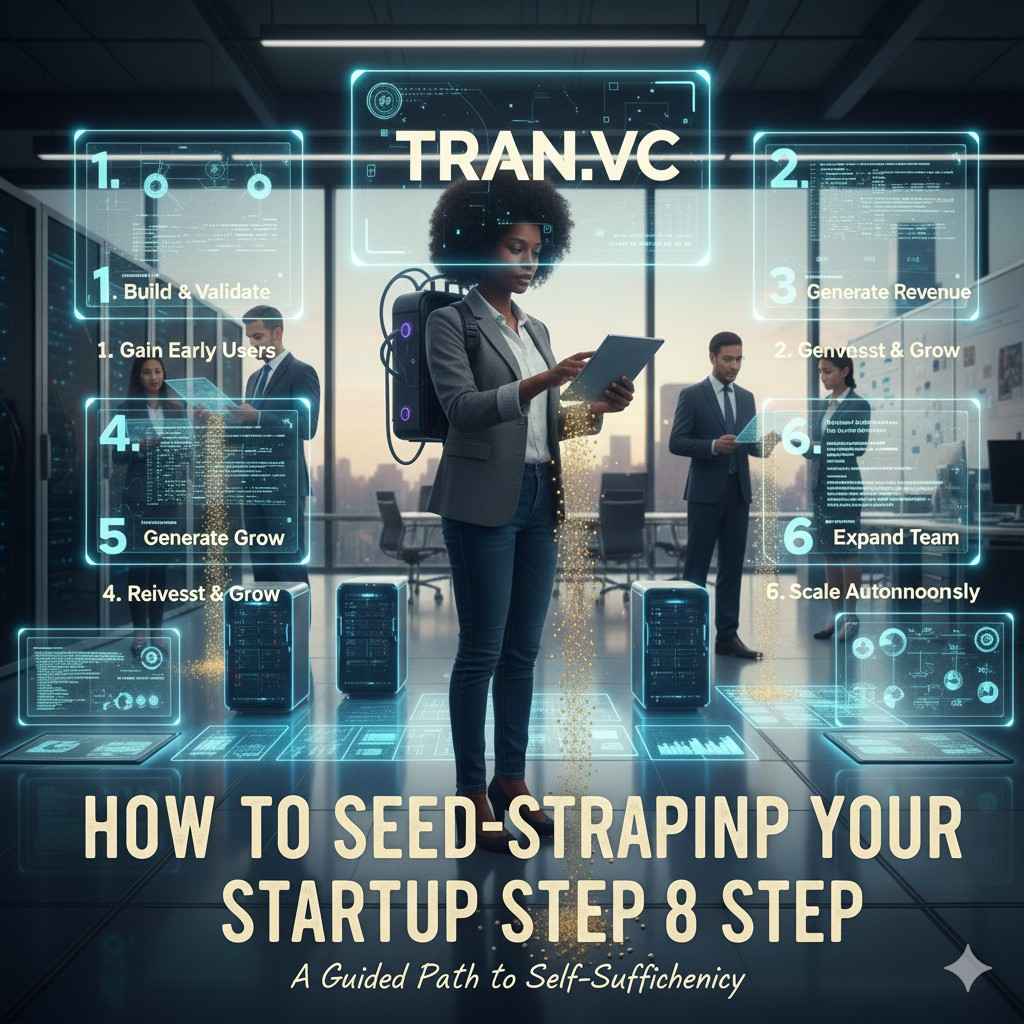
The first step in seed-strapping is not to design your dream platform. It is to find the smallest thing you can build that gives real value to a very clear user. You do not need every feature. You do not need every idea. You just need one sharp use case that proves your tech helps someone in a real way.
To do this, pick one user type you understand well. It might be a machine operator, a data analyst, a lab manager, or a warehouse team. Ask what they struggle with and where your tech can ease that pain. Then shape your first version around that one moment of value. Every line of code should move you closer to solving that exact problem.
When you ship that first version, you are not trying to impress the world. You are trying to hear an honest “this helps” from a real person. That is your first win. From there, you can refine, extend, and improve. But you now have proof that your idea is not just interesting, it is useful.
Step Two: Build a Simple IP Capture Habit
As you work on that first version and the next few cycles, you build a small habit that will change your company in the long run. Each time you ship or solve something tricky, you write down what was new about it. You keep a shared document or a simple log where the team adds short notes on new methods, flows, or tricks they discover.
You do not need fancy tools for this. You just need the discipline to pause for a few minutes when something important happens. Over time, that log becomes a goldmine. It shows the real story of your invention as it unfolds. It helps you remember details that are easy to forget when you move fast. And it gives your IP partners a clear view of what to protect and how.
With Tran.vc, this log becomes the raw material for structured IP work. We can review it with you, spot the patterns, and help you decide which items are strong enough for filings and which ones support them. This is how you build an IP portfolio that matches your actual product journey, not a random collection of ideas picked at the last minute.
Step Three: Talk to Users and Investors in Simple, Real Words
Seed-strapping also changes how you talk. You practice explaining your tech in clear, simple words. You focus on what it does, who it helps, and why it is hard to copy. You avoid buzzwords and vague claims. Instead, you tell short, real stories about what your product did for someone last week.
When you talk with users, this helps them trust you faster. They see that you care about their problem more than your own ego. When you talk with investors later, it shows that you understand both the technical side and the human side of your product. That mix is rare and very powerful.
Your IP work supports this clarity. When you have well-written patents or applications, they often become a guide for your language. The claims and descriptions force you to be precise about what your system does and how it works. You can then re-use that clear thinking in your product narrative and your pitch.
If you want a partner that helps with both the tech story and the IP story, you can apply to work with Tran.vc at: https://www.tran.vc/apply-now-form/
What Happens If You Skip Seed-Strapping
Growing Fast Without a Base
When founders skip seed-strapping, the story often looks the same. They raise a small round early. They feel pressure to move fast. They hire before they are ready, add features because someone asked, and chase every new idea that sounds big.
On the surface, things look busy. There are more meetings, more people, more announcements. But under the surface, the core product may still be unclear. The real edge of the tech is not protected. The team is tired, and no one can say in simple words what the company truly owns.
When the time comes to raise the next round, this gap shows.Investors see motion, but not much that is hard to copy. The company feels “late” even though it moved quickly. That is the hidden cost of skipping a calm, focused start.
Letting Others Define Your Direction
Without seed-strapping, founders are more likely to let outside voices shape their direction too early. A large customer asks for a custom feature, so the team drops everything. An investor pushes for a different market, so the roadmap changes again. Over time, the product drifts away from the original insight that made it special.
This drift can be slow and subtle. No single decision feels wrong. But after a year, the company looks and feels very different from what the founders first imagined. The tech may be impressive, yet it does not solve one clear problem deeply. That makes it easier for rivals to match or pass you.
Seed-strapping helps you avoid this by making your core tech and IP the anchor. You still listen to feedback. You still adapt. But you do not bend so far that you forget what only you can do.
If you want help staying close to your own vision while still growing, you can apply to Tran.vc at: https://www.tran.vc/apply-now-form/
How Seed-Strapping Prepares You for Serious Seed Rounds
Showing Up as a Ready Partner, Not a Project
When you seed-strap, you do not walk into your first major seed round asking investors to “take a chance” on you. You walk in as a founder who has already done the hard work of thinking, building, and protecting. That changes the tone from the first call.
Instead of long, vague promises, you can show a working product, real user stories, and protected IP around your key methods. You can explain what you do in plain language and back it with filings that prove you thought ahead. You are not just a project or an experiment. You are a young company with real assets.
This is the kind of setup top seed investors respect. They see a team that used the early stage well. They see discipline, not chaos. They see that if they invest, their capital will land on top of a solid base, not a pile of half-finished ideas.
Getting Better Terms and Better Partners
When you are not desperate for money, you can choose your partners with care. Seed-strapping gives you this power. Your burn is under control. Your IP is in motion. Your product is making steady progress. You can afford to say no to the wrong deal.
This often leads to better terms. You are not bargaining from a place of fear. You can be clear about what you want, what you will not accept, and how you see the next few years. Investors feel that clarity. The ones who align with your vision lean in. The ones who do not simply move on, which is a good thing.
You are not trying to win over everyone. You are trying to find the few partners who share your belief in deep, defensible tech and patient, thoughtful building. Seed-strapping filters for those partners almost by itself.
Tran.vc also helps here in a simple way. When you show up with a clear IP story and structured filings, you signal that you are serious about building a lasting company. This makes it easier for you and for the right investors to find each other.
If you would like to step into your next round with that level of strength, you can start by applying at: https://www.tran.vc/apply-now-form/
Seed-Strapping for AI, Robotics, and Deep Tech
Why These Fields Need a Different Start
AI, robotics, and deep tech products do not behave like simple apps. They have longer build times, more research work, and complex systems under the hood. The “move fast and break things” playbook often fails here. You cannot fake depth with a slick interface for long.
In these fields, your edge lives inside your models, your data flows, your control loops, and your hardware designs. These are not things you can bolt on later. They are part of the core from day one. That is why seed-strapping fits deep tech so well. It respects how long hard things take, and it helps you protect that effort as you go.
Instead of pushing you to grow before the science is ready, seed-strapping gives space for careful work. You can refine your model, tune your robot, improve your algorithm, and still feel forward motion because your IP story grows at the same time as your product.
Turning Hard Problems into Clear Stories
One of the toughest parts of building in AI or robotics is learning how to explain what you do without losing the depth or boring your audience. You may spend months on a tiny piece of the system that has huge impact but is hard to describe. Seed-strapping helps you practice this translation early.
When you work with a partner like Tran.vc, you get used to breaking down your ideas into simple, clear parts. You describe inputs, outputs, key tricks, and why they matter. This is the same muscle you need later for customers, hires, and investors.
Patents and IP work become a kind of training. They force you to see your own work with fresh eyes. You ask, “What is really new here. Why does it matter. How is it different from what came before.” These questions sharpen your thinking and your story.
If you are building in AI, robotics, or deep tech and want that kind of support, we would be glad to hear from you. You can apply any time at: https://www.tran.vc/apply-now-form/
What Seed-Strapping Feels Like Day to Day
More Time on Deep Work, Less on Theater
A big benefit of seed-strapping is how your days feel. Instead of spending most of your time pitching, preparing decks, and jumping from meeting to meeting, you spend more time in deep work. You write code, run tests, speak with users, and think about your system.
There is still pressure, of course. You want to move forward. You want to win. But the pressure comes from inside the craft, not from outside noise. You measure success by things you can control: better performance, happier users, stronger IP, clearer stories.
This kind of work day is often why you became a technical founder in the first place. Seed-strapping brings you back to that. It lets you enjoy building again, even while you stay serious about growth and funding.
Building a Culture of Care and Ownership
The way you start your company shapes your culture for years. If the first chapter is all about chasing rounds and buzz, the team learns to value noise over depth. If the first chapter is about careful work, user truth, and protecting what matters, they learn to value quality and ownership.
Seed-strapping sends a clear signal to your early team. It says, “We build things that last. We do not rush just to look big. We respect our own ideas enough to protect them.” People who join that kind of culture often stay longer, care more, and do better work.
This culture also shows up in how you treat partners and customers. You become the kind of company that says what it means, does what it says, and moves forward with intention. That kind of reputation is hard to buy with any amount of funding. It is built, slowly and honestly, from the first days.
If you want your early culture to grow around these values, Tran.vc can be part of that story. You can apply at: https://www.tran.vc/apply-now-form/
Is Seed-Strapping Right for You
The Kind of Founder Who Benefits Most
Seed-strapping is not for everyone. It is for founders who care more about deep work than fast headlines. It is for teams who want to understand their edge and protect it, not just ride the latest trend. It is for people who would rather own a strong, durable company than chase a quick flip.
If you are the kind of founder who sketches systems for fun, who reads papers late at night, who feels a rush when a hard problem finally clicks, seed-strapping likely fits you. It gives you space to do your best work without starving your company of support.
You still want to grow. You still want to raise, hire, and scale. But you want to do it on a base that you trust. You want to step into each new stage with assets, not just hope. That is exactly what seed-strapping helps you build.
Questions to Ask Yourself Right Now
To see if seed-strapping is right for you, you can ask yourself a few simple questions. Are you clear on what part of your tech is truly new. Have you written it down in plain words. Do you have even a rough plan for how to protect it. Do you feel pushed to raise before you feel ready.
If your honest answers are “no” or “not yet” or “yes, I feel pushed,” then seed-strapping may help reset your path. You do not need to start over. You just need to shift how you move from here.
You can keep building, keep serving users, and at the same time start treating your IP and early structure as core work, not a side task. That one change can alter the whole arc of your company.
If this resonates with you, you can share a bit about your startup with us at: https://www.tran.vc/apply-now-form/
Bringing It All Together
A Different Way to Start, Built for What You Are Building
Seed-strapping is a simple idea with deep impact. You build like a careful, lean founder, but you do not do it alone. You get support in the form of time, skill, and IP services instead of just cash. You use your early years to shape a company with real, protected value, not just exciting slides.
For AI, robotics, and deep tech startups, this way of starting fits the work. Your hardest problems need time and focus. Your biggest wins live in methods and designs that deserve protection. Your best investors will respect a company that took the early stage seriously, instead of rushing through it.
Tran.vc was created to back this kind of founder. We invest up to $50,000 in in-kind patent and IP services so that you can keep control, stay lean, and still build a strong moat from day one. We work with you to turn your code, models, and systems into assets that speak clearly to users and investors alike.
If you are tired of feeling like you have to choose between building slowly with no help or rushing into a round you are not ready for, seed-strapping gives you a third path. It lets you move with calm, with intention, and with support that matches the depth of your work.
If you read this and felt a “yes, this is how I want to build,” then your next step is simple. Tell us about your startup, your tech, and where you are today. You can apply any time at: https://www.tran.vc/apply-now-form/
From there, we can see together whether seed-strapping with Tran.vc is the right next move for you and your company.