
Every startup begins the same way: a few smart people, a messy whiteboard, and a spark that feels bigger than the room you’re in.
In the first weeks, you are not thinking about legal clauses. You are thinking about building. Shipping. Testing. Surviving. You are trying to turn an idea into something real.
But here is the hard truth: the earliest weeks are exactly when ownership gets decided.
Not because you sign some dramatic contract on day one. Ownership gets decided quietly, in small moments. A co-founder writes the first version of the model on their personal laptop. A contractor tweaks the robot control loop “as a favor.” An advisor shares a key approach and then later says it was their method. A university lab mate sends code from an old research repo. Someone uses open source in a way that later forces you to publish your own code. A developer pushes commits from a previous employer’s machine. A startup studio gives “help” and expects rights later.
None of these moments feel like a big deal at the time.
Then you raise money. Or try to.
And suddenly the questions start.
Who owns the code?
Who owns the inventions?
Did every person who touched the product assign their rights to the company?
Are there any limits on what the company can patent?
Does anyone outside the company have a claim?
Is there any risk that a key part of the tech belongs to someone else?
If you cannot answer those questions with clean, signed papers, the deal slows down. Or the investor asks for a big discount. Or a buyer walks away. Or your competitor files first. Or a former contractor sends you an email that begins with, “I think we need to talk about my contribution…”
This is why IP ownership clauses matter from day one.
Not because you love paperwork. Not because you want to “act big.” But because you are building something valuable, and value needs a clear owner.
And if you are building in AI, robotics, or deep tech, this is even more important. Your product can look simple on the outside. But the real value is inside: the models, the training method, the data pipeline, the system design, the control logic, the edge cases you solved, the safety moves, the way you cut compute cost, the sensor fusion trick, the workflow that makes it usable. Those are assets. Those are the “why you win” pieces.
If those assets are not clearly owned by the company, you do not really have a company yet. You have a project.
So in this article, we are going to talk about what IP ownership clauses really are, why they protect you, and how to put them in place early without slowing your team down. We will keep it practical. We will keep it simple. And we will keep it focused on real founder problems.
Also, if you are building in AI, robotics, or deep tech and you want help doing this the right way from the start, Tran.vc can help you build a strong IP base early through in-kind patent and IP services (up to $50,000). You can apply anytime at https://www.tran.vc/apply-now-form/.
Why You Need IP Ownership Clauses from Day One
The quiet way ownership gets lost
Most founders do not “give away” their IP on purpose. It slips away in normal work moments, when everyone is moving fast and no one wants to slow down.
A teammate writes early code on a personal laptop and never signs anything. A contractor fixes a hard bug and sends the patch in a chat message. An advisor suggests a key method and later believes they should be listed as an inventor. A friend from school shares a script they wrote in a lab years ago. It all feels casual.
Months later, when money or traction shows up, those casual moments turn into serious questions. If you cannot show clean ownership, you may not be able to prove your company owns the thing it is selling.
That is what IP ownership clauses prevent. They turn informal work into clear company property, without drama and without guesswork.
IP ownership clauses are not “legal noise”
It is easy to think of clauses as stiff legal words that do not matter until later. But IP is not like a chair you can point to and hold. IP is a right, and rights depend on who created the work and what agreements were signed.
If you do not set the rules early, the default rules take over. Those default rules often favor the creator, not the company. That can be fine for a solo founder who built everything alone. But even then, you still want the company to own it, not you personally, because investors fund companies, not personal projects.
Ownership clauses are a simple way to say, in writing, “Work created for the company belongs to the company.” That one idea, written properly, can save you from painful cleanup later.
Why this hits deep tech teams harder
Deep tech is built from details that outsiders cannot see. In AI, the value may sit in the data flow, the training setup, the way you fine-tune, or the edge-case handling that makes the model reliable. In robotics, value may sit in control loops, sensor fusion, calibration steps, safety behavior, or the way hardware and software work together.
Because the value lives in these internal choices, a small contribution from the wrong person can become a big risk. One contractor who improved the core approach without assigning rights can create a major hole in your story.
And the more technical the product is, the more likely it is that you will want patents. Patents demand clean inventor records and clear ownership. If that is messy, filings become harder and more risky.
If you are building in AI, robotics, or other tech and want to set this up the right way early, Tran.vc helps founders build an IP foundation through in-kind patent and IP services (up to $50,000). You can apply anytime at https://www.tran.vc/apply-now-form/.
What “IP” really means in a startup
IP is more than patents
When people hear “IP,” they often think only about patents. Patents matter, but IP is a wider set of things your company can own and protect.
IP includes your code, product designs, models, training method, data work, and written materials. It includes diagrams, architecture, and sometimes even the way you run key steps inside the product. It can include names and brand elements too, though that is usually a separate track.
If you do not treat these items like assets, they end up floating around. Floating assets are easy to copy and hard to defend.
Ownership versus access
Many founders confuse “we have the files” with “we own the rights.” Having the code in your Git repo does not automatically mean the company owns it. Having the design in Figma does not automatically mean the company owns it.
Rights come from who created the work and what they agreed to. Without a strong agreement, a person can claim they still own what they made, even if you paid them. In many places, payment alone is not enough to transfer IP rights.
This difference matters most when something goes wrong. When everyone is friendly, nobody argues. When money, credit, or fear enters the room, people start looking for leverage. Ownership is leverage.
Why investors care so much
Investors are not trying to be annoying when they ask about IP. They are trying to reduce risk. If your company does not own what it sells, then the company may not be able to keep selling it later.
A serious investor has seen deals collapse because a former contractor owned a key component, or because a co-founder left and claimed rights, or because a prior employer had a claim. Many investors have lived through lawsuits that started from weak paperwork.
So when an investor asks about ownership clauses, they are asking a simple thing: “Is this company real, and is the moat owned by the company?” If you can answer cleanly, you build trust fast.
The real job of an IP ownership clause
It tells the story of “who owns what”
An ownership clause is not meant to be scary. Its job is to tell a clean story.
This story says that the company owns the work that is created for it. It also says that the people who create the work agree to help confirm that ownership when needed, like when filing a patent or responding to diligence questions.
Without this story, every invention becomes a debate. With it, inventions become assets.
It prevents “split IP,” which is a deal killer
Split IP happens when parts of your product are owned by different people. That can happen in small ways, like a contractor owning the core algorithm while the company owns the UI. It can happen in bigger ways, like a co-founder leaving and keeping rights to the model.
Split IP is a nightmare because you can’t easily license or sell your product, and you can’t easily stop others from using it. If you want to raise, investors see split IP as a red flag. If you want to sell, buyers see it as a major risk.
An ownership clause is a simple way to prevent split IP before it starts.
It creates clean paths for patents
Patents require clear inventor chains and clear ownership. Even when inventors are employees, it is still important that agreements are in place, because patents are legal property that must be assigned properly.
If your company wants to file patents, ownership clauses are not optional. They are the track the train needs to run on.
Tran.vc focuses heavily on this early foundation because it is where many technical founders get burned. If you want support building an IP plan and setting up strong ownership from the start, you can apply anytime at https://www.tran.vc/apply-now-form/.
Where founders usually get hurt
The “friendly contractor” problem
A common story goes like this. A founder hires a contractor quickly because speed matters. The contractor sends work, the founder pays, and everyone is happy. No one signs a proper IP assignment because it feels awkward.
Later, the company raises a round. The investor asks for contractor agreements. The founder scrambles. The contractor is now busy, or asks for more money to sign, or has disappeared. Even if the contractor is not trying to cause trouble, the missing signature becomes a blocker.
Sometimes it gets worse. Sometimes the contractor feels underpaid compared to the value they helped create, so they push for equity or a big payment in exchange for signing. At that point, the founder is negotiating from weakness.
Ownership clauses avoid this by making IP assignment part of the normal process, not a special ask later.
The co-founder exit that changes everything
Early teams form fast. Sometimes the fit is strong. Sometimes it is not. If a co-founder leaves and there is no clean agreement, your company can end up with a core piece owned by someone who is no longer around.
Even if the person is fair, they may be hard to reach. Even if they sign later, investors still worry about the risk that they could claim rights or cause issues in the future.
This is why founder agreements must include strong assignment language. It is not about mistrust. It is about making sure the company can survive normal team changes.
The prior employer risk
This one surprises many founders. If someone builds your product while still employed somewhere else, or uses tools and time from their job, that employer may claim that the work belongs to them.
Even after someone leaves, many employment agreements include clauses that cover inventions created during employment, and sometimes even for a period after leaving, depending on location and contract terms. If someone brings code or ideas from a prior job, you could inherit that problem.
Ownership clauses alone do not solve this, but they force you to ask the right questions early. They create a moment where a team member must confirm that what they contribute is safe to contribute.
The “advisor said it first” confusion
Advisors can be very helpful, and most are not trying to take your IP. But invention credit can get messy when the line between “general feedback” and “inventive step” is not clear.
If an advisor suggests a unique approach that becomes part of your core claim in a patent, they might need to be listed as an inventor. If they are listed, you will need an assignment from them too. If there is no agreement in place, this becomes a hard conversation later.
It is better to set expectations early. Clear advisor agreements and clear invention processes keep relationships clean.
What to put in place early without slowing down
The simple rule: the company owns work made for it
The heart of a good ownership setup is one clear idea: work created for the company belongs to the company. This should cover code, designs, inventions, and any other materials created in the course of work.
It should also cover work created outside work hours if it relates to the company’s business, depending on local laws. Many founders avoid this topic because it feels heavy, but the point is simple: if you build the moat for the company, the company should own the moat.
When this is stated clearly, people know the rules. That reduces conflict, not increases it.
Present assignment and future assignment
A strong clause usually does two things. First, it assigns rights to the company now for work already created. Second, it promises to assign rights in the future for work created later.
This matters because work happens over time, and not all inventions are obvious on day one. You want coverage that matches real life. You do not want to chase signatures for each small update.
Duty to help with filings
When patents are filed, inventors often need to sign papers. Sometimes they need to answer questions. Sometimes the patent office asks for changes and more signatures.
A good agreement includes a duty to help, even if the person later leaves the company. This is not about controlling someone. It is about making sure the company can protect what it created.
In practice, this clause becomes a quiet safety net. When everything is smooth, you never notice it. When something is stuck, it saves you.
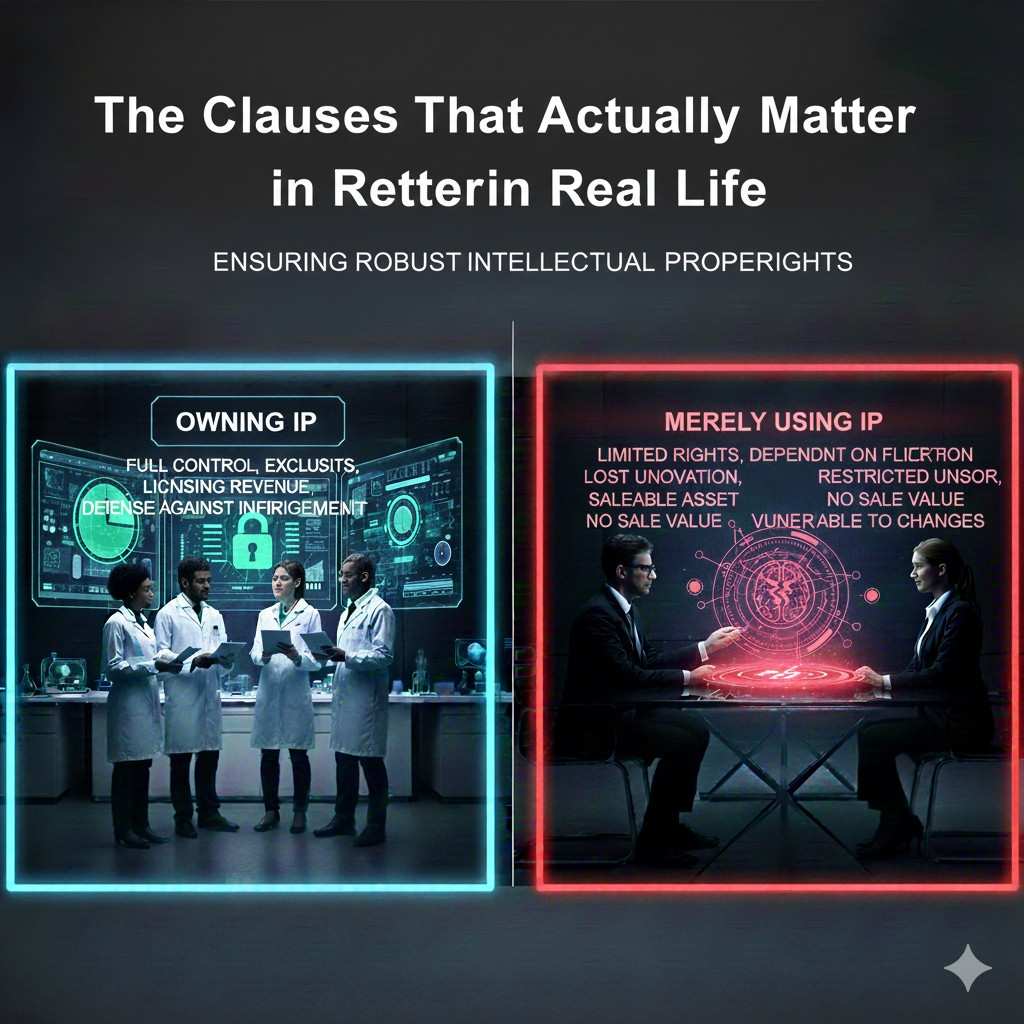
The difference between owning IP and merely using it
Why “we built it” is not always enough
Founders often feel sure that if the team built the product, then the company must own it. That feels fair, and it feels logical. But IP law does not always follow feelings or logic. It follows rules about authorship, invention, and written transfer.
If you do not have a clear written transfer, the person who created something may still own it, even if they were paid. In some places, even employee work can create confusion if contracts are weak or missing key lines. With contractors, the risk is even higher because contractor work is often presumed to belong to the contractor unless assigned.
This is why ownership clauses matter so early. You are not trying to “take” anything. You are making sure the company can safely use, protect, and grow what is being created for it.
The “personal laptop” trap
Early work often happens in personal spaces. That is normal. But personal spaces sometimes come with personal accounts, personal cloud storage, and personal licenses. Over time, it becomes hard to tell what is company work and what is personal work.
If a founder’s personal account controls the repo, the domain, the cloud keys, and the training dataset, then the company is exposed. If that founder gets sick, leaves, or has a dispute, the company can lose access or control.
IP ownership clauses should sit alongside basic operational hygiene: company-controlled accounts, company-owned repos, and clear transfer of early work into the company’s hands. It is not about distrust. It is about building something that can outlive any one person.
The risk of “permission” instead of “ownership”
Sometimes a contributor says, “You can use it.” Founders accept that because it feels friendly. But permission is not ownership. Permission can be revoked. Permission can be limited. Permission may not cover future uses.
Investors and buyers do not like permission. They like ownership. Ownership is stable. Ownership lets the company file patents, enforce rights, and negotiate from a position of strength.
If your core tech is built on permission, you are standing on a floor that can move.
The clauses that actually matter in real life
Assignment language that is broad enough
In the real world, “IP” is messy. It shows up as code, diagrams, test rigs, training scripts, prompts, fine-tuning recipes, deployment pipelines, mechanical drawings, firmware, and even spreadsheets that capture key logic.
A weak agreement names only one type of work, like “inventions,” and leaves gaps. A strong agreement uses language that covers the many forms that technical work can take, without becoming vague nonsense.
The goal is not to write a novel. The goal is to make sure that the agreement matches how builders build.
Inventions created before the company existed
This is a common point of confusion. Many founders start building before the company is formed. They may do early experiments, prototype code, or even a working version of the product while the company is still just an idea.
Once the company exists, you want that early work transferred in. If it stays personally owned, it can create tax issues, diligence issues, and ownership confusion later. It can also cause fights between founders if one person claims the “real IP” is theirs because they started earlier.
A clean founder IP assignment can move that early work into the company in a fair, documented way. This is one of those steps that feels boring but pays off for years.
Inventions created after someone leaves
People leave startups. It happens. Sometimes it is friendly. Sometimes it is not. The company still needs the right to use and protect what was created while that person was involved.
This is where strong assignment language and duty-to-assist language matter. It is also where good documentation habits matter. If you can show what was created when, and by whom, you reduce the space for arguments.
A calm, clear process early prevents emotional mess later.
How this plays out in AI companies
Training data and rights are part of ownership too
In AI, people focus on model weights and code, but data is often the true crown jewel. If you do not have rights to use the data you trained on, you might not have the right to sell the model output, depending on how the data was collected and licensed.
This is not only a legal issue. It is also a business issue. Buyers and partners will ask where the data came from. If the answer is vague, trust drops.
Ownership clauses help with this because they force you to define what people can bring in, and what they must not bring in. They also help you set rules around datasets created during work, so the company owns those datasets.
The model is not one thing
A model is not just weights. A model is a set of choices. The prompt layer, the fine-tuning method, the retrieval setup, the evaluation suite, and the deployment wrapper can be the real moat.
If a contractor built your evaluation harness and owns it, they can walk away with a key asset. If an advisor designed your data labeling method and later claims ownership, you may lose control of a core step.
The more “systems” your AI product becomes, the more places there are for ownership to leak. Ownership clauses keep the whole system inside the company boundary.
The open-source edge case that can bite you
Open source is powerful, and many startups rely on it. But not all open-source licenses are the same. Some are permissive. Some have conditions. Some can force you to share your own code if you combine things in certain ways.
IP ownership clauses do not replace good open-source policy. But they help you enforce one, because they make it clear that people must follow company rules when they bring code in.
If you want to raise money, you want a clean story here. You do not want to discover late that a key piece of your product has a license condition that scares investors.
Tran.vc often helps technical teams think through these details early, because strong IP is not only about filing patents. It is also about making sure your foundation is clean. If you want help building a strong IP plan from the start, you can apply anytime at https://www.tran.vc/apply-now-form/.
How this plays out in robotics companies
Hardware plus software makes ownership more complex
Robotics mixes mechanical design, electrical design, firmware, control algorithms, safety behavior, and manufacturing steps. One change in one layer can change the whole system.
This is why robotics teams must be extra careful with contractors and vendors. A mechanical design consultant might own a CAD file if the agreement is weak. A firmware contractor might own the core sensor drivers. A manufacturing partner might “improve” a design and then claim rights to that improvement.
If your robot works because of the integration, then every part matters. A missing assignment in one layer can weaken the whole product story.
Vendors and integrators may have their own templates
Many robotics teams work with labs, shops, and integrators. Those partners often have standard terms that include rights for them. Sometimes it is subtle, buried in a statement of work. Sometimes it is direct, like a clause that gives them ownership of improvements.
Founders sign quickly because they need parts and progress. Later, those terms can block patents or licensing deals.
A strong ownership mindset from day one helps you catch these terms early. You do not have to fight every vendor. But you do need to know what you are signing, and you need to protect the core pieces that make your robot special.
Safety logic and field data can become core assets
Robots learn in the field, even if not through machine learning. Logs, failure cases, calibration patterns, and safety improvements become a large part of the moat.
If your team treats field data like “just logs,” it can drift into personal storage or vendor storage. If your agreement does not define that the company owns this data and the derived improvements, you can lose control of a key asset.
Ownership clauses help you state clearly: anything created as part of the company’s work, including data and improvements, belongs to the company.
The founder’s practical playbook for day one
Make ownership part of onboarding, not a special event
The easiest way to keep IP clean is to make it normal. When someone joins, they sign the right agreements. When a contractor starts, they sign before work begins. When an advisor joins, they sign before they give deep technical input.
If you wait until later, you turn it into an awkward “please sign this now that we are valuable” moment. People notice the timing. They may feel used, even if you did nothing wrong.
If you do it early, it feels standard. It feels like a professional company. It reduces stress for everyone.
Keep your invention records simple but consistent
You do not need a heavy system. You need a habit. Capture what is being built, who is working on it, and when key changes happen. Link commits to tickets. Keep notes on major design decisions. Store core docs in company-owned tools.
This is not only for lawsuits. It is for clarity. When you file a patent, you will be glad you can trace the path of the invention without guessing. When an investor asks questions, you can answer quickly.
The point is not perfection. The point is a clean trail.
Avoid the “we’ll fix it after we raise” myth
Many founders think they will clean up IP later, after they raise. But raising is the moment when people look closely. That is when missing paperwork becomes expensive.
If you try to fix it at that point, you are doing it under pressure, and people can sense your urgency. That weakens your position.
A clean setup from the start is a quiet advantage. It makes fundraising smoother, faster, and less stressful.
If you want Tran.vc’s help setting up strong IP ownership and a patent strategy early, you can apply anytime at https://www.tran.vc/apply-now-form/.