
You don’t need perfect charts to raise. You need a clear, calm story that proves three things: people get value fast, they come back on their own, and each week your product gets safer, cheaper, and easier to use. Traction is not noise. It’s a few honest moments, measured the same way, that show steady control over risk and time.
This guide walks you through how to craft that story—from the first win a user feels, to the habits that form, to the tiny paid steps that turn proof into dollars. You’ll learn how to define metrics in plain words, show cause and effect with dates, and link your best lifts to methods you actually own. No fluff. Just moves you can run this month.
If you want a partner to help you protect the engine behind your results while you raise, Tran.vc invests up to $50,000 in in-kind patent and IP services for AI, robotics, and deep tech teams. Apply anytime at https://www.tran.vc/apply-now-form/.
Start With the Job and the First Win

Your story starts with one job your product does on a normal day. Keep it plain. Keep it close to the field. When the job is clear, every number has a home. Rooms relax because they can see what “good” looks like in the real world, not just in slides.
Define the job in buyer words
Say the job in one short line a customer would use. Use the words they already say at work. “Cut re-teach time at changeover.” “Draft a clean spec from messy notes.” “Flag a bad record and fix it.” Simple words stop long debates and guide your team.
Write it at the top of your metrics doc and your deck. Repeat it on every chart. This link makes each plot feel part of one story. It also helps partners repeat your message in their own meetings.
Check it against real scenes. If your line does not match last Tuesday on the floor or in the tool, rewrite it. A line that fits the week turns small wins into strong proof.
Make activation measurable
Activation is the first real win. It is not a login. It is not a tour. It is the moment the job got done once. Define it in a sentence. Keep it strict: either it happened, or it did not.
Track two things: the share of new users who hit the win and the median time it took. Time matters. A fast win feels safe. A slow win breeds doubt. Put both numbers side by side.
Group users by start week. Read cohorts, not rolling averages. Label the week a fix shipped. “Added dry run—Jan 12.” When the line jumps after the label, your story shows cause, not luck.
Build Habit So Value Sticks
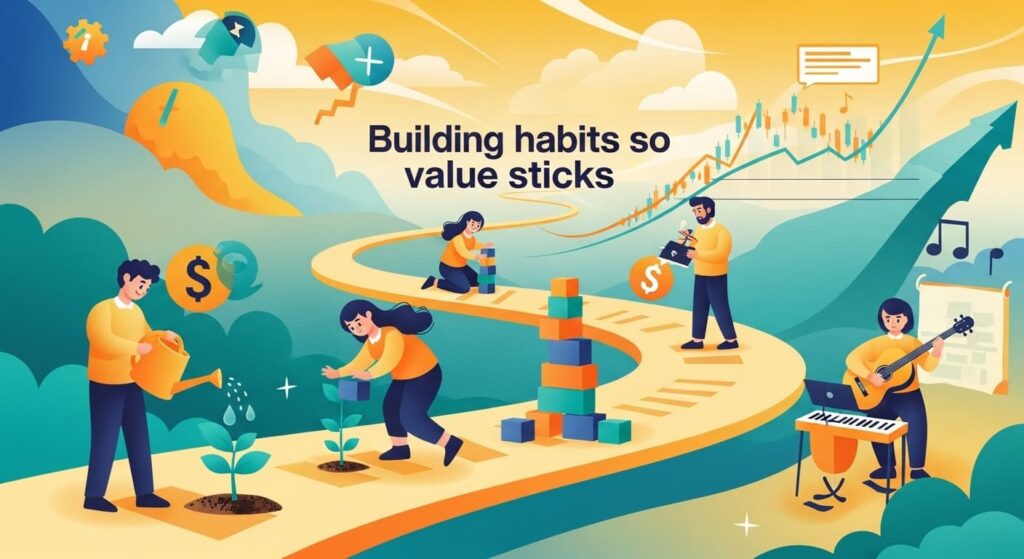
A single win is good. A second win, done without help, is better. Habit is the quiet force in your story. It says users return on their own because the product saves time, lowers risk, and remembers their last step.
Choose the “active” event that proves use
Pick one repeat action that matches the job. “New safe run at line speed.” “New draft sent as is.” “Batch cleaned and synced.” Do not count logins or clicks. Count work.
Write that event on the slide in tiny type. Use the same words in product copy and support docs. Shared words keep charts honest and keep teams aligned.
If you sell to teams, add an account view: “Any teammate ran a new job this week.” Behavior beats billing at this stage. You are proving use, not invoices.
Lift the tail with small, safe steps
Plot cohorts to week eight or month two. Show the first drop and the flat tail. That tail is your habit number. Label it. “Week eight tail ~34%.”
Make the second win faster than the first. Land users on last good settings. Offer one-click repeat. Add a confidence badge so scary steps feel safe. These tiny moves raise the tail because they remove fear and friction.
Tag the lift with a date and the change: “Kept presets—Jan 19.” Pair it with one screen or a 20-second clip. Visual proof ends debate and makes your win easy to forward.
Turn Proof Into Near-Term Dollars
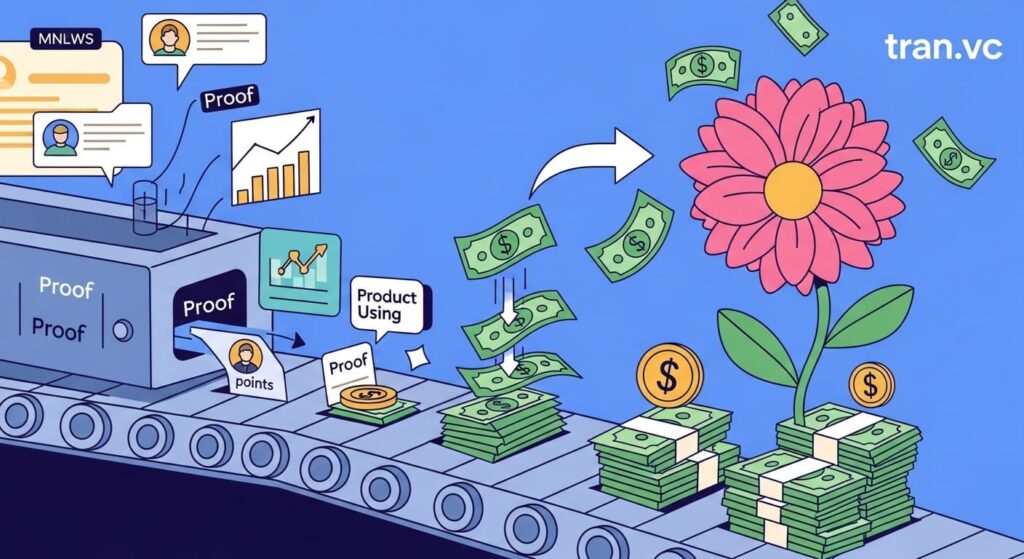
Investors want to see a clean path from value to money. You do not need big ARR. You need one small paid step that a manager can approve fast, tied to the same job and guardrails you already proved.
Design a tiny, fair first step
Keep scope narrow: one scene, one metric, one guardrail, two weeks. Write it in one line. “Two-week run on line two to cut re-teach minutes by half; dry run before live; manual stop allowed.”
Price it with the buyer’s unit. Per line, per device, or per team. Anchor the fee to the outcome you already moved. When price feels like a fraction of value, the talk is short.
Put owners and dates on the offer. Names beat titles. Dates beat hope. This turns interest into a plan and shortens the path to “yes.”
Qualify pipeline with one hard rule
Use one rule for “qualified”: buyer with the pain, path to budget, next step dated. If any part is missing, it is not qualified. Apply this rule to every source the same way.
Show stage speed for the last few wins: discovery → sandbox/shadow → tiny paid step. Label the change that cut time. “One-page pilot order −11 days.” Time saved is a non-revenue signal that feels like revenue.
Attach one artifact to each deal: a clip, a bundle, or a redacted LOI/MOU line. Files travel inside the buyer’s org. Files close gaps your words cannot.
Prove Quality and Safety in Human Terms

AI and robots need trust. Your story must show that the system is accurate when it should act and cautious when it should wait. Keep measures simple. Keep scenes real. Tie fixes to lifts with dates.
Pick one quality metric per job
Choose the unit people feel. “Accept rate without edits.” “Edits per 100 words.” “Correct flags at target speed.” “Safe resume under four seconds.” Write the metric in one line on the slide.
Keep a tiny hand-checked set that mirrors tough cases. Perfect labels on a small set beat noisy labels on a big one. Use this set each week to see if the curve moves.
When quality rises, name the change in plain words. “Pinned sources,” “few-shot templates,” “glare-safe planner.” Put the date next to it. Dates build belief.
Make safety a ratio, not a paragraph
Count guardrail events per day and the share that resolved safely without help. Add time-to-safe and time-to-resume. These numbers show care and uptime at once.
Record one short clip for each top hazard. “Defer under glare,” “stop on drift,” “ask before apply.” Clips beat claims.
If a unique arbitration or fallback loop drives safe choices, write the steps and consider filing. A trusted safety engine you own is a moat investors remember.
Show Cost Lines That Fall as You Grow
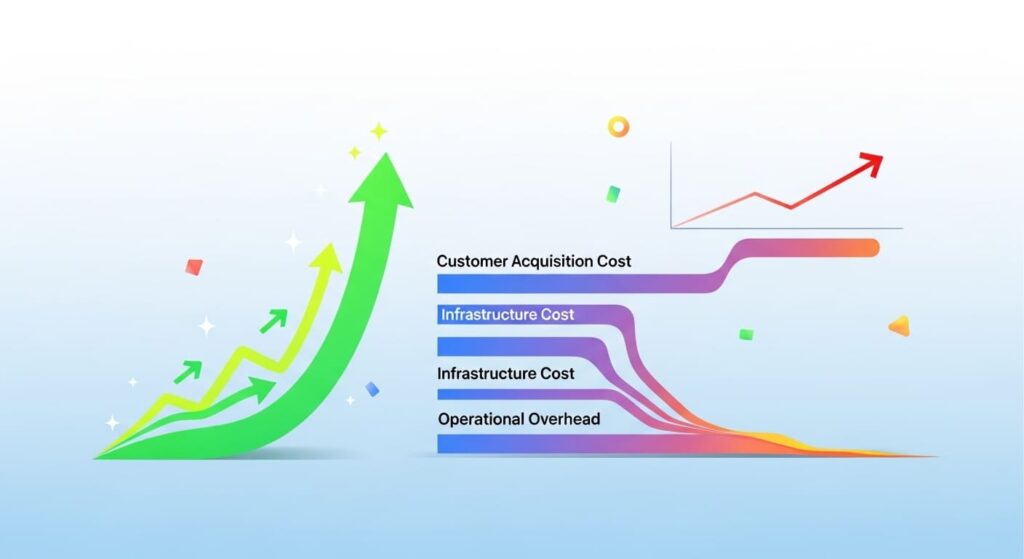
Falling cost to serve is a strong early signal. You can show it without a big model. Track just a few ratios, ship one lever at a time, and put dates on each drop.
Measure what maps to margin
Start with compute cost per active account, storage cost per active account, and minutes of human help per activation. Use weekly windows and write each equation on the chart.
Add one lever and watch the line: caching, batching, quantization, smarter polling, or a preset that cuts setup time. Label with a date. “Cache keys—Jan 12 → cost/active −34%.”
Close the slide with a plain line: “Cost per active fell while activation rose.” That one sentence says “scale is possible” without a spreadsheet.
Turn efficiency into edge
If a scheduler, cache recipe, or preset sequence keeps costs low under load, capture it as steps: inputs → checks → actions → fallbacks. Keep code out. Keep order clear.
File a focused provisional if the steps are novel and useful. Protected efficiency lets you hold price while competitors race to the bottom.
Note “method protected” in small type where relevant. Calm mention, big impact. You just tied margin to moat.
Keep Product Velocity Calm and Visible
Speed matters when it moves the right lines. A dated change log tells partners you ship often and learn fast—without drama. It also gives you ready proof for updates and diligence.
Log one change, one metric, one image
Each week, publish a single line: date → change → metric moved. Add one screenshot or 20-second clip. “Jan 18 — auto-preset → activation +8 pts.”
Show misses with the same tone. “Jan 22 — auto-threshold → no lift; rolled back.” Honesty builds trust and shows quality discipline.
After two lifts from the same kind of change, you have an engine. Name it. Protect it. Engines, not features, carry rounds.
Price That Feels Fair on Day One
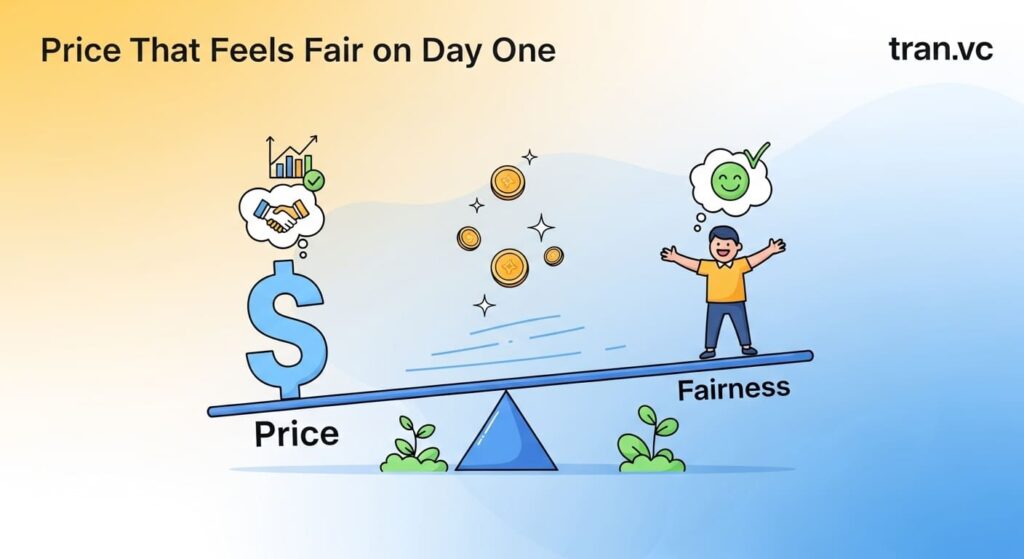
Price should read like common sense. When the number sits next to a result the buyer already tracks, the talk is short and calm. Your goal is a small, clear first step that proves value and sets a base for growth.
Anchor to one outcome the buyer cares about
Choose a single outcome that shows up in their weekly report. It could be minutes saved, errors fixed, or safe actions completed. Speak in their unit so no one has to translate. When your fee is a fraction of a number they trust, approval feels safe.
Write the anchor sentence in plain words and keep it stable. “Fee covers a two-week run to cut re-teach minutes by half.” After the run, restate the same line with the measured result and the same tone. You are echoing proof, not inventing a new story.
If your product helps many roles, pick the outcome owned by the person who signs. A line manager signs for minutes saved on shift. A data lead signs for false rejects reduced. Fit the anchor to the signer and friction drops.
Pick one clean unit and hold it steady
Set one unit that matches how the buyer budgets. Per line for processes, per device for hardware, per seat for teams. A single, obvious unit removes hidden complexity and keeps legal brief.
Keep the unit for a full quarter so you can read conversion and expansion without noise. If you change, document the why and the effect. A dated note like “switched to per line; close time fell two days” becomes a strong slide later.
Avoid stacking units. If you must tier, tie tiers to the same unit and a simple boundary. Stability builds trust and lets the champion retell your price inside their firm without you.
Tune with one lever at a time
Once you see three quick “yes” decisions, try a modest lift on the next two deals while scope stays the same. Small experiments reveal the ceiling without stalling momentum.
When pushback appears, find the heavy piece—unit, scope, or amount—and change only that one. Two changes hide cause and waste weeks.
Record each tweak with date and result. A line like “raised per line 12%—no change in close time” reads like control. Control is what partners want at pre-seed.
Tell Your Growth Through Cohorts
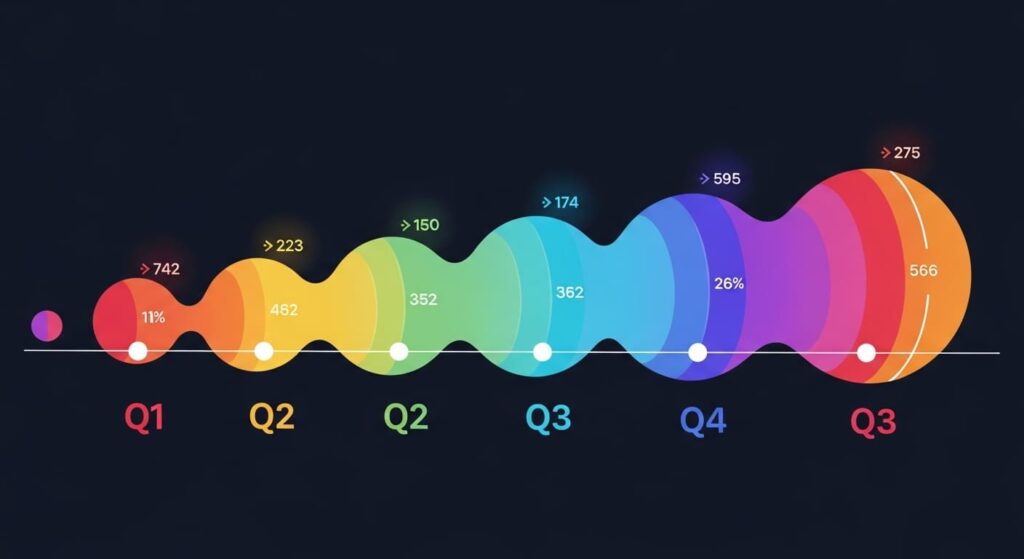
Cohorts turn small data into a story. They show how each week’s users behave over time and make cause and effect visible. Used well, they make your learning curve look like craft, not chance.
Fix one lens and keep definitions still
Choose weekly cohorts for users and monthly for accounts. Write the lens on the chart in tiny type. Stability is the trick; it teaches the room how to read your lines and stops debates.
Freeze activation and active definitions for a month at a time. If you must change, add the date and the reason on the slide. Honest change earns trust because it frames the past correctly.
Show the last eight to ten cohorts so the eye can see the first drop and the flat tail. Too many lines blur shape. Too few hide motion. Your aim is instant reading, not art.
Label what you shipped and when
When a line lifts, tag the exact point with the small fix you shipped. “Kept presets—Jan 19.” “Confidence badge—Jan 26.” Five plain words and a date tell the whole story.
Pair each tag with one screen or a 20-second clip in the appendix. Visual proof ends debates and helps champions pass your story up the chain.
Keep labels literal. Say what changed for the user, not the project codename. “One-click repeat” beats “workflow revamp” because it connects to behavior.
Segment once to prove fit, not to confuse
Add one second curve for the wedge you target most: a role, a channel, or a use case. When the right segment retains higher, you look focused, not narrow.
Explain the gap in human terms. “Shift leads return more because dry run removes fear.” Human truth sticks better than jargon and makes your roadmap obvious.
Close the slide with one next move aimed at the lower curve. “Make reviewer approve in one tap.” When the next cohort shows the lift, you turn a chart into a plan.
Security on One Page That Buyers Actually Read

Security stalls when answers are vague or long. One page of clear words can clear most early reviews. It should say what you collect, where it lives, who can see it, and for how long.
Draw a clean boundary with simple language
Write one calm paragraph that states what your system does and does not do. “We read text and metadata; we do not store raw files beyond X days; we never write to your systems without a manual confirm.” Boundaries reduce fear because they set edges.
Add a small diagram: inputs, processing, storage, outputs. Mark encryption at rest and in transit. Show role-based access with two boxes: customer and vendor. Pictures end long threads.
Name the default retention and the strict option. Defaults move fast. Strict options win tough rooms. Offering both shows respect and control at once.
Answer ten questions in two lines each
Hit encryption, access, logging, regions, backups, deletion, incident response, vendor access, PII handling, and audit. Keep each answer to two sentences so the whole FAQ fits on one page.
Avoid tense legal tone. Plain words travel better inside large firms and let your champion copy-paste with confidence.
Date the page and note changes. “Updated 2025-01-12: shortened log retention to 30 days.” Timelines prove maturity and speed follow-ups.
Provide light, real proof
Attach a redacted log sample with timestamps. Seeing grain builds more trust than a long claim.
Attach one screenshot of permissions. Viewer, editor, admin in simple words settles nerves faster than a paragraph.
If you built a privacy method that gets the same insight with less data, write the steps and consider filing. Useful privacy is both a sales win and a moat. Tran.vc can help you protect it while you ship.
Build a Tiny Data Room That Travels

Big folders slow busy people. A tight, tidy room moves decisions because it is fast to read and easy to forward. Include only items that answer common questions with proof.
Keep it small and self-explanatory
Add one architecture page, one security page, one safety page if you touch the physical world, three short clips tied to real scenes, two one-page before/after memos, your metrics definitions, and a one-page pilot order. That’s enough.
Each file should stand alone. If a document needs your voice to make sense, rewrite it shorter. Your champion must be able to carry your story without you in the room.
Put a one-paragraph README at the top that lists contents and update dates. Reviewers open the right files first and walk away with fewer doubts.
Name and date files like a pro
Use boring names with dates: Activation-Cohort-2025-01.pdf, Pilot-Changeover-Clip-2025-01-15.mp4. Clear names open on phones and survive forwards.
Stamp “Updated YYYY-MM-DD” on each PDF footer. Dated truth beats undated claims in every diligence pass.
Replace files in place instead of stacking versions. One source of truth lowers confusion and speeds review.
Refresh one item per month
Swap one clip or chart with a fresher one each month. Keep the frame the same so change pops.
Add one line to the README: “Cohort updated with Jan 19 dot; activation +7 pts after dry run.” Your room becomes a living log people trust.
If an artifact keeps winning meetings, tie it to a method and filing. Durable proof should sit on assets you own. Tran.vc can help convert those into strong claims while you grow.
Handle Weak Numbers Without Fear
Not every chart sings. That’s normal. What matters is how you explain the dip and what you ship next. Calm, clear fixes turn weak numbers into trust, because they show control.
Say the gap in one plain line
Name the metric, name the moment, name the cause. “Activation fell in Week 6 after we moved import; users got stuck on file format.” Keep it short so the room hears the point. Short lines feel honest. Long lines feel like spin.
Avoid hedging. Do not pile “buts.” A single cause shows you looked closely and found the edge that broke. That tone reads as leadership under stress.
Add the date you saw it. Dates prove you watch your own work. They also set a clock for the fix, which tells the room you will move, not wait.
Show the fix and the early sign
Describe the change in simple steps. “Added sample set, auto-detect, and a dry run.” Steps beat slogans. People can picture steps.
If the main metric is too slow to move, show a proxy. “Import tickets fell from 19 to 6.” Proxies are honest when they map to the job; they buy you a week to land the big lift.
Put a tiny dot for the first new cohort, even if small. Early dots say the plan is working. Investors remember motion that starts now, not promises that start later.
Close the loop in your next update
In two weeks, come back with the same chart and the same rule. New dot, same axes. The eye sees the lift at once.
Write one sentence under it: “Fix landed; activation +9 pts; median time −6 minutes.” Dated deltas calm rooms more than long essays.
If the fix came from a method you invented—a preset, planner, or validator—write the steps and consider filing. Traction tied to an owned engine is rare. Tran.vc can help you protect it while you ship.
References That Travel Inside Firms

A real voice beats a glossy case study. Two short quotes in buyer words can carry your story farther than ten charts. The trick is to make it easy for champions to share truth without meetings.
Capture raw words from the floor
Ask for one sentence about one scene and one number. “Dry run made it safe to try on shift.” “Accept rate hit 63% with pinned sources.” Keep their spelling and tone. Real words feel real.
Record the moment you earned the line. A 20-second clip with the result on screen lets a stranger believe the quote with no extra work.
Store the quote and clip together. When you paste the quote near the chart it reflects, the room links human truth to the metric in a heartbeat.
Place quotes where decisions happen
Put one line on the slide, near the curve it matches. The chart says “what”; the quote says “so what.” That pairing travels well in partner meetings you never attend.
Send the same line in your update email with the clip link under it. Updates get forwarded; short, honest lines survive forwards.
Add the role, not the full name if privacy matters. “Line Lead, West Plant.” Roles are enough to anchor trust without extra legal work.
Ask for light, not heavy favors
Offer a ten-minute call, not an hour. Bring one clip and one number to jog memory so your reference does not have to prepare.
After the call, thank them with a note that names the win they helped create. Your respect makes the next ask easier—for them and their peers.
When the same person vouches twice, note it. Repeat champions are force multipliers. Protect that relationship with care and punctual updates.
LOIs and MOUs as Traction Amplifiers
You can use simple paper to turn belief into a plan. A Letter of Intent says “we plan to do this if checks pass.” A Memorandum of Understanding says “here’s how we will do it.” Both are short, fast, and powerful.
Write them in the buyer’s language
State the job, the scene, and the guardrail in one line. “Two-week run on Line 2 to cut re-teach minutes by half; dry run first; manual stop allowed.” Plain words reduce fear.
Add a date and an owner. Names beat titles. Dates beat hope. “Start March 10. Ops lead: Priya.” Now calendars move and rooms book time.
Keep the promise small. “If goal met, discuss two-line expansion.” You are lighting the next step, not the whole road. Small steps get signed.
Use paper to compress time
Pair an LOI with a security one-pager and a tiny FAQ. Most stalls die when answers are short and concrete.
Move from LOI to MOU in days, not weeks. The LOI sets intent. The MOU sets steps. Fast flips show discipline and make champions look good.
Track days from LOI → start and MOU → first result. When you tighten wording and those clocks fall, put the dates on a slide. Process lift is traction.
Link paper to proof and IP
Attach one clip and one metric to the MOU. Decisions speed up when proof sits next to plan.
If the reason the buyer said yes is a method—glare-safe preset, retrieval recipe, arbitration loop—write the steps and file a narrow provisional.
Note it lightly: “Method protected.” Traction plus moat is the line investors repeat later. Tran.vc can help draft, refine, and file in-kind while you keep moving.
A Founder Update Rhythm That Compounds

Your update is part of your traction story. Short, dated notes show motion without noise. They keep warm funds warm and turn “maybe later” into “let’s re-meet.”
Use one screen with the same frame
Top row: activation rate and median time to first win. Middle: week-eight tail. Bottom: median days to first dollar. Same axes every time. New dots, same frame.
Add three lines with dates: what you shipped, what moved, what’s next. “Jan 18 — auto-preset → activation +8 pts. Next: reviewer one-tap approve.”
Close with one ask tied to your wedge. “Two lines, two weeks, glare guardrail.” Specific asks unlock specific intros.
Answer with artifacts, not adjectives
Attach one 20-second clip and one redacted MOU/LOI line. Files beat narratives because they end debate.
Keep file names boring and dated. People open clear names on phones in halls.
If a method drove the lift in your update, add a quiet note: “provisional filed.” You just told a bigger story with six calm words.
Earn trust by showing misses
When a change does not move the dot, say so. “Jan 22 — auto-threshold: no lift; rolled back.” Calm rollback signals quality.
Tell what you learned and what you will try next. Small, dated bets feel like craft.
Over months, this rhythm becomes proof. Rooms see the same frame, the same rules, and steady motion. That is the story that wins.
Your Q&A Defense Kit
Great stories still face hard questions. A tiny, ready kit turns Q&A into a fast, steady close. Think of it as a set of files that answer, not slides that argue.
Prepare answers to five core doubts
Accuracy: bring a hand-checked set and the before/after curve. Safety: bring a clip where the guardrail fired and time-to-resume. Cost: show cost per active falling with a dated lever. Pipeline: show qualified deals with next-step dates. IP: show a one-page method sketch and filing status.
Keep each answer one screen, one file. If you need voiceover, the file is too long.
Practice the handover. “Let me flip to the clip.” Speed and calm handoffs read as competence, not deflection.
Use the same vocabulary everywhere
Repeat the job line, the activation definition, and the “active” event across answers. Shared words make answers click faster.
If a term is new, define it once on the page in tiny type. Rooms appreciate clarity more than charisma.
Consistency also protects you in diligence. Same rules, same charts, same files—the signal is “this team is in control.”
Keep the kit fresh weekly
Swap in one newer clip or chart each Friday. Do not change the frame. Change stands out when the container is steady.
Archive old files in one folder with dates. When someone asks, “what did Week 4 look like,” you have it.
If a question repeats across rooms, add a file to the kit. Questions are roadmap hints. Treat them like tickets.
Tie Traction to Hiring and Roadmap

Your charts should guide who you hire and what you ship. When hiring, roadmap, and metrics align, you look inevitable. That feeling raises rounds.
Hire to lift the lowest dot
If activation lags, hire someone who kills setup pain. If tails sag, hire someone who designs for habit and safety. If days to dollars drag, hire a GTM builder who writes one-page orders and runs sandboxes.
Write roles as weekly outcomes, not titles. “Cut time-to-first win by 8 minutes in 30 days.” Outcomes attract builders who move numbers.
Score new work on the same board you use in updates. When a hire lifts a dot, show the dot and say their name. Ownership builds speed.
Roadmap the next cohort lift
Pick one small fix per week that should move one curve. Save state, add dry run, one-tap approve, sample data, clearer copy. Tiny steps compound.
Tie each fix to a metric and a date. “One-tap approve → week-4 tail +5 pts.” These micro-links turn roadmap into proof.
When a fix moves two cohorts, promote it from “feature” to “engine.” Engines deserve deeper investment—and often deserve a filing.
Protect engines as you scale
Write engines as steps: inputs, transforms, checks, fallbacks. Keep code out; keep order clear.
File focused provisionals on engines that move charts and survive messy inputs. You are turning rare craft into durable edge.
Note “method protected” where the engine shows up in your deck. Calm, light, and memorable.
The Appendix That Closes Gaps Fast
Your appendix is not a junk drawer. It is a set of small files that end debates. Keep it light, dated, and close to the work.
Include one clip per claim
Activation clip: first win landing. Safety clip: guardrail firing and safe resume. Quality clip: before/after with labels. Each under 20 seconds.
Keep device, light, and compute in a corner caption so viewers trust the setup. Honest bounds make small wins big.
Update one clip a month. New scenes, same frame. Motion is obvious because the shape stays still.
Add one-pagers for methods and security
Method page: steps in plain words, where it lives in the product, and which chart it moved. Security page: boundary, diagram, retention, and a log sample.
These two files answer 80% of diligence in minutes. They also make your champion look prepared in internal meetings.
If a privacy method reduces data by design, say so and file it. Buyers move faster when you ask for less.
Keep the room findable
Name files with boring, dated names. “Cohort-Tail-2025-01.pdf.” “Safety-Defer-Clip-2025-01-18.mp4.” People forward what they can find.
Use a short README with links and updated dates. A map saves reviewers time and earns goodwill.
Replace, don’t stack versions. One truth source reads as control. Control closes rounds.
Two Slides That Carry Your Story Without You
Most partners will retell your story in a short meeting you do not attend. Give them two pages that do the job. Keep shapes stable. Swap in fresh dots monthly.
Slide A: Proof under real limits
Top line holds the job in customer words. Below it, three small boxes: Activation, Retention, Quality/Safety. Each has a target, a result, a constraint, and a still image. The reader sees value land and stick under honest bounds.
Place two tiny date tags on charts where you shipped a change that lifted the curve. Labels show craft, not luck.
Add a quiet footer: “Method: glare-safe preset (provisional filed).” You just linked outcome to moat in six calm words.
Slide B: Motion toward dollars
Left column shows two dated release notes with the metric each moved. Right column shows a small table of qualified pilots with next-step dates and amounts. Bottom shows median days to first dollar with one date tag “one-page order.” The page reads like speed with control.
Finish with your tiny paid step: scope, guardrail, metric, owner, start date. Clear asks get yes. Vague asks stall.
Use the same two slides in updates. Paste new dots monthly. Familiar frames make change obvious and believable.
Keep answers one click away
Store a 20-second clip for each claim in your appendix, along with the security page, the pilot order, and a redacted LOI/MOU line. Files answer questions faster than adjectives.
Name files so a champion can find them weeks later. Many approvals happen without you. Your job is to make retelling easy.
If a method sits behind your best chart, include a one-page sketch of the steps (inputs → checks → fallbacks). It helps counsel see utility and helps investors see durability.
Conclusion: A Calm Story Beats a Loud One
Investors want a steady, human story. Define one job, show a fast first win, prove habit with a clean tail, and move to a small paid step that fits how buyers work. Put dates on each lift. Pair each chart with a screen or clip. Keep your words plain so anyone can retell them. This is traction: simple, repeatable proof that risk is falling each week.
Turn your best lifts into assets. If a preset, planner, retrieval trick, or safety loop keeps moving lines, write the steps and protect them. Then note it lightly: “method protected.” Traction plus moat is the mix that raises rounds on good terms. You do not need many numbers—just honest ones that match the work.
If you want a partner to help you lock this in, Tran.vc invests up to $50,000 in in-kind patent and IP services for AI, robotics, and deep tech teams. We sit with you to choose the right wedge, file clean claims, and package proof in two slides that travel. If that is your next step, apply anytime at https://www.tran.vc/apply-now-form/.