
You work hard to build your product. Your name, logo, and taglines should work hard too.
This guide shows you how to map your trademarks to your profit and loss (P&L). In plain words. No fluff. You will see where your marks make money, where they save money, and how to prove it.
Use this to make better calls, win budget, and raise with leverage.
Want help turning this into a real plan for your startup? Apply anytime: https://www.tran.vc/apply-now-form/
Quick win: what you’ll do in this guide
- List your trademarks (and ones you want).
- Link each mark to a product, buyer, and goal.
- Pick a few simple numbers to track.
- Run small tests to prove value.
- Tie results to lines on your P&L.
- Share the story with your team and investors.
- Repeat every quarter.
You can do this in a weekend. Keep it simple. Keep it real.
First, a 60-second primer
What is a trademark?

A trademark is how people know it is you. It can be a name, logo, icon, color, sound, or tagline. It points to your product and your promise.
What is a P&L?
A P&L shows your money in and your money out over a time period. Key lines:
- Revenue (money in)
- Cost of Goods Sold (COGS)
- Gross margin
- Sales & Marketing (S&M)
- Research & Development (R&D)
- General & Administrative (G&A)
- Operating profit (or loss)
We will map each mark to these lines.
Why this matters now (even pre-seed)
- Strong names lower your customer acquisition cost (CAC).
- Clear marks boost win rate and price.
- A known mark shortens the sales cycle.
- Clean rights reduce legal risk and rebrand risk.
- Good marks help hiring and partnerships.
You can measure each of these. Then you can put the value in your P&L. That’s how you raise with leverage, not hope.
Ready to turn your marks into assets? Apply here: https://www.tran.vc/apply-now-form/
Step 1: Inventory your marks (15 minutes)
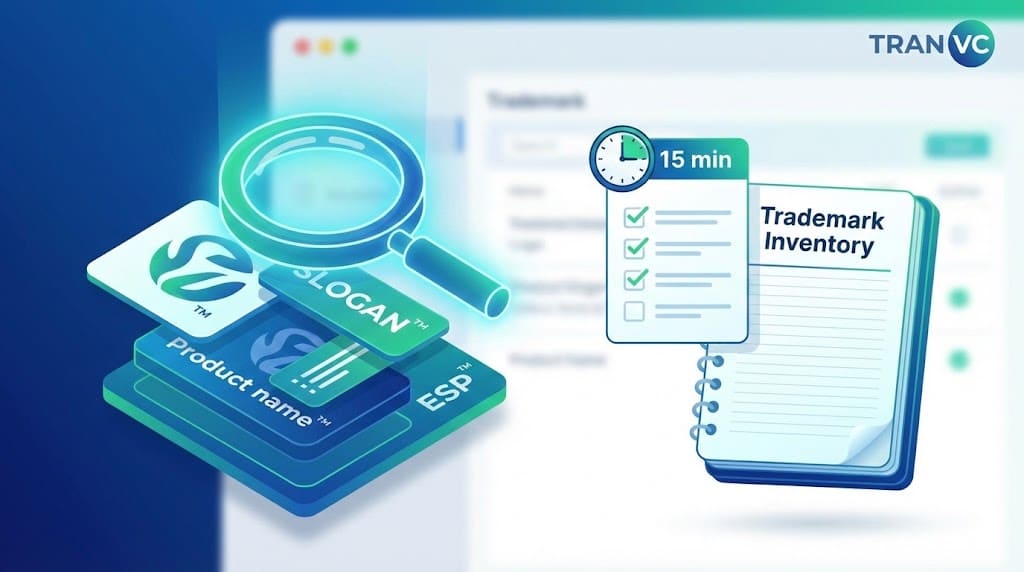
Open a sheet. Add these columns and fill them in. Be blunt and fast.
Columns
- Mark (name/logo/tagline)
- Type (word mark, logo, tagline)
- Product / feature it sells
- Buyer (who it speaks to)
- Use today (website, app, sales deck, hardware label, docs)
- Territory (US only? EU? India? online only?)
- Status (™ used, filed, registered)
- Risk (low/medium/high)
- Goal (drive trials? price? trust? channel?)
Example:
| Mark | Type | Product | Buyer | Use | Territory | Status | Risk | Goal |
|---|---|---|---|---|---|---|---|---|
| ROBOVIEW | Word | Vision SDK | CTO | Site, docs, pitch | US/EU | ™ only | Medium | Trials |
| Blue Hex Icon | Logo | All | CTO / PM | App, site | Global | Registered (US) | Low | Trust |
| “See More. Code Less.” | Tagline | SDK | Dev | Site, social | Global | Not filed | Medium | Click-through |
Keep it short. We will link this to money next.
Step 2: Choose the money levers your mark should move
For each mark, pick one or two levers. Don’t chase all at once.
Revenue levers
- More leads (organic brand searches, direct traffic)
- Higher conversion (landing → signup; demo → paid)
- Higher price (price premium vs. generic)
- Bigger deals (avg. contract value)
- Faster sales (shorter days to close)
- Higher retention (lower churn)
- More cross-sell (attach rate of add-ons)
Cost levers
- Lower CAC (more direct traffic, branded search)
- Lower support cost (trust = fewer “is this safe?” tickets)
- Lower sales cost (fewer calls to convince)
- Lower legal cost (rebrand risk, disputes)
- Lower COGS (brand enables standard parts, channel terms)
Pick levers that fit your stage. Pre-PMF? Focus on traffic and trials. Post-PMF? Focus on price and retention.
Step 3: Pick simple metrics (make them easy to pull)

Tie each lever to one clear metric. Examples you can get from GA, Stripe, CRM, or a simple spreadsheet.
- Brand searches per week (e.g., “roboview”)
- Direct traffic share (% of total)
- Landing → signup conversion (%)
- Demo → close rate (%)
- Average selling price (ASP)
- Price premium vs. nearest rival (%)
- Sales cycle (days opportunity created → closed)
- Monthly churn (%)
- CAC by channel ($)
- Support tickets per 100 customers
- Branded inbound leads (#/week)
Do not overthink. Choose what you can track now.
Step 4: Create your “Mark → Metric → P&L” map
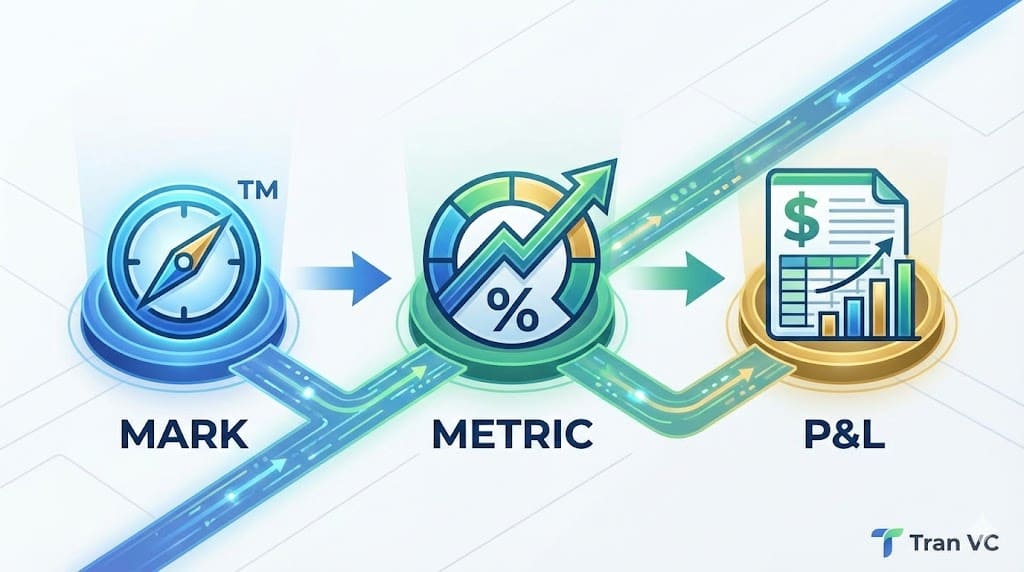
Add these columns to your sheet:
- Lever (e.g., conversion)
- Metric (e.g., landing → signup %)
- Current (baseline)
- Target (after mark change)
- P&L line (revenue, S&M, etc.)
- $ impact (per month)
Example row (SaaS):
| Mark | Lever | Metric | Current | Target | P&L line | $ impact (mo) |
|---|---|---|---|---|---|---|
| ROBOVIEW | Conversion | Landing → signup | 2.5% | 3.5% | Revenue | +$12,500 |
How to estimate $ impact, simply
- Leads per month: 20,000 site visits.
- Conversion lift: from 2.5% to 3.5% = +1.0 pp = 40% more signups.
- Signups: 500 → 700 = +200.
- Trial-to-paid: 10% → +20 paid.
- ASP (monthly): $625 → $12,500 more revenue/month.
Document your math in a note cell. You’re not trying to be perfect. You’re trying to be directionally right and repeatable.
Step 5: Run tiny tests (2–4 weeks)
You don’t need big budgets to prove value. Try these fast tests.
A/B landing page test
- What: Page A uses generic name (“Vision SDK”). Page B uses ROBOVIEW mark and logo.
- Goal: Lift in click-through to “Get a demo.”
- Measure: Conversion rate and qualified demo requests.
Branded vs. generic outreach
- What: Two email sequences. One uses mark and tagline; one uses generic product name.
- Goal: Lift in reply and booked calls.
- Measure: Reply rate, meeting rate, meetings per 100 emails.
Price anchor test
- What: Quote the same feature set with the mark vs. without the mark (“Generic Vision SDK”).
- Goal: See if marked offer holds 5–10% higher price with no drop in win rate.
- Measure: Win rate, ASP.
Marketplace / channel listing
- What: List under your branded mark in a marketplace. Compare to a generic listing you control.
- Goal: Clicks and installs per week.
- Measure: CTR, installs, reviews.
Trust signal test
- What: Add “® Registered Trademark” and brand story to pricing page.
- Goal: Lift in completed checkouts and fewer “is this safe?” tickets.
- Measure: Checkout completion %, support tickets.
Run the smallest test that gives a clear “keep or kill” signal.
Step 6: Tie results back to your P&L lines

Here’s where to put each kind of gain.
Revenue
- Conversion lifts
- Price premium
- Cross-sell attach rate
- Higher renewal rate
COGS
- Branded channel terms (lower fees)
- Standardized packaging/labels due to mark (lower unit cost)
Sales & Marketing (S&M)
- Lower CAC (more direct/branded traffic)
- Fewer touchpoints to close (lower sales hours)
- Higher email/domain reputation (better deliverability)
General & Administrative (G&A)
- Fewer disputes and takedowns
- Avoided rebrand (big one—see below)
Special: Rebrand risk (hidden monster)
A forced rebrand can burn months and a lot of cash. If your mark is weak or conflicts with others, you risk:
- New domain and design
- SEO reset
- New legal
- Reprinting hardware, labels, packaging
- Customer confusion
Assign a dollar number to avoided rebrand. Example: “We save an expected $120k by clearing and protecting our mark now.” That is real G&A/S&M savings.
Step 7: Use simple formulas to show value (copy-paste ready)
You can paste these into a spreadsheet.
1) Extra revenue from conversion lift
Extra Paid Users (per mo) = Site Visits × (New Conv% − Old Conv%) × Trial→Paid%
Extra Revenue (per mo) = Extra Paid Users × ARPU
2) Price premium value
Price Premium ($) = (New Price − Old Price)
Extra Revenue (per mo) = Price Premium × # New Deals per month
3) Faster sales cycle value
Cash Flow Gain (per mo) = (Old Close Days − New Close Days) ÷ Old Close Days × Monthly New Revenue
(Use this to show working capital benefit; investors love this.)
4) Lower CAC from branded traffic
Saved CAC ($ per mo) = (Old CAC − New CAC) × # New Customers
5) Retention improvement
Saved Revenue (per mo) = (Old Churn% − New Churn%) × MRR
6) Avoided rebrand
Avoided Cost ($ one-time) = Design + Website + Legal + Packaging + Domain + Lost Leads + Team Time
Write the sources for each number (GA, Stripe, HubSpot, guess with reason). Keep a “confidence” column (Low/Med/High).
Step 8: Make the case in one slide (template)

Use this structure for your board, your team, or your next raise.
Slide title: “Our Trademarks Drive Profit”
- Top line: “ROBOVIEW mark increased signup conversion by 40% and added $12.5k MRR in 30 days.”
- Three bullets:
- +$12.5k/month from higher conversion
- −$6.7k/month S&M from lower CAC
- $120k rebrand risk avoided (one-time)
- Mini table: Mark → Metric → Lift → P&L line → $ Impact
- Next moves: File word mark in US/EU; file logo in US; start watch service; integrate mark into channel listings.
End with a clear ask: budget, filing plan, and next test.
Real-world mini-maps (copy these)
For an AI API startup
- Mark: “TorchRate” (word) + flame icon (logo)
- Levers: Branded search, price premium
- Metrics: Direct traffic share; ASP per 1k tokens
- Tests: Branded doc site header; quote premium to 10 warm leads
- P&L Impact: +$18k/mo revenue; −$3k/mo CAC
- Next: File word mark in Nice Class 42 (software services). Start trademark watch.
For a robotics hardware startup
- Mark: “GripSafe” for end-effector line
- Levers: Channel trust; lower support tickets
- Metrics: Distributor acceptance rate; tickets per 100 units
- Tests: Channel listing with ®; “GripSafe Certified” card in box
- P&L Impact: +$220 per unit gross margin; −15% support cost
- Next: File mark on parts and packaging (Class 7). Register logo. Print on hardware plates.
For a developer SaaS
- Mark: “LintLite”
- Levers: Trial → paid; churn
- Metrics: 14-day conversion; 90-day retention
- Tests: Badge “™ LintLite” in IDE extension; case study with brand on homepage
- P&L Impact: +$9k MRR; churn down 2 points
- Next: File word mark. Expand to EU. Start Amazon Brand Registry for plug-ins marketplace if applicable.
The 30-60-90 day plan
Day 0–30
- Inventory marks (sheet).
- Pick 2 marks to focus.
- Set baselines for 3 metrics.
- Ship two A/B tests.
- Start clearance search (basic).
- Add ™ to live uses.
- Draft brand page (what the mark stands for).
Day 31–60
- Review test data. Kill what did not move.
- Push what moved into all key pages.
- File at least one word mark in home market.
- Add “brand terms” to paid search negatives.
- Train sales to use mark consistently in quotes and decks.
Day 61–90
- Expand filing to next market (if needed).
- Start watch service to spot copycats.
- Update P&L mapping with 60-day data.
- Share one-slide summary with team and investors.
- Plan next 2 experiments (price, channel).
Need help doing this right from day one? Apply now: https://www.tran.vc/apply-now-form/
Simple checklists you can use
Brand-to-P&L checklist
- Each mark has a clear goal (1–2 levers)
- Each mark has 1–3 metrics
- Baseline set last 4 weeks
- Simple test shipped
- P&L line tagged
- $ impact estimated
- Filing plan decided (word first, then logo)
- Watch service on
- One-slide summary done
Filing checklist (keep it safe and clean)
- Run a knockout search (exact match conflicts)
- Check domains and app store names
- File word mark in your main class (software/hardware)
- File logo if it carries meaning or is on hardware
- Use ™ right away; switch to ® after registration
- Keep proof of first use (screenshots, invoices)
- Set calendar reminders for renewals
Consistency checklist (make the value show up)
- Same spelling everywhere
- Same color/lockup for logo
- Sales deck uses mark in titles
- Quotes and SOWs use mark by name
- Price page shows mark and trust badge
- Packaging/labels show mark clearly
- Marketplace listings under the mark
How to show price power (simple but strong)
Investors perk up when you show price power.
Do this:
- Identify 10 warm deals that love the product.
- Send two quotes two weeks apart:
- Quote A: generic product name.
- Quote B: same features, but with mark and brand story page linked.
- Keep the price the same in A. Add +5–10% in B.
- Track which closes and at what speed.
If win rates hold with B, you just proved price power. Add that to your P&L map under Revenue. This is your moat starting to show.
How to show lower CAC with your mark
- Add your mark to title tags, H1, and favicon.
- Build a “What is [MARK]?” page with FAQs.
- Shift 10–20% of paid budget from generic to brand terms.
- Watch:
- Branded search volume (Search Console)
- Direct traffic share
- Blended CAC
As branded share grows, CAC usually drops. Put the savings under S&M in your P&L map.
How to show faster sales cycles
- Put your mark and ® (or ™) on the proposal template.
- Add a one-pager “What [MARK] covers” → reduce legal back-and-forth.
- Add 3 trust logos (customers) under the mark on your deck.
- Track “days from first call to signed.”
If days drop, that is a working capital win. Add to Revenue working capital note or S&M efficiency.
What to do if a mark does not move the number
It happens. Kill fast. Do not cling to a name that does not pull weight.
Ask:
- Did we choose the wrong lever?
- Is the mark confusing or too close to a rival?
- Are we using it everywhere?
- Do buyers actually say or remember it?
If you cannot fix it in two cycles, pivot the mark and test again.
Pitfalls to avoid (learn from others)
- Cute but unclear names. If a buyer asks “what is it?”, conversion falls.
- Late filing. A rival can file and block you. File early.
- Logo first, word mark later. Flip it. File the word first; it carries more weight across mediums.
- Inconsistent use. Five spellings = five weak brands.
- No baseline. If you don’t measure before, you can’t prove lift after.
- Rebrand in the middle of a launch. Clear the mark before big releases.
Your one-page worksheet (copy into your doc)
Header: Month/Quarter
1) Marks in focus
- Mark A: ___________
- Mark B: ___________
2) Levers & metrics
- Lever 1: ___________ → Metric: ___________ (Baseline: __, Target: __)
- Lever 2: ___________ → Metric: ___________ (Baseline: __, Target: __)
3) Experiments
- Test 1: ___________ (Start: __ / End: __)
- Test 2: ___________ (Start: __ / End: __)
4) P&L mapping
- Revenue: +$____ per month (source: __)
- S&M: −$____ per month (source: __)
- G&A: −$____ one-time (rebrand avoided)
- Notes: __________________________
5) Decisions
- File: Word mark in __ (yes/no) | Logo in __ (yes/no)
- Rollout: pages __, decks __, packaging __
- Kill/Keep: ___________
6) Owners
- Brand: __ | Product: __ | Sales: __ | Legal/IP: __
Where Tran.vc fits (and how we help you win)
You don’t just need a nice name. You need a defensible name that ties to real money. We help you:
- Plan a smart mark strategy across products and regions
- Clear and file word marks and logos the right way
- Set up watch and enforcement (so copycats can’t ride your work)
- Build the simple tests above and connect results to your P&L
- Turn your brand into an asset investors can underwrite
We invest up to $50,000 as in-kind IP services at pre-seed. You keep control. We roll up our sleeves with you.
If this is what you need, apply now: https://www.tran.vc/apply-now-form/
FAQ (fast and helpful)
Q: We are early. Should we file now?
A: Yes, for your main word mark in your home market. It is cheaper than a rebrand later.
Q: Word or logo first?
A: File the word first. Add the logo after.
Q: What if we sell in many countries?
A: Start where you sell now and where copycats live. Add more as you grow.
Q: Can we prove value before we file?
A: Yes. Use ™ now. Run tests. File as soon as you see lift.
Q: How do we budget?
A: Use the P&L map. Ask for budget where you show dollar impact.
Q: We have a hardware line. Anything special?
A: Yes. Put the mark on plates, labels, packaging, and manuals. File in the right classes for machines and parts.
A closing note for founders
Great tech wins minds. Great marks win hearts and budgets. When you map your marks to your P&L, you prove both.
Start small. Measure. Protect. Repeat. That is how you build a moat, not hype.
When you’re ready to turn this into action with real IP experts at your side, apply here: https://www.tran.vc/apply-now-form/
Copy-paste templates (bonus)
1) Metric tracker (put in Google Sheets)
Date | Mark | Lever | Metric | Baseline | Current | Target | Delta | P&L Line | $ Impact | Source | Confidence
2) Experiment log
Exp ID | Mark | Hypothesis | Variant A | Variant B | Start | End | Result | Winner | Next Step
3) Filing tracker
Mark | Type | Country | Class | Status | Serial No. | Filing Date | First Use | Specimen Link | Next Deadline
4) One-slide script (read this out loud)
- “In the last 30 days, our [MARK] lifted [METRIC] by [X]%, adding $[Y]/mo and cutting $[Z]/mo in S&M. We filed the word mark in [COUNTRY], set up watch, and will expand to [COUNTRY 2] next. We request [budget/approval] to roll out across all surfaces and run two new tests on price and channel.”
Use these tools every month. In a few quarters, you’ll have a brand that sells, a P&L that proves it, and filings to protect it.
Let’s build that together. Apply now: https://www.tran.vc/apply-now-form/