
Most founders wait too long to think about patents.
Not because they do not care. But because it feels confusing, slow, and expensive. And early on, you are trying to build, ship, and survive.
A provisional patent can be a smart move in that messy stage. It can also be a waste of time and money if you file it at the wrong moment, with the wrong level of detail, or for the wrong reason.
This guide will make the decision simple. You will know when a provisional helps, when it hurts, and what to do next if you are still unsure.
If you are building in AI, robotics, deep tech, or anything that is hard to copy, Tran.vc can help you turn your work into real IP without burning cash. You can apply any time here: https://www.tran.vc/apply-now-form/
What a provisional patent is (in plain words)
A provisional patent application is a “placeholder” filing. It is not a full patent. It does not get examined. It does not turn into a granted patent by itself.
What it does is lock in a filing date for what you describe in it.
That date matters because in most places, the race goes to the first person to file, not the first person to invent.
So a provisional is like planting a flag that says: “On this date, we had this invention, and here is what it was.”
Then you get up to 12 months to file the non-provisional (the full patent application) that claims priority back to that provisional.
If you do not file the full application within 12 months, that provisional expires. It becomes history. No protection continues from it.
So the real value of a provisional is not the paper itself. The value is the date and the runway it buys you.
But only for what is actually written inside it.
And that last sentence is where most founders get burned.
When to File a Provisional Patent (and When Not To)
A quick note before we go deeper

Most founders wait too long to think about patents. Not because they do not care, but because it feels confusing, slow, and expensive. Early on, you are trying to build, ship, and survive, and IP work can feel like a “later” problem.
A provisional patent can be a smart move in that messy stage. It can also be a waste of time and money if you file it at the wrong moment, with the wrong level of detail, or for the wrong reason. This guide will make the decision feel clear and practical.
Why this matters for AI, robotics, and deep tech founders
In AI, robotics, and other technical products, your edge is often in the “how,” not the “what.” Two teams can build the same looking product, but the team with the better methods, pipelines, controls, models, sensors, and data handling may be the one that wins.
That is also why copying can happen quietly. Competitors can borrow your approach without matching your full stack, and investors may not see the difference unless you can explain it and protect it. If you want help turning your work into real IP without burning cash, you can apply any time here: https://www.tran.vc/apply-now-form/
What you will be able to decide after reading
By the end, you should know what a provisional does, what it does not do, and how to tell whether your current invention is “ready enough” to file. You will also know when filing now is smart, and when waiting is the safer move.
You will not need fancy legal words to follow along. The goal is a clean decision you can make with confidence, even if you are still early.
What a Provisional Patent Is (and What It Is Not)
The simplest definition
A provisional patent application is a placeholder filing. It is not a full patent, and it is not examined by the patent office. It does not become a granted patent by itself.
What it does is lock in a filing date for what you describe in it. That date can matter a lot because patents are usually a “first to file” system, not a “first to invent” system.
The filing date is the real asset
Think of the provisional as a time stamp you can point to later. When you file the full patent application, you can claim that earlier date, but only for the parts that were clearly described in the provisional.
This is the key point that many founders miss. The date is only as strong as the details in your document. If the details are thin, your date can be weak.
The 12-month clock you cannot ignore
After you file a provisional, you typically have up to 12 months to file the non-provisional, which is the full patent application that gets examined. If you do not file the full application in time, the provisional expires.
When it expires, it does not protect you going forward. It becomes a historical record that may not help you if you did not convert it properly.
What a provisional does not do
A provisional does not stop someone from copying you tomorrow. It also does not guarantee you will get a patent later. It is not a shield you can wave in court by itself.
Its job is simpler. It gives you a filing date and time to turn early work into a full, strong application.
The Most Common Founder Mistake: Filing Something Too Thin
Why “something is better than nothing” is not always true
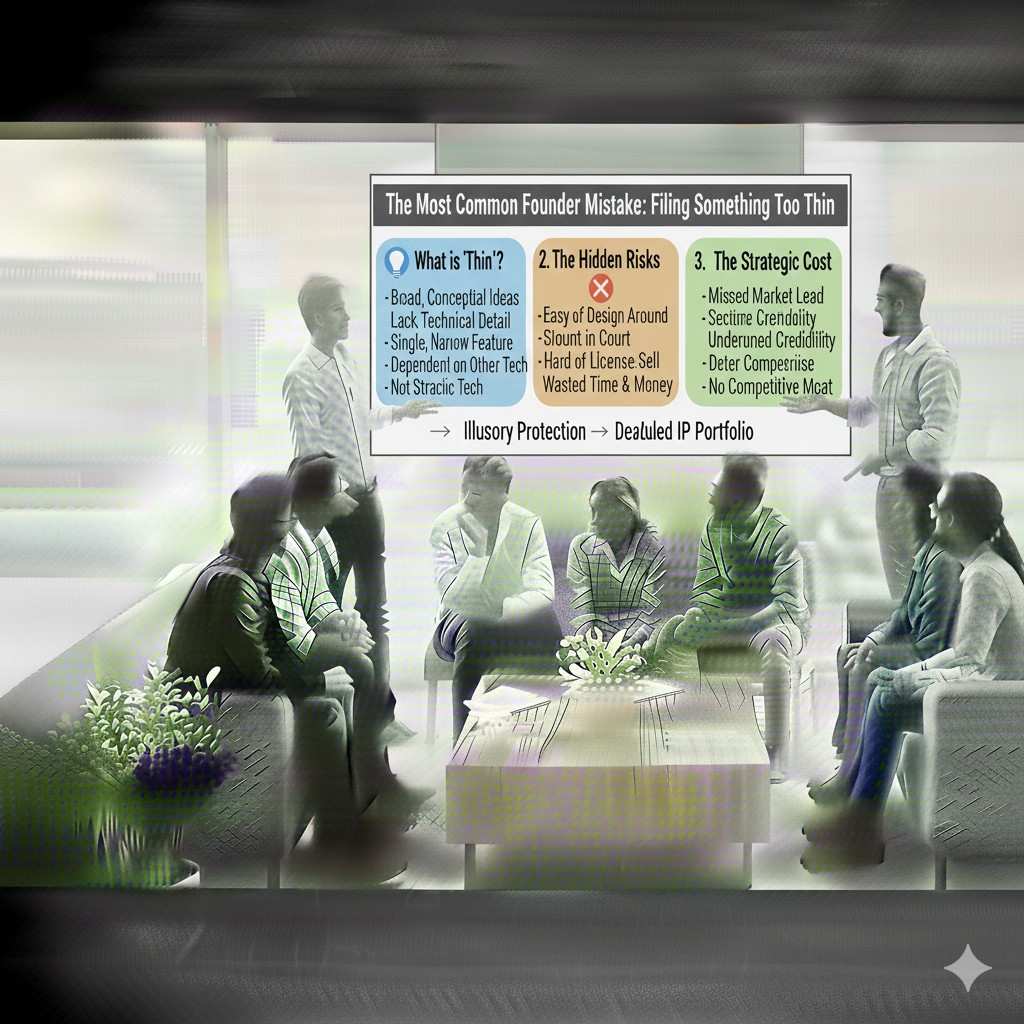
A rushed provisional can create a false feeling of safety. Founders file a short document, feel protected, and then start pitching, demoing, and posting in public. Months later, they go to file the full patent and realize the strongest parts were never described well in the provisional.
When that happens, you might not get the early date for the best claims. In the worst case, you exposed your idea publicly while thinking you were covered, and that can hurt your options.
“Describe it” is not the same as “name it”
Many founders think describing an invention means naming the feature and stating the result. For example, “We use an AI model to detect defects,” or “We have a robot that learns grasping.” That is not enough.
A solid provisional explains the steps, the structure, the flow, and the key choices that make your approach work. It should read like a careful explanation that another skilled person could follow, not like a product page.
Where thin provisionals usually fail
Thin filings often skip the hard parts, such as edge cases, failure handling, sensor noise, data drift, safety constraints, timing limits, and system tradeoffs. Those are often the very things that make your invention special and defensible.
They also often fail by not including variations. If your provisional only describes one narrow version, a competitor can step slightly to the side and argue your filing did not cover what they are doing.
When You Should File a Provisional Patent
You are about to share details outside your tight circle
If you are about to pitch to many investors, show partners your architecture, run pilots with customers, or hire contractors who will see the internals, that is often a good time to file. Even if everyone signs an NDA, details leak in real life.
The goal here is not paranoia. It is simple risk control. If you are stepping into wider exposure, having a filing date can reduce stress and keep you from holding back in important meetings.
You have a working method, not just a goal
A good rule is this: file when you can explain “how it works” in a way that feels stable. You do not need a perfect product, but you should have a method that is more than a wish.
For AI, that could mean you can describe the model type, the input pipeline, how you label or clean data, how you handle drift, how you measure results, and what makes your approach different from common practice. For robotics, it could mean you can describe the control loop, sensing, planning, safety constraints, mechanical choices, calibration, and recovery behaviors.
You found a specific technical trick that saves cost or boosts performance
Many patentable ideas are not the entire product. They are small “tricks” that make the system work in the real world. A method that cuts compute cost, reduces latency, improves stability, reduces sensor error, or avoids a failure mode can be very valuable.
If you found one of these tricks and it is likely to stay true even as the product changes, filing early can lock in a date before it spreads through your team, vendors, and early users.
You need a clear story for investors and future buyers
Strong IP is not only a legal asset. It is also a business story that helps investors understand why you will not be copied easily. If you can point to filed work around your core methods, it often changes the tone of a diligence call.
If you are raising soon and you already have real technical substance, filing a provisional can help you present your company as serious and defensible. If you want support building that story the right way, Tran.vc helps founders do this without giving up control early. Apply here: https://www.tran.vc/apply-now-form/
When You Should Not File a Provisional Patent Yet
You only have a problem statement and a rough idea

If your “invention” is still mostly a goal, filing often wastes time. Patents protect a solution, not a dream. “We will use AI to automate X” is not enough. “We will build a robot that does Y” is not enough.
If you file too early, you either write vague claims that do not hold up, or you end up with a document that does not capture the real invention that emerges later.
Your approach is changing every week
In early builds, the best teams iterate fast. That is good. But if the core method is not stable, you may not know what to write in a way that stays useful.
Filing something that becomes outdated in a month can lead to a messy chain of multiple provisionals that still miss the final, best version. Sometimes the smarter move is to wait until the method settles, then file once with depth.
The idea is mostly a business model or workflow
Some “ideas” are not patentable because they are mainly about pricing, packaging, or a basic workflow that others already do. A patent is not meant to protect “we sell to hospitals” or “we match buyers and sellers,” even if your company is real and valuable.
In these cases, your moat may come from speed, distribution, data, and execution. Patents might still play a role if you have a true technical method inside, but you should not force a filing just to feel official.
You are filing just to say “patent pending”
If the main motivation is the label, slow down. “Patent pending” can help in a pitch, but only if it is real protection work and not a thin document that creates risk.
A strong investor will not be impressed by a weak filing. A strong investor will, however, respect a thoughtful strategy that matches where you are in the build.
How to Tell If Your Invention Is “Ready” for a Provisional
You can explain it step by step without hand waving
A good sign is that you can walk a technical person through the method without needing to skip the key parts. You can say what happens first, what happens next, and why each part matters.
If you keep saying “and then the model figures it out,” or “the robot learns it,” you are probably not ready yet. Those phrases usually hide the real method, and the real method is what you want to protect.
You know what makes it different from the obvious approach
Another sign is that you can point to a clear difference from standard practice. That difference does not need to be flashy. It can be a choice of inputs, a training scheme, a control constraint, a calibration process, or a safety mechanism.
If you cannot describe what is new, you may not have a patentable invention yet, or you may need help finding the part that is truly yours.
You can list a few variations that still count as your idea
A strong provisional does not describe only one narrow version. It also describes other ways to do the same core method. That is how you widen the protection.
If you can think of a few variations that still feel like “your approach,” you are likely in a good place to file. If you cannot, you might be too early or too locked into one implementation.
Filing a Provisional the Right Way
Think like a teacher, not like a marketer

When founders write a provisional, they often slip into pitch mode. They describe the big vision, the market, and the benefits. That kind of writing may help a deck, but it does not help a patent filing.
A good provisional reads more like a careful lesson. It explains what the system does, how it does it, and what parts matter most. The goal is not to impress. The goal is to capture the invention so clearly that the filing date truly protects it.
The “core” of the invention must be fully described
If you only have time to write one part well, write the core method well. That means the steps that make your system work, not just the output. For software, it means the data flow, the logic, the decision points, and the system setup.
For AI, it often means what data you use, how you process it, what model setup you use, how you train, how you test, and what you do when the world changes. For robotics, it often means sensing, planning, control, safety checks, and how the robot handles errors in real time.
Details matter more than length, but length often signals depth
A provisional does not need to be a book. But in practice, a strong one is rarely short. When you describe a real method with care, you naturally create more pages.
Founders sometimes worry that including too much will “give away secrets.” The truth is that patent filings require you to disclose enough that the invention is clear. If you want a patent later, you cannot keep the key method hidden and still claim strong protection.
Add figures early, even if they are simple
Simple diagrams can make a provisional much stronger. A block diagram of your system, a flow of steps, and a diagram showing the modules talking to each other can do more than a page of words.
You do not need fancy drawings. You need clear ones. If you can draw it on a whiteboard and the team understands it, it is good enough to include.
The “12-Month Runway” and How to Use It Well
The best use of a provisional is learning time
That 12-month window is not a break. It is a strategy window. It is time to test what parts of your invention are real, what parts are noise, and what parts will matter most to your business.
If you treat the provisional like a checkbox, you miss the chance. If you treat it like a first step in a plan, you can turn early work into a strong, focused patent later.
Use the window to turn early experiments into stable claims
Early builds often include many ideas. Not all of them will survive. During the 12 months, you can test assumptions and find the method that stays true as you scale.
That is valuable because the full application should ideally focus on what is both new and durable. If your method survives pilots, load, and edge cases, it becomes easier to claim in a way that holds up.
Keep track of changes so you do not lose the story
A quiet risk during the year is that the system changes and nobody records what changed and why. When you finally write the full application, you may forget the key turning points.
A simple practice helps: keep short internal notes on major technical decisions and why they were made. You are not doing this for paperwork. You are doing it so your final patent can tell a clear technical story.
Consider follow-on provisionals when the invention truly shifts
Sometimes the invention changes in a meaningful way during the year. When that happens, a follow-on provisional can make sense. It can capture the new method and lock in a new date for that new material.
This is not something you want to do every month. But if you hit a real breakthrough, it can be worth filing again rather than hoping the old provisional covers it.
When Filing Early Helps You Move Faster
You stop hiding the good stuff in meetings

Many founders hold back in early sales calls and partner talks because they fear giving away the method. That fear can slow deals and weaken trust.
When you have a strong provisional filed, you can speak more freely about the “how,” while still being smart about what you share. That often leads to better conversations and faster progress.
You gain leverage in co-development and pilot talks
Pilots and co-development can be great, but they can also get messy. When you work closely with a large company, you want clean lines around what is yours.
Filing before deeper technical sharing can help you negotiate from a stronger position. It signals that you treat your invention as an asset and that you expect it to be respected.
You reduce last-minute stress during fundraising
Fundraising often forces founders to assemble materials quickly. If IP is part of your story, filing at the last minute can lead to rushed, weak work.
A well-timed provisional lets you show progress without scrambling. It also gives you time to build an IP plan that matches your product roadmap, not just your next pitch.
If you are building AI, robotics, or other deep tech and want to get this right without spending cash, Tran.vc invests up to $50,000 in-kind IP and patent services to help you build real protection early. Apply any time here: https://www.tran.vc/apply-now-form/
When Filing Early Can Hurt You
You lock yourself into the wrong invention

A provisional is only useful for what it describes. If you file when you do not yet know what the real method is, you may create a document that covers the wrong thing.
Later, you might discover the true advantage is somewhere else. Then you either file again or you try to stretch the old filing to cover new work, which can be risky.
You waste time writing instead of validating
Time is a real cost in early startups. If writing the provisional delays product learning, you may be trading a small IP benefit for a large business loss.
The right balance is to file when you have enough technical clarity that writing it will be fast and grounded, not when it becomes a big guessing exercise.
A weak filing can trigger careless public sharing
Some founders file something thin and then start posting, presenting, and publishing because they think they are protected. That can backfire if the best parts of the invention were not truly covered.
The safer approach is simple: do not increase your public sharing just because you filed. Increase your sharing only when you know your filing is strong for what you are revealing.
How Provisionals Work in the Real World for AI Startups
AI patents are rarely about “using AI”

If your idea is “we apply machine learning to X,” that is usually not special enough. Many teams are doing that across industries, and broad claims often get rejected.
The stronger approach is to focus on the technical method that makes your AI work in your setting. That might be how you build the training set, how you combine signals, how you handle missing data, how you reduce compute cost, how you improve accuracy under noise, or how you make the system stable when the input shifts.
Data handling can be the invention
In many AI companies, the most valuable work happens before the model ever trains. The pipeline, the cleaning, the labeling, the filtering, and the feedback loops can be where the advantage lives.
If you have a unique way to produce reliable training data, reduce label cost, detect drift, or manage privacy while keeping performance, those methods can be good candidates for a provisional.
Real-time constraints often create patentable methods
Many AI systems are not just offline models. They run in real time, on edge devices, or inside strict latency limits. Those constraints can force unique engineering choices that competitors cannot easily copy.
If you built a method that hits a tough latency target while keeping accuracy, or a method that adapts online without breaking safety rules, that can be the kind of “how” that is worth capturing early.