
Most people think you need millions to scale. Big round. Big team. Big spend. But if you’re a technical founder, you already know something most people miss: real leverage doesn’t come from cash alone. It comes from what you build, what you own, and how hard it is for others to copy you.
That’s where a simple $50K check can change everything—if you use it the right way.
At Tran.vc, we don’t write checks for office decor or fancy launch parties. We invest up to $50,000 worth of in-kind patent and IP services to help founders in AI, robotics, and deep tech turn raw ideas into real, defensible assets. Not later. Not “after product-market fit.” Now.
This kind of money, used well, doesn’t just keep the lights on. It helps you build a moat. It helps you turn your code, your models, your designs, and your systems into something investors can trust and rivals can’t steal.
This article is about how to do exactly that. How to scale with just a $50K check. How to choose what to build, what to protect, and what to ignore. How to raise later on your terms, with leverage, instead of from fear.
If you’re a technical founder and you’d like to explore this in your own company, you can apply anytime at: https://www.tran.vc/apply-now-form/
Using a Small Check to Build Real Power
Why Most Early Money Gets Wasted
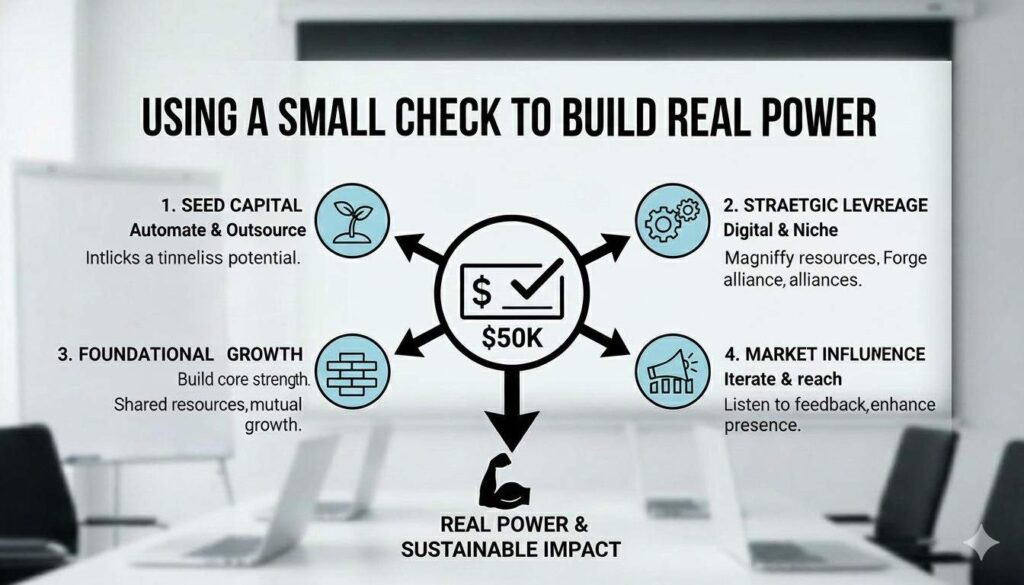
Most founders burn their first money on things that feel important but do not move the company forward. They hire too early, run ads too soon, or build features no one needs. The check disappears fast, and they are left stressed and stuck.
A small check forces a different kind of discipline. You start to see what is vital and what can wait. You learn that you do not need ten people to build something strong. You do not need paid ads to get your first users. You do not need a press article to seem “real.”
This shift alone makes a small check more powerful than a large one, because it pushes you to build with care. When you are careful, you make better choices. Better choices help you get further with less money, and that is a skill that stays with you forever.
Why IP Is the Smartest First Investment
When you use the first dollars to protect what you are building, you create long-term strength. Code can be copied. Designs can be copied. Your ideas can be copied. But a patent-backed position cannot be copied without consequences.
This matters because investors today look for real edge. They want to know why you will win and why someone else cannot take the same idea and move faster. A patent gives you a story, but more than that, it gives you leverage.
With a strong IP base, you are no longer just selling hope. You are selling ownership of something rare. You are selling the right to defend it. You are showing that your work is not just clever but legally protected.
Founders who build this early avoid painful fights later, because they enter the market with structure. They scale with confidence because they know they have something that cannot be taken from them. And when the time comes to raise a seed round, investors see not only what you built but also what you own.
How a $50K In-Kind Investment Changes Your Trajectory
Most checks buy time. This one buys strength. When a full patent team works alongside you, you skip months of guesswork. You do not sit alone trying to figure out claims, filings, and strategy. You get guidance from people who have done this for years, in real companies, across real markets.
This support gives you more than protection. It gives you direction. You start to see which parts of your tech matter most. You see which elements can form a moat. You learn what investors look for when they judge the defensibility of a startup.
With that clarity, you can build a product that aligns with your moat instead of drifting into features that do not matter. You can shape your roadmap so each step adds strength. You can grow in a straight line instead of zigzagging with no reason.
And all of this comes before you raise a seed round. That is the point. You enter the market sharper, clearer, and more credible than startups that raised five times more but did not protect anything.
If you want to explore this for your own startup, you can apply at any time at: https://www.tran.vc/apply-now-form/
Turning Early IP Into Real Market Leverage
How IP Shapes Your Product Decisions
When you begin to see your tech through the lens of IP, your product choices become easier. You start to pick features that deepen your moat. You notice which parts of your stack create real edge and which ones are easy for others to clone.
This clarity stops you from wasting time. Instead of building many small things, you double down on the one thing that sets you apart. That focus keeps your burn low and your results sharp, because every hour strengthens the core of your company.
You also become more relaxed about customer feedback, because you can now separate helpful input from noise. If a request would weaken your position or distract you from your protected core, you know to skip it. Strong teams grow by saying no more often than they say yes. IP makes those choices easier, not harder.
How IP Helps You Win Early Customers
In deep tech, trust is everything. Early customers want to know the product works, but they also want to know the team behind it can last. When you show them that your core tech is patent-backed, they see long-term stability. They see a team that is serious about the problem, not rushing to market with a half-built idea.
Many technical buyers also face risk of their own. They want to avoid solutions that might be copied or discontinued. When you show them that your work is protected, you remove a big source of fear. You also give them a way to justify buying from a young company, because they can point to legal strength, not just clever engineering.
With this kind of trust, you often get your first customers without discounts or long trials. People buy when they feel safe. IP makes them feel safe.
How IP Makes Fundraising Easier and Cleaner
When you walk into a seed meeting with a strong IP base, the tone of the room changes. You are no longer asking for permission to exist. You are showing what you already own.
Investors love momentum, but they also love protection. A patent-backed startup shows that it can defend itself. It shows that the team understands not only tech but also strategy. It shows that the moat is not just a slide in a pitch deck but a real structure.
This shifts your position. Instead of being one of many startups chasing the same idea, you become the team that planted a strong flag early. You can raise on better terms because you have leverage. You can choose the right investors because you are not desperate. You can grow at a pace that fits your plan, not theirs.
All of this begins with that small check used the right way.
If you want to build this kind of leverage for your own company, the link is always open: https://www.tran.vc/apply-now-form/
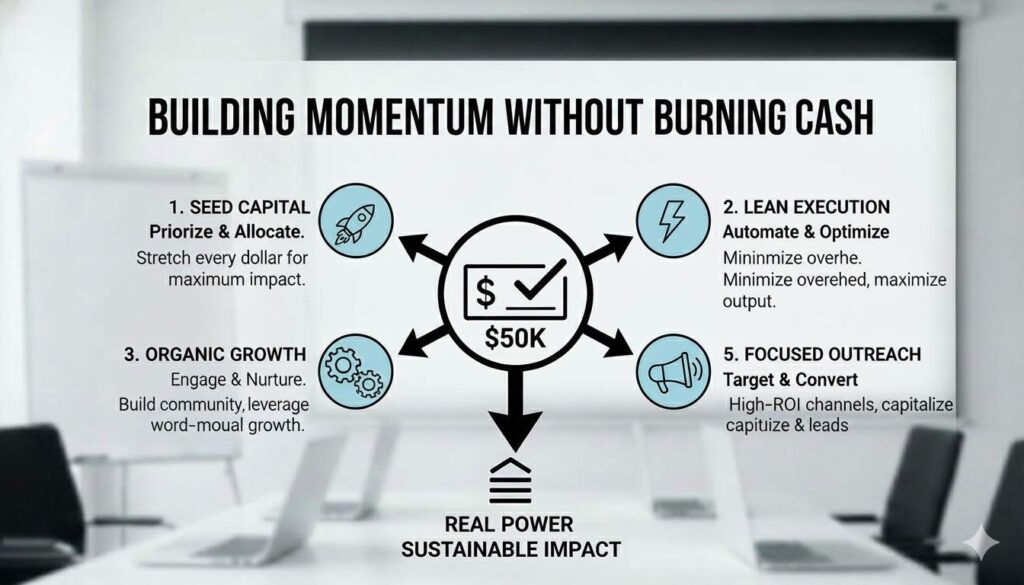
Building Momentum Without Burning Cash
Why Small Teams Move Faster Than Big Ones
A small team often outperforms a large one in the earliest stage because decisions flow faster and confusion stays low. When everyone knows the mission and everyone can see the product shaping in front of them, speed becomes natural. You do not waste time aligning five different departments or explaining every detail through layers of management. You simply build the next right thing.
Founders often think they need a big team to look real, but the truth is that a tight group with clear focus moves like a blade. Every hour is spent pushing the same direction. Every change is tested quickly. Every insight is folded back into the product without delay. This kind of speed is not possible once you hire too fast.
A $50K check works best inside a small team because there is no room to lose yourself in complexity. You make sharper choices. You stay close to the customer. You stay close to your tech. And because you stay close, your product grows exactly where it needs to grow rather than wandering into ideas that drain your time and money.
How a Strong IP Base Reduces Engineering Waste
When you know the core of your tech is protected, you do not feel pressure to reinvent everything. You can build calmly, layer by layer, around the part that gives you real strength. This reduces engineering waste because you stop rewriting features that do not matter and you stop chasing new ideas out of fear of being copied.
Many teams without IP protection feel rushed. They sprint from one feature to another because they worry a competitor will catch them. This pressure causes sloppy code and messy architecture. It also forces them to rebuild parts of the system that should have been done right the first time.
With IP in place, you can slow down just enough to build with intention. You can pick the right architecture instead of the fastest shortcut. You can shape your system to scale rather than patch it each week. Your team stays calm because they know their early work has real value.
Why Early Market Tests Matter More Than Perfect Features
Founders often feel they must perfect the product before anyone can see it. This slows down momentum and wastes precious time that a small check cannot afford to lose. Early tests help you see what matters and what can wait. They also help you talk to your customers before your assumptions harden into expensive mistakes.
When you take a rough version of your core idea to a real user, you learn far more than any internal debate could teach you. You learn which parts create excitement and which parts fall flat. You learn how your users talk about the problem. You learn what they compare you to. These insights push you to refine the product in the right direction instead of polishing features no one needs.
A $50K check works beautifully when it supports a cycle of build, test, refine, and protect. You start small, but you start in motion. Every small test gives you a clearer frame for the next feature, which keeps your burn low and your progress steady.
If you want help applying this approach inside your own startup, the link is always open: https://www.tran.vc/apply-now-form/
Turning Early Traction Into Sustainable Growth
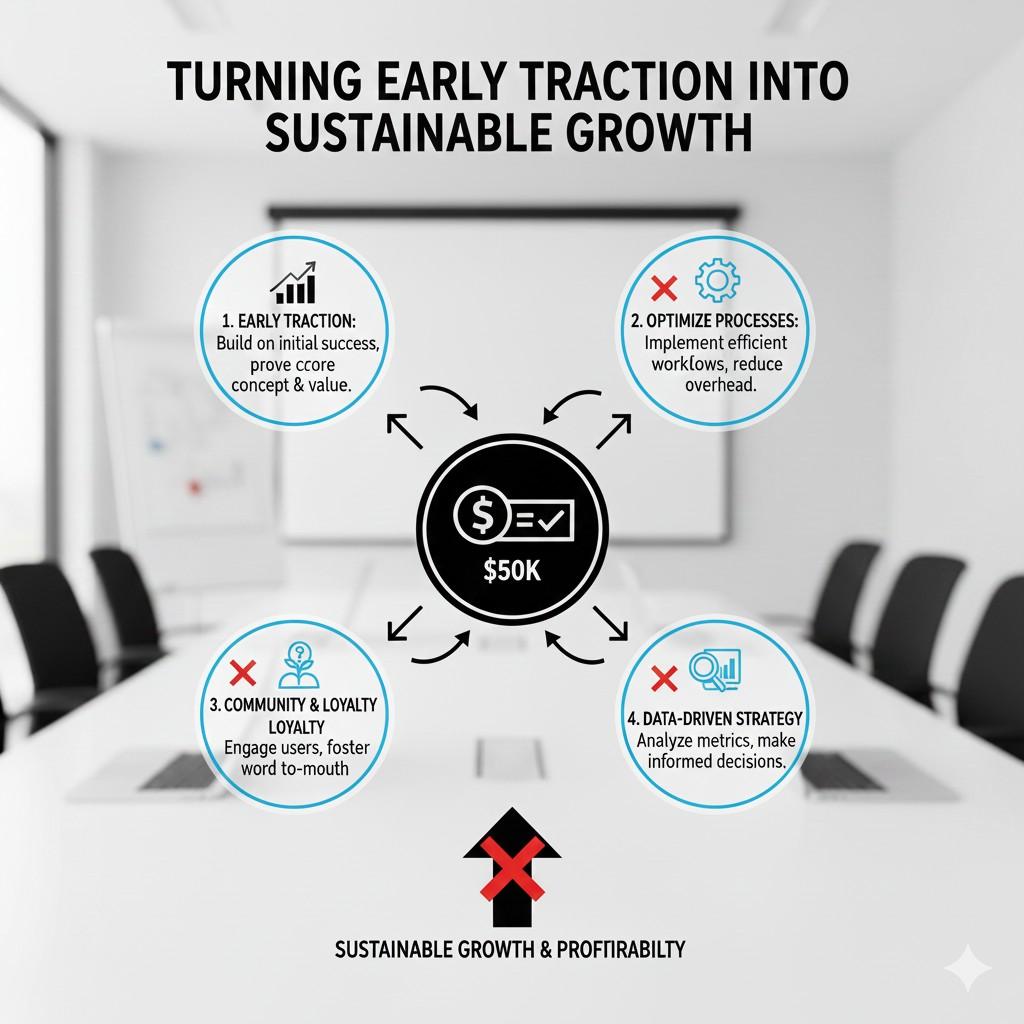
How to Keep Your Burn Low While Growing Fast
Keeping burn low does not mean holding yourself back. It means removing friction. It means cutting out the work that does not move you closer to a stronger product or a stronger moat. When you remove that noise, your pace increases even if your spend does not.
Founders who scale well with small checks spend most of their energy on actions that compound. They refine the part of the product that wins trust. They polish the part that delivers the clearest value. They talk to users often so they can improve quickly without guessing. This rhythm builds traction without draining your bank account.
You can grow fast without overspending when you know what to ignore. Most young startups slow themselves down by trying to act like big ones. They chase brand perception. They add tools they do not need. They hire people before the system is ready for them. By staying small, you avoid this trap and grow with clean steps.
How to Talk About Your Product So Buyers Believe You
A surprising truth is that buyers respond more to clarity than to complexity. They want to understand what your product does, how it helps them, and why it is safe to choose you over someone bigger. When you speak simply and confidently, you lower the risk they feel.
Your IP story plays a powerful role here. When you can say your core method or system is patent-backed, buyers immediately sense stability. They see that you built with care. They see that you understand the value of your work. This makes them more open to trying your product, even if you are early in your journey.
Good communication is not about sounding impressive. It is about reducing fear. When you explain your product in a way that makes the buyer feel calm and informed, you shorten the sales cycle and reduce the need for heavy discounts or long trials. This is important when your money is tight and your time is even tighter.
How to Use Feedback Without Losing Your Direction
Customer feedback can be helpful, but if you take every suggestion literally, you will lose your focus. A small check teaches you to filter feedback with care. You listen for patterns, not one-off requests. You look for what aligns with your protected core, not what would stretch you thin.
If a customer asks for a feature that weakens your focus, you can explain why you are not building it. When you know your IP position, you can also see which features strengthen your moat. These are worth considering because they make your product harder to copy and easier to defend.
The goal is to use feedback to refine your trajectory, not redirect it. A steady direction builds momentum. A shifting direction drains it. With clear filters in place, you can evolve without losing the shape of your product.
If you want to build this kind of clarity into your roadmap, you can apply at: https://www.tran.vc/apply-now-form/
Designing a $50K Scaling Plan
Map the Next 90 Days
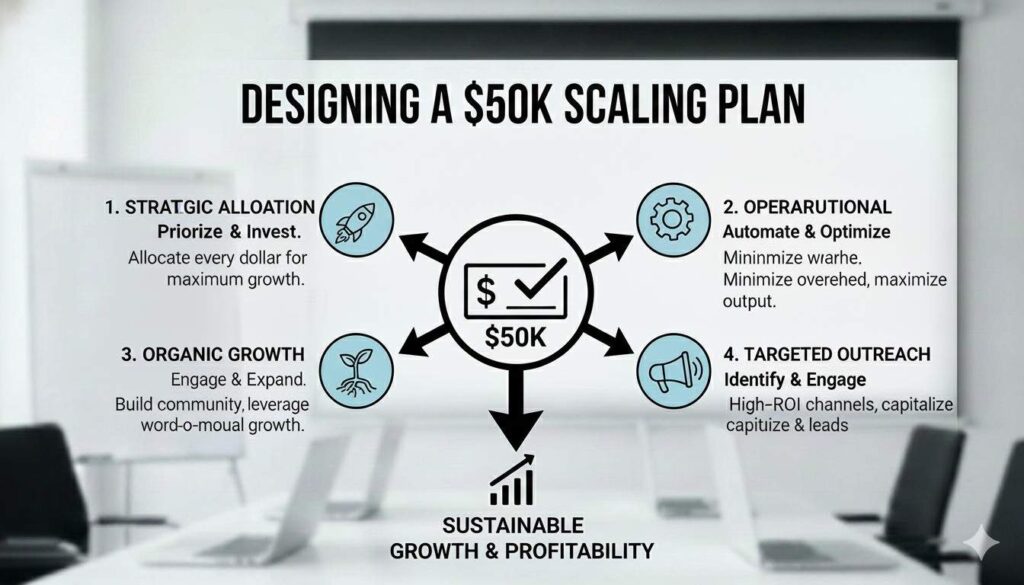
When you get a $50K check, it is tempting to think in years. You picture big teams, big rounds, big markets. But the most useful way to think about this money is in days, not years, and in clear steps, not dreams. A tight ninety-day plan turns a small check into real movement.
Start by asking one simple question. In three months, what must be true for this company to feel more real than it does today? Maybe you want a working demo in a real customer’s hands. Maybe you want a clear patent filing on your core method. Maybe you want the first paid pilot. Pick two or three hard but simple outcomes and treat them as your north star.
Once you know these outcomes, you can work backward. You can decide what to build this week, who to speak with, what tests to run, and which parts of your tech must be documented for IP work. This keeps you from drifting. Every day either moves you closer to those outcomes or it does not. If it does not, you cut it. A small check rewards this kind of sharp focus and punishes vague hopes.
When you work with a partner like Tran.vc, you also fold patent work straight into this plan. You do not treat IP as “extra.” You treat it as part of the main path. As you shape the product, you shape the claims. As you test features, you learn which ones are worth protecting. The patent team and your build plan move together instead of in separate tracks.
If you want support mapping your own ninety-day plan around IP and product, you can apply at any time here: https://www.tran.vc/apply-now-form/
Decide What to Protect First
Not every part of your product needs a patent. Trying to protect everything is slow and expensive, and it does not serve you. The art is in choosing what really matters. That choice is where a $50K in-kind IP investment has the most impact.
Start with the question: what is the one thing that, if a rival copied it, would hurt you most? It may be a model training method, a data pipeline, a robot control system, or a way you fuse sensors. It is usually not the user interface. It is the engine under the hood. That engine is your first IP target.
With good patent guidance, you go deeper than one method. You think in systems, flows, and use cases. You look at how your pieces work together to create value. The goal is to capture the heart of your edge, not just a single trick. This kind of thinking also improves your product design, because it forces you to see what is truly unique about your work.
When you make this choice early, you stop feeling like every feature is equal. You know which parts are core and which are support. You spend more time improving the core and less time fussing over details that do not move the needle. This again is how a small check goes further than you think. It pushes you to pick what truly matters and back it with real protection.
Build Only What You Can Support
Many founders overbuild. They add extra dashboards, extra flows, extra knobs. It looks impressive in a demo, but it slows everything down. It also creates hidden costs in support, bugs, training, and customer onboarding. With a $50K check, you cannot afford this kind of bloat.
A better rule is simple. Only build what you can support with a small team. If a feature demands a new team member just to maintain it, it may not be worth building yet. If a flow makes your product confusing to explain, it may need to wait. Focus on the few actions that deliver real value and tie back to the IP you are protecting.
This does not make your product weak. It makes it clear. When your product is clear, customers know why they are using it and you know how to explain it. Clear products are easier to sell, easier to improve, and easier to scale. The power comes not from many features, but from one strong path that solves a hard problem well.
This is also how you prepare for later rounds. Investors do not need to see a long feature list. They need to see a product that users understand, backed by a moat that rivals cannot cross. That is what you build when you use a $50K check to protect and polish the core instead of chasing every idea.
If you want to explore which parts of your product should be core and protected, you can apply here: https://www.tran.vc/apply-now-form/
Avoiding the Biggest Mistakes with a Small Check
Chasing Vanity Instead of Value
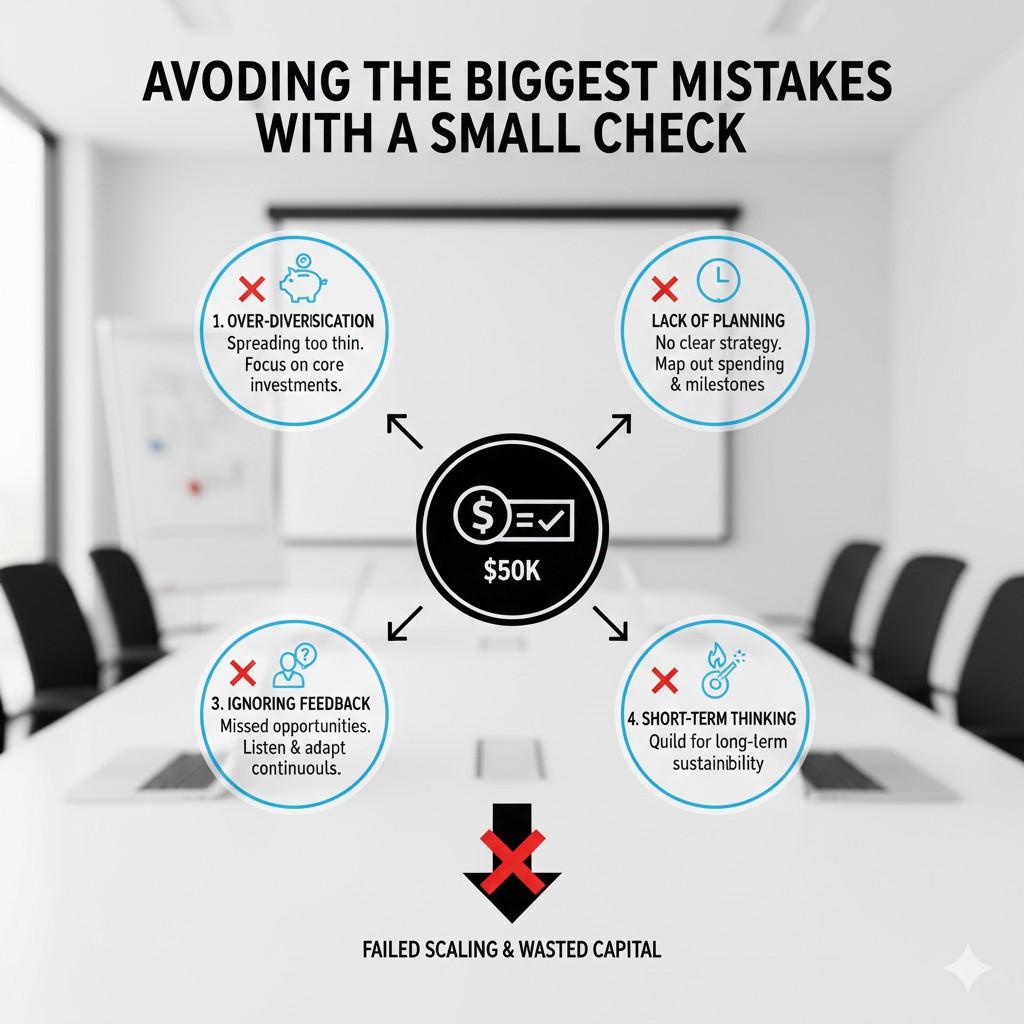
One of the fastest ways to waste a small check is to chase things that look good but do not help the business. Fancy launch events, stylish office space, big brand campaigns, or shiny decks can all feel exciting, but they rarely give you more customers or more edge. They mainly give you more cost.
With a limited budget, every dollar must work. That does not mean you never spend on brand or design. It means you only spend when those things drive clear actions. A simple site that explains your value is worth it. A clear deck that tells your IP story is worth it. But anything that exists only to impress people on social media is a luxury you cannot afford.
Founders who scale with small checks learn to measure value in real outcomes. Did this step bring us closer to a patent filing? Did this effort bring us new users, new insight, or new trust? If the answer is no, they cut it. This sounds strict, but it is freeing. You stop comparing yourself to big companies and start behaving like a sharp, focused team.
Copying Big-Company Habits
Another common trap is to copy how large companies work. You see their org charts, their tools, their titles, and you try to mimic them. The problem is that big-company habits are built for scale, not for speed. They add process where you need agility. They add meetings where you need deep work.
With a $50K check, you do not need layers. You need direct action. A small team with clear roles can make a week feel like a month of work at a large firm. But if you bring in heavy processes too early, you slow that magic down. It becomes harder to ship. It becomes harder to change your mind.
Instead of copying their structure, learn from their lessons. Many big companies wish they had moved faster when they were small. They wish they had protected more IP earlier. They wish they had kept teams thinner for longer. You have that chance now. Keep your habits light, your tools simple, and your focus tight.
Ignoring Legal and IP Risk
Some founders see legal and IP work as a problem for “future us.” They plan to clean it up after they raise. But by then, it is often late. A rival might have filed a similar patent. A partner might have unclear rights over code. A contractor might own parts of the system you thought were yours. Cleaning this up later is hard, messy, and expensive.
Using a $50K in-kind patent and IP investment to tackle these questions early is not just smart, it is protective. You clear up who owns what. You file on the parts that give you edge. You build with clean lines of control. This sets you up for smoother deals with customers and investors because the risk is lower.
It also sends a strong signal. When you show that you took legal and IP seriously from day one, people see you as a careful builder, not just a fast coder. This image helps in sales, hiring, and fundraising. People like to work with teams that respect both speed and structure.
If you want help avoiding these traps in your own company, you can always apply here: https://www.tran.vc/apply-now-form/
What Scaling with $50K Really Looks Like
A Simple Story of an AI Founder
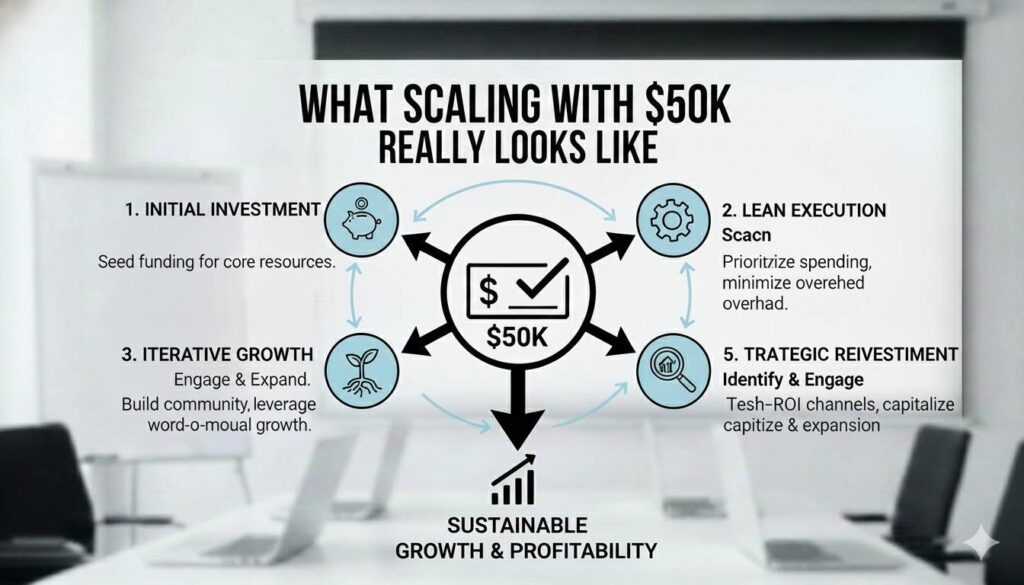
Imagine a founder building a deep model for defect detection in factories. She has strong code, a small set of pilot images, and one early factory willing to test. She does not have a big round. She has a $50K in-kind IP check and a tiny, focused team.
In the first month, she works with IP counsel to map the key steps that make her system special. Maybe it is the way she fuses thermal and visual data. Maybe it is the way her model learns from operator feedback in real time. Together, they shape a clear patent plan while the team builds a working demo for the pilot factory.
In the second month, the pilot begins. The system runs on a small set of lines. The founder watches how operators use it. She tweaks the interface so it fits their day, but she does not add extra features that do not serve the main job. At the same time, the patent draft moves forward, capturing the system, not just one model tweak.
In the third month, the pilot shows real numbers. Fewer defects slip through. Less time is spent on manual checks. The founder now has a live use case, user quotes, and a patent filing in progress. She can talk to new factories with real proof. She can talk to investors with both traction and protection. She did all of this without a large burn, because the check and the plan were tight.
This is what scaling with $50K looks like. It is not flashy. It is steady, sharp, and real. The founder used support to protect her edge, learn from real users, and build a simple path to more pilots, instead of trying to look big before she was ready.
How Tran.vc Fits into That Story
Tran.vc is built exactly for founders like this. The firm does not just send money and vanish. It steps in with deep patent and IP experience, shaped by real work with tech companies and hardware brands. The investment comes as up to $50K worth of in-kind IP and patent services, which means you get expert time, not just cash in a bank.
You are not left alone to guess what to file or how to explain your tech in a strong way. You get a team that helps you see which parts of your work are worth protecting and how to frame them so they hold up. You get partners who understand that IP is not a side task. It is part of your strategy.
At the same time, Tran.vc thinks like builders, not just like lawyers or investors. They care about helping you create a product moat before the market gets crowded. They care about giving you more power in your next raise. They care about you keeping control of your company instead of giving away too much too early.
If this is the kind of partner you want on your side while you scale with a small check, you can apply at: https://www.tran.vc/apply-now-form/
Bringing It All Together
Why Leverage Beats Large Rounds
Many founders think the main goal is to raise as much cash as possible, as fast as possible. But cash without a moat is weak. You spend more to stay ahead. You react to rivals instead of leading. You feel rich on paper and poor in power.
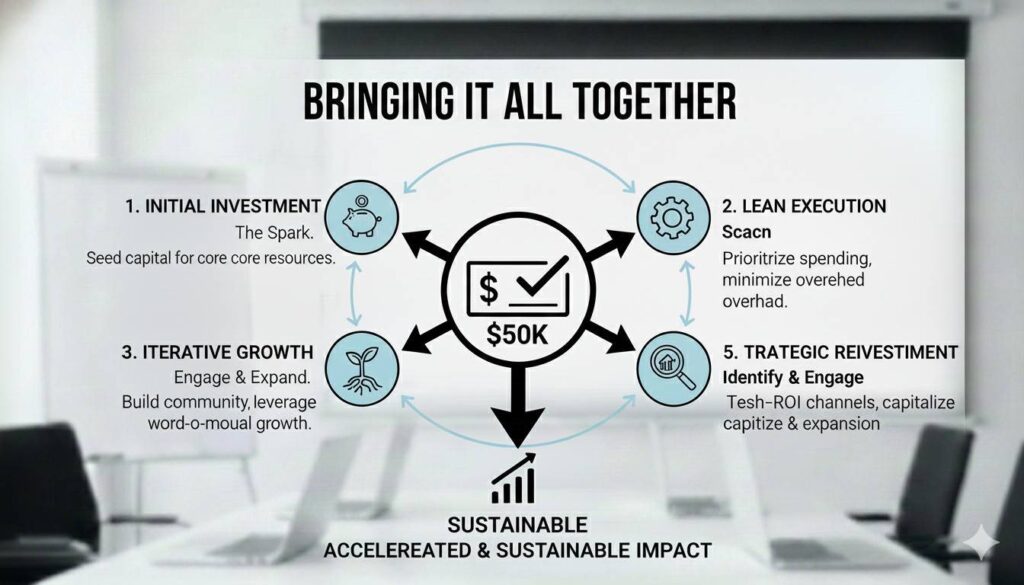
Leverage is different. Leverage is when a small move gives a big result. A strong patent on a core system is leverage. A simple product that users love is leverage. A small team that ships fast is leverage. A clear story that investors trust is leverage. When you have these, you can do a lot with very little.
A $50K check focused on IP and clear product work gives you leverage. It turns your ideas into assets. It turns your early builds into proof. It turns your next raise into a real choice instead of a rescue. You may still raise larger rounds later, but you will do it from a place of strength, not from fear.
This is the core idea of scaling with just a $50K check. It is not about learning to survive on scraps. It is about learning to build with intent. It is about protecting what matters while you are still small. It is about using each dollar to deepen your moat and each week to sharpen your product.
Your Next Step as a Technical Founder
If you are a technical founder in AI, robotics, or deep tech, you are already doing something hard. You are building new tools, new models, new systems. It is easy to feel that the only way forward is a big round and a big team. But you now know there is another path.
You can start with a small, focused check. You can use it to lock in your edge instead of buying speed you cannot sustain. You can combine product work and IP work so they push each other forward. You can keep your burn low and your learning high. You can grow on your own terms.
The key is to treat IP as a first-class part of your plan, not as an afterthought. The key is to pick clear outcomes for the next ninety days and give them your full attention. The key is to avoid waste, avoid vanity, and avoid habits that belong to much larger firms.
You do not have to walk this path alone. Tran.vc was built to stand next to teams like yours at this exact stage. With up to $50K worth of in-kind patent and IP services, plus real guidance from people who have built and exited companies, you get a partner who cares about both your tech and your future.
If you are ready to see how far you can go with a focused $50K check and a strong IP plan, your next step is simple. Share your story, your idea, and your ambition. You can apply any time at: https://www.tran.vc/apply-now-form/
From there, the goal is clear. Turn your code, your models, and your systems into assets. Build a moat before the market floods. Scale with leverage, not just with money.